
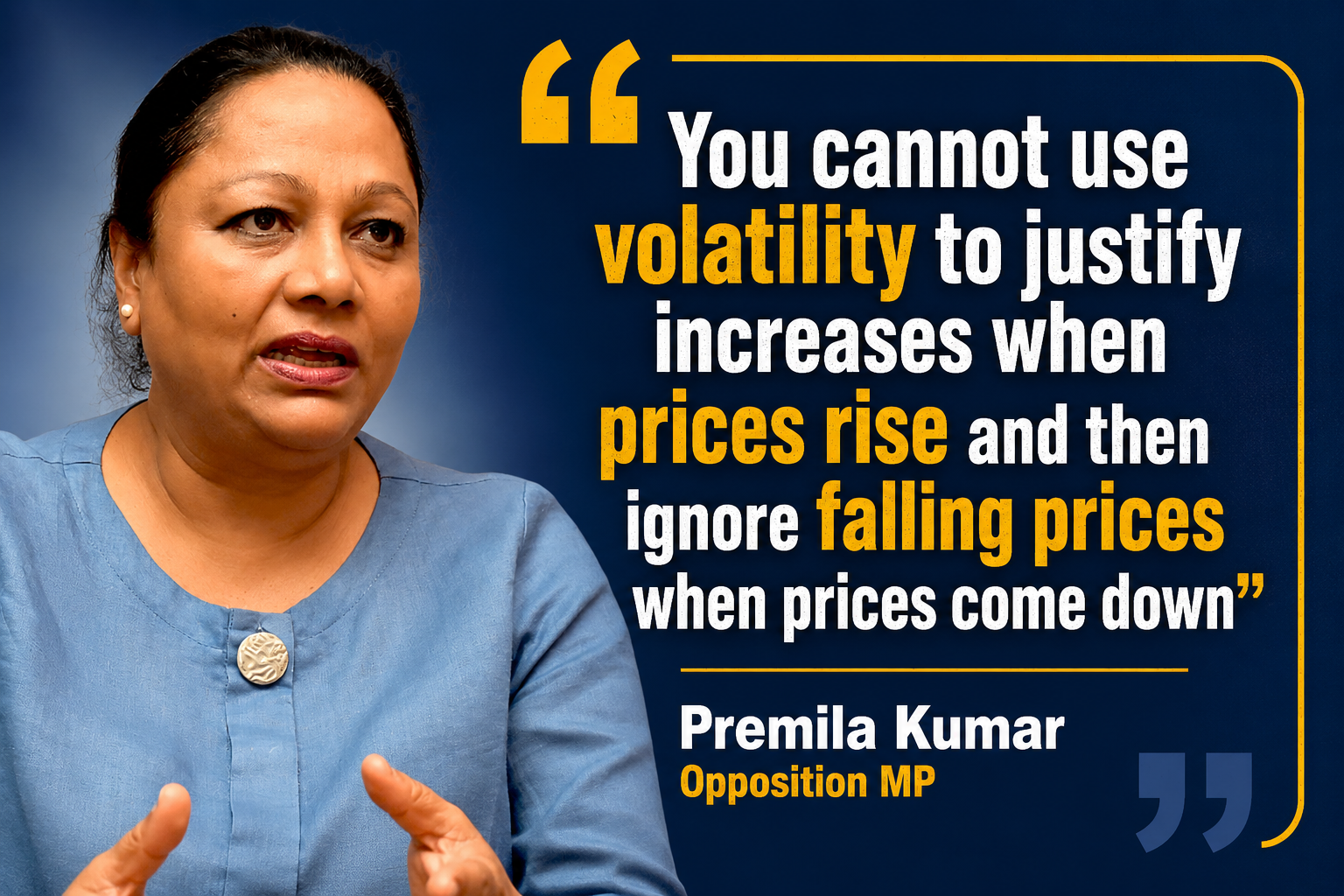
Opposition Member of Parliament Premila Kumar has called on the Fijian Competition and Consumer Commission to immediately review temporary taxi fare increases and the electricity fuel surcharge following a fall in fuel prices.
Kumar said consumers were required to absorb higher costs when fuel prices increased and should now receive relief when those costs fall.
“When fuel prices went up, consumers were told that higher prices were unavoidable because of international fuel costs,” Kumar said.
“Now that fuel prices have fallen, consumers should not be told that the increases must remain because international prices are ‘volatile’.”
She said the FCCC had approved a temporary taxi fare increase from July 1, 2026, which increased the distance charge for general taxis from 10 cents to 14 cents per 100 metres.
For Nadi Airport taxis, the distance charge increased from 15 cents to 21 cents per 100 metres.
“Consumers immediately felt the impact. But if the fuel cost pressures that justified the increase have eased, why should passengers continue paying the higher fare?” Kumar questioned.
“A temporary increase cannot become a permanent increase simply because consumers have already been made to pay it.”
Kumar said the same principle should apply to the electricity fuel surcharge.
She said the FCCC had allowed Energy Fiji Limited to impose a 5.91 cents per kilowatt-hour fuel surcharge on households earning $30,000 or less.
At the same time, she said Government provided EFL with a four-month fuel rebate of 20 cents per litre for diesel and 12 cents per litre for heavy fuel oil.
“Now that the fuel prices have fallen, when will consumers see the benefit?” she asked.
Kumar said electricity and transport were essential expenses that families could not easily avoid.
“Families cannot switch off their electricity because the bill is too high. They cannot simply choose not to travel to work or hospital because taxi fares have increased. These are essential costs.”
She said households were already under pressure from the cost of food, transport, electricity and other necessities, and additional charges placed further strain on family budgets.
Kumar said regulation needed to work in both directions when underlying costs changed.
“You cannot use volatility to justify increases when prices rise and then ignore falling prices when prices come down,” she said.
“If fuel prices rise again, the FCCC can review the situation again. That is precisely why these measures were described as temporary.”
Kumar said the principle should be straightforward.
“When costs rise, consumers may have to bear some of the increase. When those costs fall, consumers must also receive the benefit.”
“Otherwise, ‘temporary’ becomes another word for permanent.”
She called on the FCCC to immediately reassess both measures in light of lower fuel prices.
“Consumers should not be expected to carry the burden when prices go up while service providers retain the benefit when prices come down,” Kumar said.

