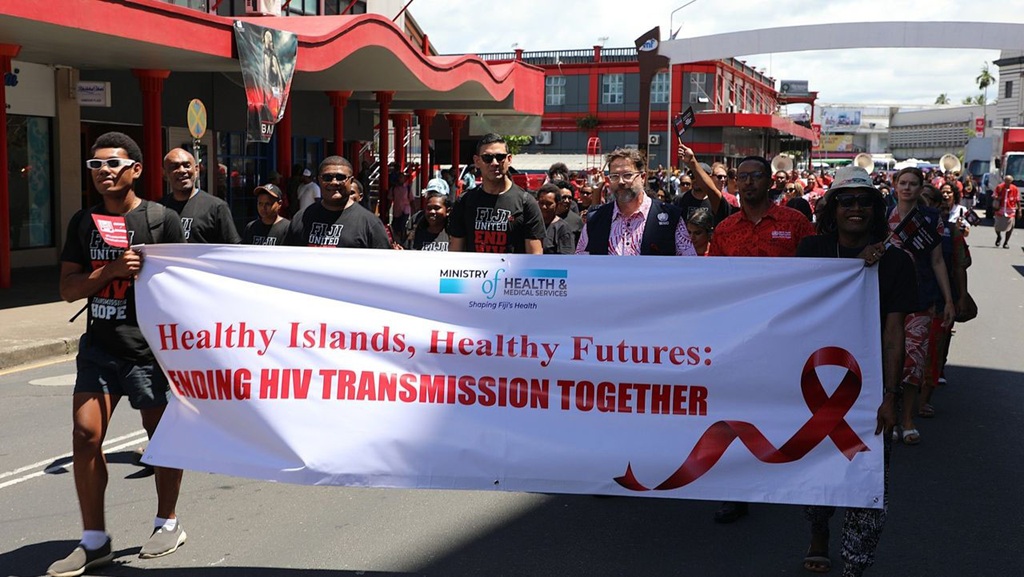
I guess not many people anticipated that Fiji, among all countries, would find itself where it is today.
The tiniest dot on the world map navigating one of the world’s fastest-growing HIV epidemics.
Last year, Health Minister Dr Ratu Atonio Lalabalavu declared HIV a national outbreak after 1093 new cases were recorded between January and September 2024, alongside 115 HIV-related deaths, warning then that the virus was evolving at a very fast rate in our communities.
The Ministry of Health has now released the latest and most relevant data on Fiji’s HIV crisis through the Fiji HIV Surveillance Report 2025: National Epidemiological Analysis of HIV Testing, Diagnosis and Care Cascade compiled by Mr Joseph Mun Reddy under the technical oversight of National HIV Outbreak and Cluster Response chair Dr Jason Mitchell.
In an earlier interview, Dr Mitchell told this newspaper at least 9000 Fijians are now living with HIV, even as millions of dollars allocated for the national response remain unused amid a rapidly escalating crisis.
He said infections surged to 2016 in 2025, a 723 per cent rise in three years.
More than half of those infected are not on treatment, with babies still being born with HIV.
Now, with the release of the surveillance report, the picture is clearer: the crisis Fiji was warned about has not slowed, it has deepened, widened, and is now being recorded most heavily among iTaukei.
Just for clarity, the new surveillance report does not put that “9000” estimate into a final national total, but it does lay out the confirmed scale of the crisis in registered cases, 2016 new diagnoses in 2025 and 5676 cumulative cases recorded since surveillance began.
Leading demographic
iTaukei now make up almost 94 per cent of Fiji’s newly diagnosed HIV cases.
The Fiji HIV Surveillance Report 2025 shows that of the 2016 newly diagnosed HIV cases recorded last year, 1894 were among people identifying as iTaukei, representing 93.9 per cent of all new diagnoses.
Fijians of Indian descent accounted for 105 cases or 5.2 per cent, while other ethnic groups accounted for 17 cases, or 0.8 per cent.
But the report also carries an important caution: these figures reflect people who accessed HIV diagnostic services and received a diagnosis.
They should not be read as proof that one ethnic group has a higher underlying risk or prevalence than another.
The report says the pattern may also be shaped by health-seeking behaviour, testing uptake, service access, geography, and population demographics.
Still, even with that caution, the direction of the data is difficult to ignore.
In 2022, iTaukei made up 82.5 per cent of recorded diagnoses, with 203 cases.
That rose to 85.8 per cent in 2023 with 353 cases, then 90.3 per cent in 2024 with 1430 cases, before climbing again to 93.9 per cent in 2025 with 1894 cases.
That means the story is not simply that more HIV cases are being found. It is that the surge is being found overwhelmingly within one community, and that raises uncomfortable questions Fiji must now answer carefully and without stigma.
The report shows Fiji recorded 2016 newly registered HIV cases in 2025, the highest annual number since national surveillance began.
By the end of 2025, the country had recorded 5676 cumulative HIV cases, with a substantial share of all cases identified only in recent years.
This is where the report becomes more than a medical document. It becomes a mirror.
It points to a country where HIV is no longer a distant, hidden or narrowly contained issue.
It is now moving through communities, families, relationships and social networks with a speed that has outpaced old assumptions.
Youths at the centre
Among the 2016 new cases in 2025, the largest group was aged 20 to 24, with 646 cases, or 32 per cent of all diagnoses.
Those aged 25 to 29 accounted for 419 cases, while those aged 30 to 34 accounted for 285 cases.
Together, people aged 20 to 34 made up about 67 per cent of all new HIV diagnoses. Adolescents aged 15 to 19 accounted for a further 257 cases.
That means Fiji’s HIV outbreak is cutting deepest into the age group that should be building careers, starting families, entering trades, universities, farms, factories, hotels and offices.
It is now a young people’s crisis.
The geography is just as stark. The Central Division recorded 1359 of the 2016 new cases in 2025, or 67.4 per cent of all diagnoses.
The Western Division recorded 556 cases, or 27.6 per cent. Together, the two divisions accounted for nearly all new diagnoses in the country.
This suggests the epidemic is being driven heavily through Fiji’s most populated and connected corridors.
The report also shows males made up most new diagnoses, with 1325 cases, or 65.7 per cent. Females accounted for 683 cases, or 33.9 per cent, while eight cases were recorded among transgender individuals.
Children and infants
Perhaps the most troubling part of the report is the rise in children affected by HIV.
In 2025, 67 cases were recorded among children aged 0 to 14, with 56 of them in the 0 to 4 age group.
The report says these cases are consistent with mother-to-child transmission during pregnancy, delivery or breastfeeding, or delayed identification of children who acquired HIV around birth.
In an earlier interview, Interim Lead SRH & HIV Unit and chairman Dr Jason Mitchell confirmed that one baby is being diagnosed with HIV every week in Fiji, with at least one death each month.
This points to ongoing gaps in prevention of mother-to-child transmission and early infant diagnosis.
That is the part of the report that should stop the country cold. Because when babies are being diagnosed, the failure is not theirs.
It belongs to systems, services, delays, stigma, missed tests, missed treatment and missed chances to intervene.
How are people getting it?
Transmission data also shows how complicated the outbreak has become.
In 2025, 1167 cases, or 57.9 per cent, had an unknown mode of transmission, largely because many people were not yet enrolled in care when the analysis was done.
Among cases where the transmission route was known, people who inject drugs accounted for 362 cases, heterosexual (straight) transmission accounted for 286 cases, male-to-male sexual transmission accounted for 144 cases, and mother-to-child transmission accounted for 57 cases.
Dangerous gaps
Of the 2016 newly diagnosed individuals in 2025, 845 were not enrolled in care at the time of reporting.
That is 41.9 per cent, the largest single break in the HIV care continuum. The report also found that among those with available CD4 results, 36 per cent presented with counts below 200 cells/mm³, consistent with advanced HIV disease at diagnosis.
In plain terms, many people are being found late, and too many are still not being pulled quickly enough into treatment.
The mortality data reinforces this concern. The report says 88.9 per cent of deaths in 2025 occurred among people diagnosed between 2023 and 2025, suggesting many had little time between diagnosis and death to stabilise on treatment.
The ministry’s testing expansion is significant.
The report shows more than 92,000 screening tests were conducted across laboratory and point-of-care platforms in 2025. Point-of-care testing alone rose from 4624 tests in 2024 to 18,201 tests in 2025, a fourfold increase.
That expansion matters because the more Fiji tests, the more hidden infections it finds.
But the report’s own conclusion is diagnosis alone is not enough.
Fiji must ensure people who test positive are rapidly linked to treatment, started on antiretroviral therapy without delay, and supported to remain in long-term care.
That is the real test now.
Fiji’s HIV crisis is now young, largely iTaukei, heavily concentrated in the Central and Western divisions, and increasingly visible through expanded testing.
The worst response would be denial. The second worst would be blame.
The only response that makes sense is speed, faster testing, faster treatment, faster protection for mothers and babies, faster harm reduction, faster sexual health education, and faster linkage to care before another year of surveillance turns today’s warning into tomorrow’s tragedy.