THE reasons many Fijians are falling behind in school may not begin in the classroom but long before it.
It is not a disputed fact that the number of dropouts has increased significantly over the years.
Fiji is facing a serious education crisis, with 28 per cent of upper secondary-aged youth currently out of school.
Education Minister Aseri Radrodro earlier revealed that 13,000 youths are out of school, with a 39 per cent dropout rate between Year 8 and Year 12, and 23.7 per cent of those aged 15 to 24 not engaged in education, employment, or training.
Speaking at the high-level stakeholder engagement earlier this year with the Tertiary Education Loan Service under the “No Learner Left Behind” initiative, Mr Radrodro warned that this growing disconnection from learning increases the risk of social harm.
Staggering, I know.
So where does the problem begin? And is there a solution, one not unique to Fiji?
Why are so many of our youths out of school? And why are iTaukei students among the most affected?
After all, the iTaukei make up the majority of the population and own more than 80 per cent of the country’s land.
It would seem reasonable to expect that this group would be well-positioned to succeed within the education system.
But according to discussions before the Constitution Review Committee (CRC) last week, the issue may lie much earlier, in the years when a child’s cognitive development is first shaped.
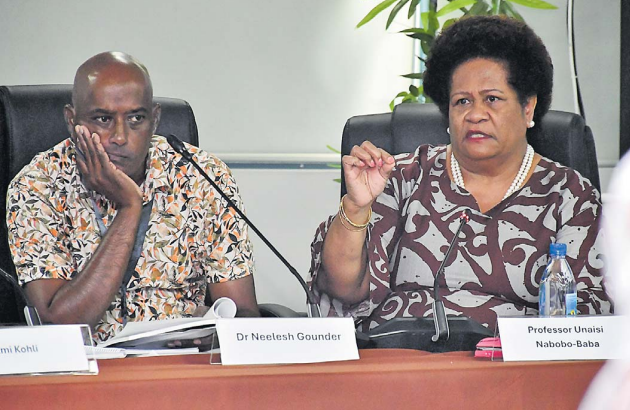
Responding to submissions by the Ministry of Education, Fiji National University vice-chancellor and CRC member Professor Unaisi Nabobo-Baba stressed that much of a child’s intellectual foundation is formed before the age of eight.
“Between 0 and 8, the IQ of everybody is made, almost,” she said.
She pointed to a critical shift in how the problem is understood, that by the time a child begins to struggle in school, the root cause may already be deeply embedded.
Ministry of Education officials echoed this concern, acknowledging significant challenges in meeting their legal obligations under the 2013 Constitution.
Deputy secretary for primary and secondary education, Timoci Bure, explained that government support through the Free Education Grant is provided on a per-student basis to help schools cover operational costs and ease the financial burden on families.
However, the figures reveal a stark imbalance.
Early childhood education receives about $50 per child per term, compared with around $156 at primary level and between $300 to $400 at secondary level.
“The most critical level in the system is early childhood education,” Mr Bure said.
“Literacy and numeracy challenges often originate at this stage.”
Yet access to this level remains uneven.
In some cases, children must travel across seas to attend school, a reality that raises serious concerns, particularly given that these are the years when children are meant to be closest to home and family.
Officials also pointed to broader systemic constraints, from limited funding and teacher shortages to gaps between what the Constitution requires and what the ministry can realistically deliver.
“There is a wide gap between the legal framework and the government programs.”
At the same time, the structure of the education system itself is being questioned.
While close to 80 per cent of employment opportunities in Fiji fall within technical and vocational fields, these pathways continue to receive less emphasis and funding compared with traditional academic routes.
“No one really cares for TVET, it is still given lip service,” Mr Bure said, warning of a growing skills gap in the labour market.
Prof Unaisi Nabobo-Baba stressed that the foundation of intelligence is largely formed in early childhood, particularly between the ages of zero and eight.
She pointed to countries like Japan as an example of how early childhood development is prioritised.
“This is why in Japan, that’s where all the money goes, between 0 to 5. There is a reason.”
Prof Nabobo-Baba emphasised that proper nutrition and early stimulation are critical during these formative years.
“Every child needs to eat properly, that is basic to intelligence.
“In this country, we start later, and once that early foundation is missed, it becomes very difficult to correct,” she said.
She warned that gaps at this stage can have lasting consequences, noting that once this early development window is missed, it becomes increasingly difficult to address learning challenges later in life.
Which brings the issue back to where it may have always been.
If the foundation of learning is formed before a child even enters a classroom, then Fiji’s education crisis may not just be about what happens in schools.