
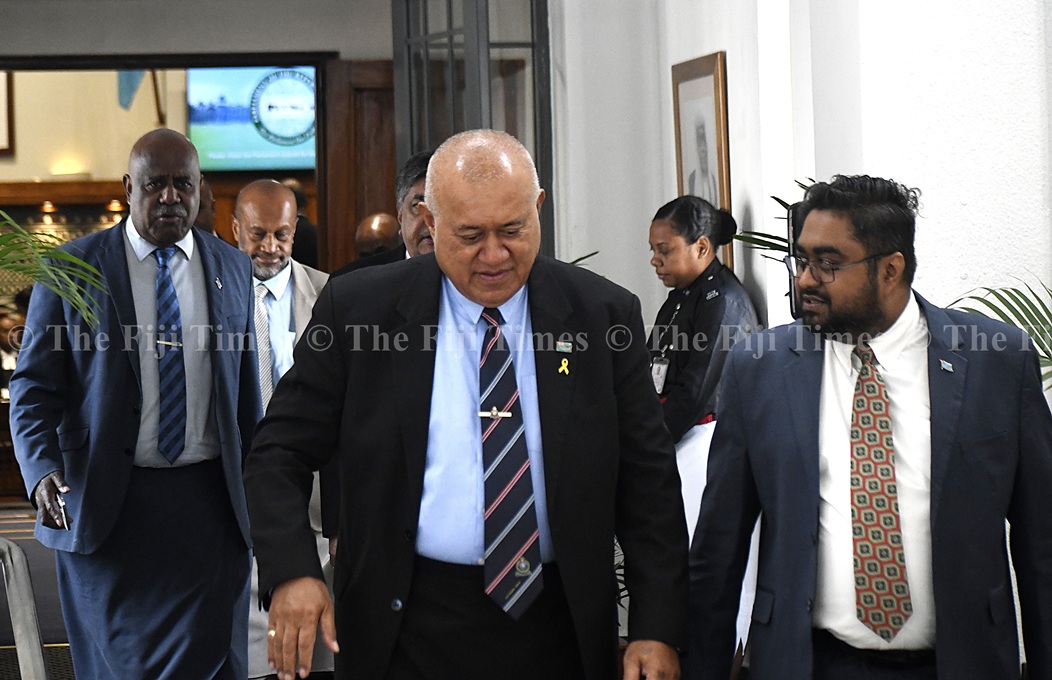
Joint enforcement operations involving the police and the military have contributed to a 30 per cent decline in illicit drug cases during the first quarter of 2025-2026, said Minister for Policing and Communications Ioane Naivalurua in Parliament yesterday.
Speaking during the 2026-2027 National Budget debate, Mr Naivalurua said Government had strengthened its response to transnational serious and organised crime (TSOC) and illicit drug networks through a new national coordination policy.
“Two months ago, the general policy direction on the National Coordination of Transnational Serious and Organized Crime, also known as TSOC, and Illicit Drug Enforcement in Fiji was issued and subsequently endorsed by Cabinet last month,” he said.
The policy, he said, aimed to establish a coordinated national approach to identifying and dismantling criminal networks involved in drug trafficking and organised crime.
“The intention of this policy is to provide clear direction for a strong and coordinated national response to detect, disrupt, dismantle, neutralise, and curb TSOC and illicit drug networks.”
He said operations would be coordinated through the National Joint Enforcement Centre (NJEC), where agencies would share intelligence and work towards a common objective.
“These joint efforts will be manned from the National Joint Enforcement Centre, where personnel will work to share intelligence, coordinate operations with a common purpose.”
Mr Naivalurua acknowledged the support of the military in joint operations with police, saying overall crime rates had also decreased by 18 per cent.
“These operations form a crucial framework for sustaining, coordinating, and safeguarding Fiji’s national security against the harms of illicit drugs.”
However, he stressed that enforcement alone would not solve the problem.
“Effective change requires contribution from all sectors, and success can only be achieved when all of us stand together.”

