
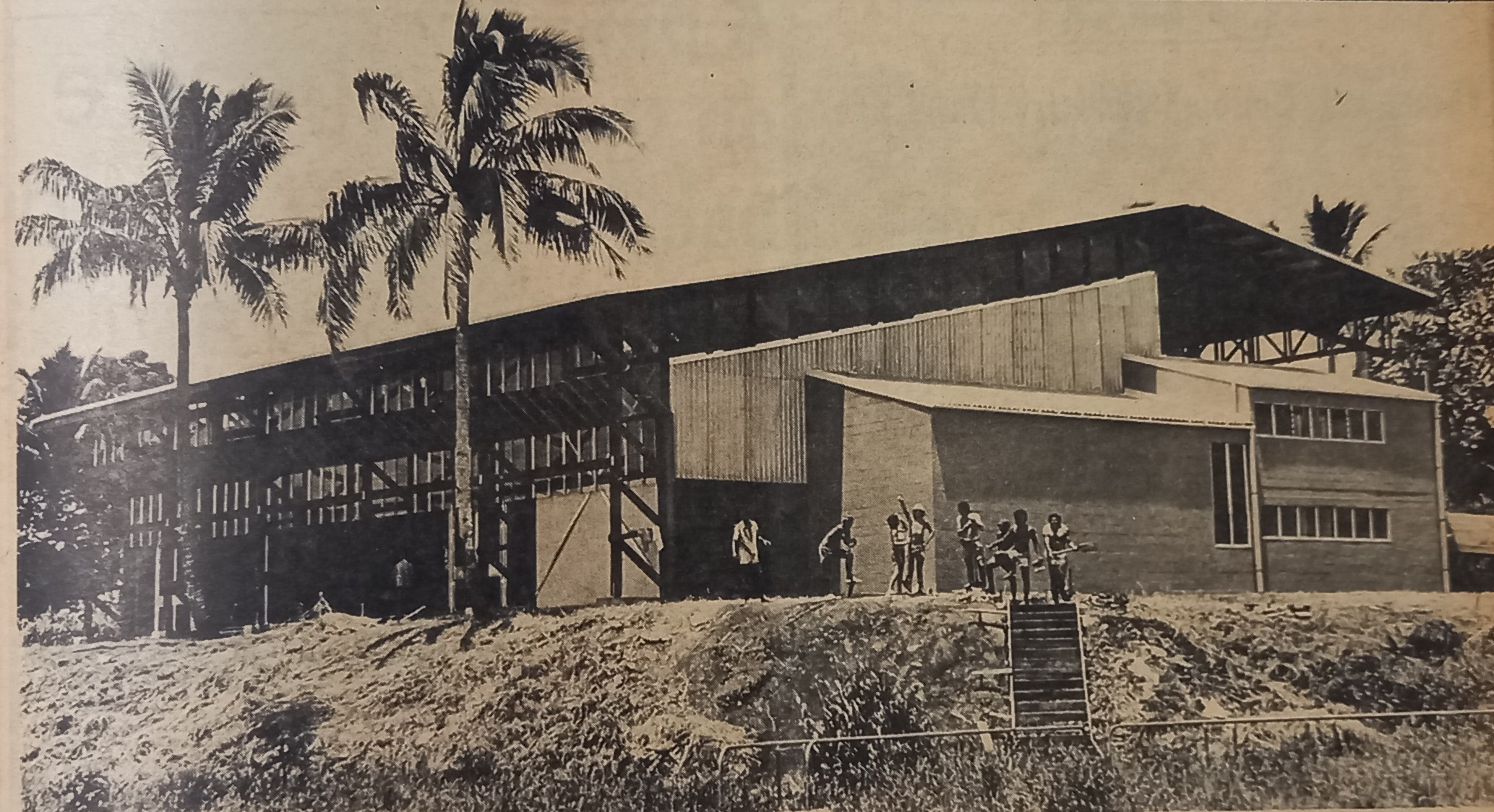
If you are the observant traveller, there’s something you will catch a glimpse of each Itime you zoom past Carpenters Street, off Grantham Road in Raiwai.
But you probably would never have given it any thought or attention. I’m talking about the peculiar looking wooden building on Leys Rd behind the Raiwai ground.
The structure rose from scratch through efforts of the community, government and development agencies and got transformed into a bustling space in the 1970s.
According to The Fiji Times records, after three years of planning, fundraising and construction, the young people of Raiwaqa Housing Estate witnessed the official opening of their Youth Centre, built at the cost of $200,000 in 1974.
Today, the Youth Centre may seem just like a weathered structure but many young people went through its doors. Some later carved named for themselves in various fields of life.
It was a symbol of hope, youth dynamism and empowerment in the early days of the residential area. By the early 1970s, Raiwaqa had an estimated population of more than 12,000. Of this figure, around 7000 were under the age of 21.
This represented one of the largest single concentrations of young people in peri-urban Fiji. With such dense congregation came the dreadful possibility of it being turned into a breeding ground for crime and unemployment.
Some foresaw this unwanted situation and the need to engage youths in the area and prevent them from getting into trouble.
One of them was Ed Hattuer – a hardworking youth worker. He put together a report on the need to set up a youth centre in 1971 at the site where it stands today.
The site was immediately adjacent to the new swimming pool which was an October 10 gift from Mr John Falvey and right behind the only full size rugby field in Raiwaqa (now referred to as Raiwai ground) Falvey was a prominent member of the Legislative Council in the 1960s and became Fiji’s first Attorney-General when Fiji gained independence in 1970.
The swimming pool gave an alternative venue for children who couldn’t afford paying the admission fees charged at Suva Olympic pool.
According to a letter to the editor on July 2, 2016 prior to the construction of the pool, kids that were raised in Raiwai, Raiwaqa, Tutaleva and Kaunikuila would swim at a place called Ramjani, near what is now Carptrac and Garden City in Raiwai.
When Raiwai swimming pool was opened there was no more going to Ramjani as the cover charge at the neighbourhood pool was 5 cents, compared with Olympic Pool’s 50 cents.
“Raiwai Swimming Pool back then was a scene like Bondi Beach, crowded, back to back with no space to spread your legs and hands,” the letter writer said. “I feel sorry for those kids who couldn’t find a 5 cents coin as they can only watch from outside the gate or invite another friend or two to go to Ramjani.”
Later, the services of Mr John Lyth of the Public Works Department, and Mr Elwyn Evans were obtained for some architectural assistance, which they provided at the early stage of the project.
Mr Keswick Howden of Jackson and Walker, a specialist in the particular design required for the centre played an important role in the discussions of various needs of the committee that worked on the project. His firm also offered their services at nominal costs.
The Government of Fiji, seeing the value of setting up a youth centre in Raiwaqa, provided a grant of $25,000 in 1972, $20,000 in 1973 and $20,000 in 1974, to cover part of the cost of building Raiwaqa Youth centre.
In the years after 1974, the Government gave $1,500 per annum to the centre and the committee that looked after it raised $3,000 in two charity carnivals and $1,800 from a ‘ buy a block’ fundraising campaign. Prime Minister Ratu Sir Kamisese Mara, when crowning the Carnival’s Charity Queen in 1972, gave $3000 from the PM’s Independence Gift Fund to help run the place.
While the committee struggled to raise the required funds, the project attracted international interest from the Canadian International Development Agency. Acting on the advice of the Canadian High Commissioner, Mr A.R.Menzies, the committee approached the CIDA and as a result an offer of $7,000 was received.
The YMCA of Vancouver contributed $10,000 to the Canadian gift and a loan of $30,000 was raised from the Fiji National Provident Fund.
In 1974, the centre was officially opened by the counsellor from the Canadian High Commission in Canberra, Mr Doug Fogarty.
In the 1970s, the project was a sterling example of cooperation and community effort. Established in 1971, the youth centre had a main hall large enough to contain an in-door basket court or seat 500 people, The Fiji Times of February 2, 1974 noted.
The first three full time staff were Tomu Vunakece, Alena Vosararawa and Pasepa Isireli Minister for youth, Education and Sport during the Alliance Government, Mr Jone Naisara, said the fine building was to ‘serve the recreational and training needs’ of the young people living in the Raiwai-Raiwaqa Housing Estate.
One of the purposes of the facility was to implement programmes tailor-made for young boys and girls.
According to a survey held in the Raiwaqa- Raiwai area, girls demanded more courses in office jobs.
There were planned counselling services, typing classes and other subjects for office work. “..A girls’ club was formed to co-ordinate interests in young girls for home economics and it was encouraging to see that they could initiate new ideas and run their own programmes once a week,” Teisa Tora was quoted in The Fiji Times (1974) as saying.
Tora was the secretary of the committee that ran the youth centre. At the end of 1973, a qualified Home Economics teacher from the South Pacific Commission, Elizabeth Werle, agreed to assist the girls who received skills training at the centre.
It was mandatory for girls to take typing and English language classes especially designed to cater for ‘typical business situations’.
There were training facilities for tailoring and other vocational courses aimed at improving the skills of boys.
“While we will not be offering full time employment, we shall be teaching young people to a standard that may enable them to obtain jobs on a regular basis,” Tora said.
Miss Tora herself had plans for training in handicrafts and cottage industry.
She had in mind tie-dye T-shirts, silk screening, sign writing, carving and many others. A proposed vocational training scheme for plumbers was also listed to train unemployed young men who did not have adequate academic qualifications to be accepted as apprentices and trained to enable them to secure jobs.
Over a decade later, the Raiwaqa/Raiwai Youth Center was not so much in a ‘rosy’ state of affairs, but was definitely a center that youths of the two communities attended to rebuild their faith in themselves. More upgrading was needed.
According to an article published by The Fiji Times on February 8, 1989, the library at the center was a ‘single book-shelf’ where the books looked as if they had been ‘time-warped from some Victorian mantelpiece’.
The director of the center, Ravuama Nanovo said even though the facility wasn’t ‘the best or the cleanest’, it certainly got the job done in ‘ensuring youths in the area were busy carrying out projects in the community’.
In the late 80s the centre did some amazing projects and empowered many youths. Despite the fact that most men and boys as young as 16, who worked through the center, had police records, they found camaraderie and unity.
For example, a 14-year-old housing estate rebel got a kick out of the finer arts of Polynesian cooking.
Those who found meaning and purpose at the centre did not care about the damp air, the lack of human energy and the crispy skin of paint peeling away to reveal dirty naked concrete.
The swimming pool given by Sir John was a marshy swamp. At the time of Mr Nanovo’s appointment as director in 1988, there were 30 boys at the time who were registered as visitors to the centre.
“The main aim of the center is to keep these youths out of mischief. This is done by giving them a goal, or to give them an opportunity to work towards something,” Mr Nanovo to The Fiji Times.
One of those opportunities presented itself in August 1988 with the setting up of a lawn mowing project. That kept 16 boys busy mowing lawns for private homes, the University of the South Pacific grounds and other private subdivided land.
A Ministry of Youth grant brought two lawn mowers, a brush cutter and paid the boys’ wages. One of the youths who found work at the centre was Naibuka Bolatagane, who had been a visitor to the center for over 10 years before he became involved in the project for the first time. The project gave the 33-year-old men “something to do”.
Firewood cutting was another project at the centre. It got the boys involved in cutting and selling firewood.
Another project was a mini-mart lent to the centre. There were four boys from the center working at the minimart selling fish, sweet potatoes, dalo and other groceries at a cheaper price than retail prices. The mart was constructed to help the boys learn the finer points of entrepreneurship.
“It’s a wonderful and emotional thing to see these boys giving money to their mothers and families,” Mr Nanovo said.
“What we are trying to do here is to make them regain their sense of self-respect and their dignity.”
Something wonderful happened at the centre in 1988 when two of the youths from the center answered a Burns Philp advertisement to be part of the crew on a ship The boys asked Mr Nanovo for a letter of recommendation which he happily drafted.
They typed their letters and handed them over to the ship’s office in hope for a possible interview.
Two week later the three boys flew out to Samoa where they started work manning a fisheries ship. “It’s wonderful to see a big company like BP stretching out a helping hand. It’s given the boys a real incentive,” Mr Nanovo said.
Rather than rousing the slightest twinge of compassion, the center and its boys have, at times, found themselves the object of common scorn and contempt. But Mr Nanovo promised the youths at the center to help them in every way he could.
In May 2015, when PM Frank Bainimarama handed over lease documents to the trustees of the Raiwai Youth and community council, he reminded young people of many Fijian sportsmen and women who grew up and developed their talents in Raiwaqa.
“As I stand before you today, a flood of memories washes over me of the great times everyone who has been involved with this place has experienced and the great names in sport who have been nurtured here and were instilled with the love of the games in which they excelled,” Mr Bainimarama said.
Some of the names he mentioned were Elesi Ketedromo; Alavina Waqa; Metuisela Motu; and Taitusi Naiduki, who became national reps for Volleyball and used to train here.
And the big names in basketball – Seini Dobui; Saula Koroi; Mareta Tamani; Mili Talei; and Peni Ratumaiyale.

