
THE ship Leonidas set sail from Calcutta, India, on March 3, 1879, carrying 462 Indian indentured labourers to work on cotton and later sugarcane plantations in Fiji.
They were the first group of indentured labourers brought to Fiji by the British colonial government.
Among them were Dayaram and his wife Maikee, who had left behind their two sons, Mahend Singh and Sohan Lal, in India.
After a voyage of more than a month, the Leonidas arrived in Fiji on May 15, 1879. Soon after arriving in Suva, Maikee gave birth to a son, Mahabir Dayaram, whose birth was recorded on her immigration pass.
Dayaram later completed his girmit contract with the Colonial Sugar Refining Company on J. Barry’s plantation in Levuka.
Mahabir Dayaram is believed to have been the first Indo-Fijian born in Fiji.
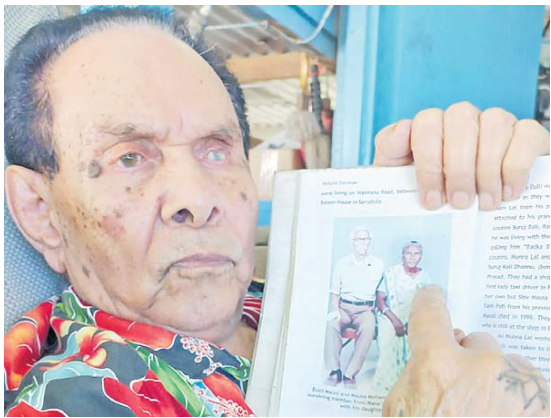
Evidence supporting this claim, including immigration passes and family records, was compiled in a book published in 2011 by Mahabir’s great-granddaughter, retired schoolteacher, the late Phulmati Nand.
“The couple gave birth to a baby boy and he was known as the first Indian to be born in Fiji,” the book stated.
“The boy was born in a place which is now known as Howell Road in Suva. The couple named the boy Mahabir.”
Mrs Nand wrote that she was proud to learn her grandfather was considered the first Indo-Fijian born in Fiji.
The book stated that Mahabir was nicknamed “Marvie” by British overseers. In 1881, another son, Munna Lal, was born to Dayaram and Maikee.
The family later travelled back to India with their Fiji-born sons, Mahabir and Munna Lal, where they reunited with their elder sons. After spending some time there, they returned to Fiji together.
Mrs Nand described her grandfather as a hardworking man who owned a small grocery shop and had a passion for horse racing.
“He reared horses and trained them,” she wrote.
According to the family tree published in the book, Mahabir Dayaram had three wives and 17 children.
His great-grandson, Robert Ram Bali, 82, of Olosara in Sigatoka, said many members of the older generation had since passed away.
“Even from my generation, some have passed away and some are alive,” Mr Bali said.
He said his father, Ram Bali, drove a Vauxhall taxi owned by the Government and became well known for transporting chiefs and government leaders, including Ratu Sir Lala Sukuna.
Mr Bali said his father later moved the family to Deuba, then to Nadi before settling permanently in Korotogo, Sigatoka.
He worked at Nacocolevu Agriculture Station in Nadroga and later established “Bali’s Plumbing Works”, a business that continues today under the management of his son, James Bali.
Mr Bali said his mother, Helen Danford, came from a chiefly family in Namosi and was related to the family of the current Tui Namosi.
“We are still recognised in Namosi. They call me ‘vasu e Nabukebuke’ because my mother came from the chiefly clan.”
He also reflected on the segregation that existed during colonial times, saying Indian, iTaukei and European children attended separate schools.
“Being half Indian and half iTaukei, I attended Nakaulevu Indian School, now Rampur Primary School.
“That’s where I learned Hindi, and today I can still read and write it.”
Mr Bali said he proudly embraced both Indian and iTaukei cultures and wanted future generations to continue respecting all religions and traditions.
“My forefathers promoted unity throughout their lives.
“I would like to see everyone live peacefully together in unity.”

