
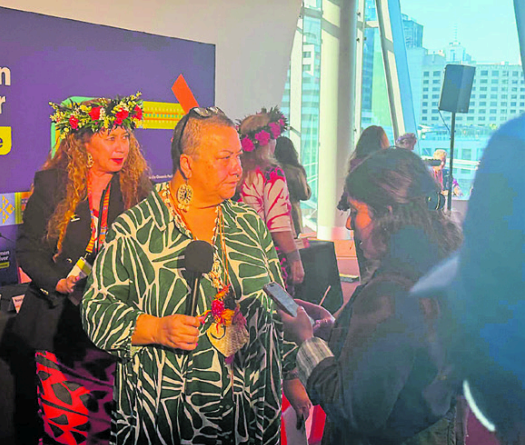
Six thousand women. One global stage. And a conversation the world can no longer afford to sideline.
Inside Melbourne’s vast convention halls, the energy is unmistakable. Delegates from every corner of the globe have gathered for the Women Deliver Conference 2026; activists, policymakers, journalists, young leaders – all united by a single, urgent goal: advancing gender equality in a world that continues to fall short.
For me, this isn’t just another international assignment. It is deeply personal.
As a journalist from the Pacific, I have spent years telling stories that matter or at least trying to. Stories about women, about inequality, about resilience. But too often, those stories are pushed aside. There is always something “more urgent”: politics, economic pressures, natural disasters. Gender issues, despite their scale and impact, struggle to hold the spotlight.
And yet, here in Melbourne, those very issues are front and centre.
What Women Deliver is really about
At its core, the Women Deliver Conference is about power – who has it, who doesn’t, and how that imbalance shapes the lives of women and girls.
It is about access: to education, to healthcare, to economic opportunities, to leadership spaces. It is about rights – the right to live free from violence, the right to make decisions about one’s own body, the right to be heard.
But beyond the policy language and high-level discussions, it is also about lived realities. The stories behind the statistics.
And for Pacific women, those realities carry a distinct weight.
The Pacific perspective: Small islands, big challenges
In the Pacific, the challenges facing women are layered and complex.
Gender-based violence remains one of the most pressing issues. In Fiji, statistics have consistently shown that a significant number of women experience violence in their lifetime.
These are not just numbers – they represent mothers, daughters, colleagues, neighbours.
Economic inequality is another persistent barrier.
Women are overrepresented in informal and low-paying sectors, with limited access to financial independence. Leadership spaces, whether in politics, business, or community decision-making, remain largely male-dominated.
Then there is climate change – an issue that disproportionately affects the Pacific and, within it, women. As communities face displacement, food insecurity, and resource scarcity, women often carry the burden of holding families and communities together.
These are the stories we carry into global spaces like Melbourne. Stories that demand attention, not as side conversations, but as central to the global development agenda.
A journey shaped by storytelling
My journey to this conference has been shaped by years in journalism – nearly two decades of navigating newsrooms where priorities shift rapidly and attention spans are short.
Reporting on gender issues has never been straightforward.
There is a constant tension: how do you keep these stories alive when they are so often overshadowed? When breaking news pushes them down the page, when audiences are conditioned to move on quickly?
There have been moments when it felt like shouting into the wind.
And yet, there have also been moments of impact – when a story resonates, when a voice breaks through, when change, however small, begins.
Being here in Melbourne, surrounded by journalists from around the world who share that same struggle, is both affirming and confronting. It is a reminder that this is not just a Pacific challenge – it is a global one.
The problem of “disjointed attention”
One of the recurring themes in conversations here is the fragmented way gender issues are covered.
They spike during international days, major reports, or high-profile incidents. Then they fade.
This disjointed attention has real consequences. It shapes public understanding. It influences policy urgency. It determines whether issues are seen as systemic problems or isolated events.
In the Pacific, this is particularly evident. A case of violence might dominate headlines for a few days, but the deeper conversation, about prevention, support systems and cultural norms often remain underexplored.
What conferences like Women Deliver do is force a sustained focus. They create space for deeper conversations, for connections, for learning.
But the real challenge lies beyond the conference halls: how do we carry that momentum home?
The Melbourne Declaration: A call to action
One of the key outcomes of this year’s gathering is the Melbourne Declaration for Gender Equality – a document that sets out a collective vision and commitments for advancing women’s rights.
It is both ambitious and necessary.
The declaration calls for stronger accountability, increased investment in gender equality, and a renewed commitment to tackling systemic barriers. It recognises that progress cannot be piecemeal – it must be intentional, coordinated, and sustained.
In an earlier report, Fiji Women’s Rights Movement director Nalini Singh emphasised the importance of moving beyond rhetoric.
She spoke about the need for real accountability, not just commitments on paper, but tangible actions that translate into change on the ground.
Her message is clear: women in Fiji, and across the Pacific, do not need more promises. They need results.
That sentiment echoes strongly here in Melbourne.
Why this matters now
The urgency of this moment cannot be overstated.
Globally, there is growing recognition that gender equality is not just a “women’s issue” — it is fundamental to economic growth, social stability, and sustainable development.
But recognition alone is not enough.
For Pacific women, the stakes are particularly high. Climate pressures are intensifying. Economic challenges are evolving. Social norms are shifting, but often not fast enough.
At the same time, there is immense strength within Pacific communities. Women are leading at the grassroots level, driving change in ways that are often underreported.
Those stories deserve to be told – consistently, prominently, and with the depth they require.
Carrying the conversation forward
As I move through this conference, from panel discussions to hallway conversations, one thing stands out: the power of collective voices.
There is something transformative about being in a space where women’s experiences are not marginalised, where they are the starting point of the conversation.
But this is not where the work ends.
For journalists like myself, the responsibility is clear. It is not just about reporting what happens here. It is about sustaining the conversation long after the conference concludes.
It is about challenging newsroom priorities. About pushing for space. About ensuring that gender issues are not treated as occasional features, but as ongoing narratives.
Because the truth is, these stories are not secondary.
They are central.
A personal reflection
Soon, I will leave Melbourne and return to the Pacific, where the headlines will once again compete for space and urgency.
But I will carry these conversations with me – not as distant discussions, but as reminders of what is at stake.
Because behind every statistic is a woman navigating real challenges, in real time.
And those are stories that cannot wait for the next global gathering to be told.

