Foreign Affairs Minister Sakiasi Ditoka has issued a strong call for national unity in the fight against transnational drug trafficking, warning that Fiji is facing sophisticated international criminal networks that exploit the country’s vast maritime domain.
In a social media post, Ditoka said some commentators underestimate the scale of the challenge, believing that policing Fiji’s borders is simply a matter of deploying patrol boats and waiting for traffickers to appear.
“The reality is far more serious than that,” he said.
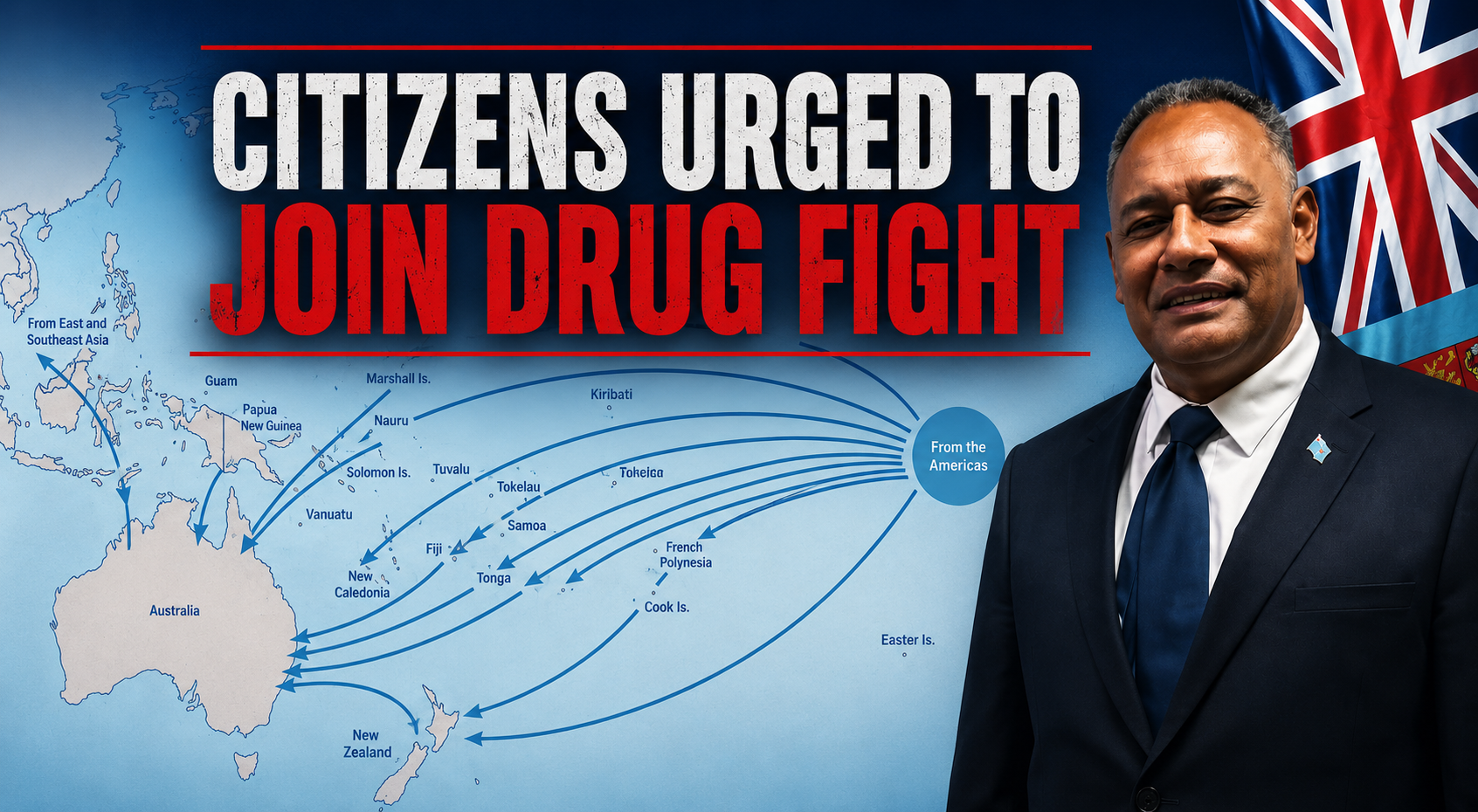
Referring to maps presented by a senior New Zealand Police officer at last week’s Fiji–New Zealand/New Zealand–Fiji Business Council Conference, Ditoka said Fiji occupies a strategic position within major maritime routes linking Asia, the Americas, Australia and New Zealand.
He noted that while these routes facilitate legitimate trade and travel, they are also being exploited by organised criminal syndicates.
“Fiji sits in the middle of a vast ocean network connecting Asia, the Americas, Australia and New Zealand. The same routes that facilitate legitimate trade and movement are also being exploited by sophisticated transnational criminal networks.”
Ditoka said Fiji is responsible for monitoring more than 1.2 million square kilometres of ocean, making the task of border security particularly complex.
“The criminal organisations we face are not village-level operators. They are well-funded international cartels with access to enormous financial resources, logistics networks spanning continents, advanced communications and local accomplices prepared to do their bidding.”
The Minister said vulnerabilities exploited by organised crime were the result of years of institutional weaknesses, inadequate resources and compromised systems across multiple agencies.
“Rebuilding capability takes time. It requires stronger intelligence, better regional cooperation, improved maritime surveillance, upgraded technology, professional law enforcement agencies and, most importantly, an alert and engaged public.”
Ditoka pointed to the recent discovery of dozens of suspected drug parcels in the Lau Group as evidence of the important role ordinary citizens play in combating drug trafficking.
“Those packages were not discovered by aircraft, ships or satellites. They were found by ordinary citizens.”
“Members of our communities saw something unusual, acted responsibly and informed the authorities. That is exactly what we need.”
He stressed that the fight against drugs extends beyond law enforcement agencies and requires the participation of every Fijian.
“Because the truth is that every Fijian is now part of this fight. We are all frontliners.”
“Our families, our churches, our workplaces, our homes, our villages, our communities, our towns and our cities are the Forward Edge of the Battle Area.”
In a direct message to drug cartels, Ditoka said Fiji would not back down.
“They are motivated by greed. We are motivated by something far stronger.”
“We are defending our children. We are defending our families. We are defending our communities. We are defending our homeland.”
While acknowledging the fight would be long and challenging, Ditoka said Fiji must remain united and vigilant.
“The cartels are fighting for a quick dollar. We are fighting for the future of our nation.”
“We will not budge. We will not retreat. We will not give an inch. And by the grace of Almighty God, Fiji will prevail.”