
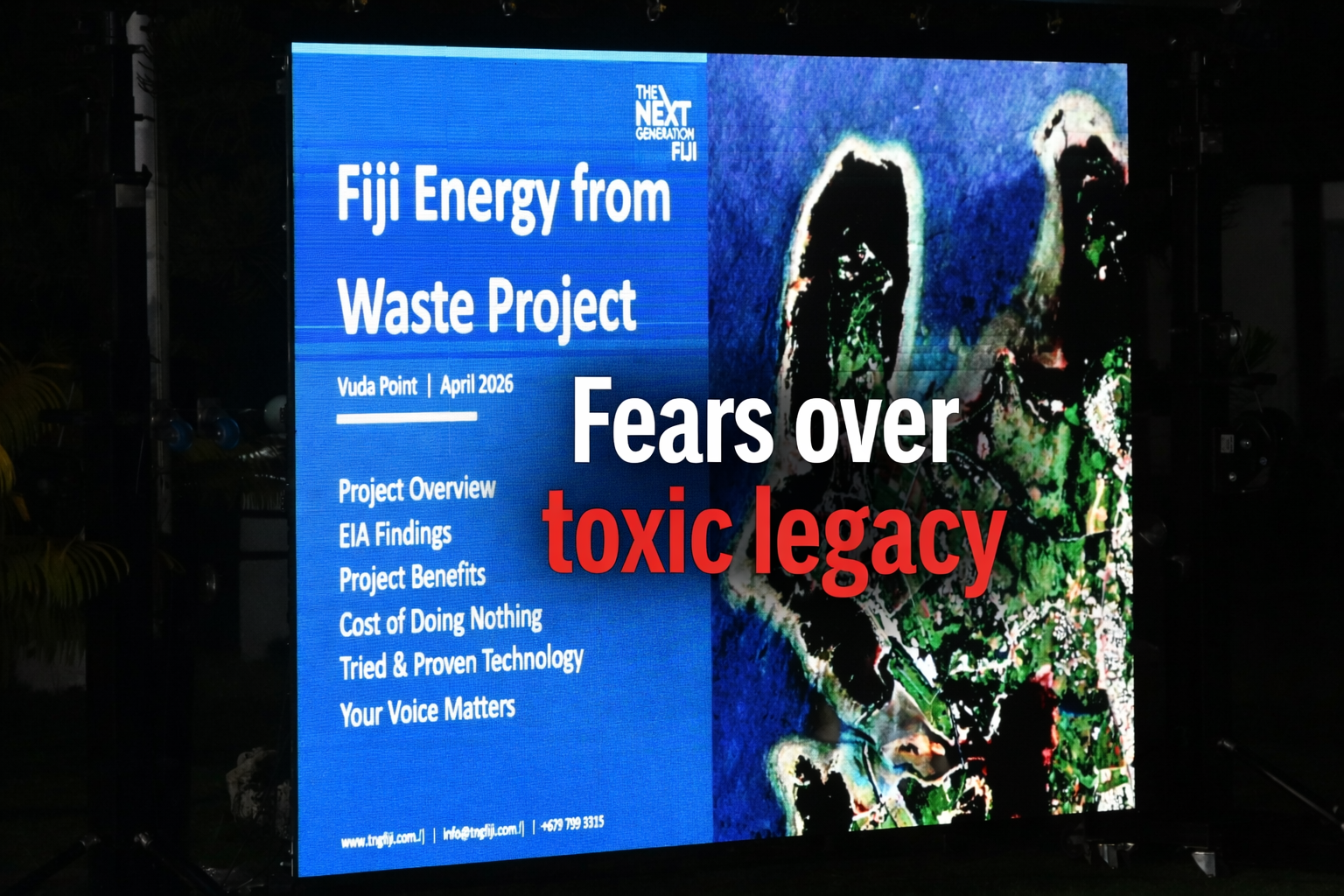
Fiji’s Permanent Representative to the United Nations, Filipo Tarakinikini, has issued a strong warning over the proposed waste-to-energy incinerator at Vuda, cautioning that the project could leave the country with long-term environmental and cultural consequences.
In a social media post, Mr Tarakinikini questioned the environmental credibility of the project, rejecting claims it offers a clean energy solution.
“Incinerators emit more carbon dioxide per unit of electricity than coal-fired power plants. This is not a renewable energy solution. It is a fossil fuel substitute wearing a green label,” he said.
He raised particular concern about the scale of waste processing and the resulting toxic by-products.
“Burning 900,000 tonnes of waste annually produces between 225,000 and 300,000 tonnes of highly toxic residue — fly ash and bottom ash laden with persistent organic pollutants, heavy metals, and dioxins,” Mr Tarakinikini said.
“This ash does not disappear. It must be stored, managed, and contained — permanently, on Fijian soil. Australia’s waste becomes Fiji’s permanent toxic legacy.”
According to the proposal, the facility would process volumes far exceeding Fiji’s own waste output, with up to four times the country’s domestic waste expected to be imported from overseas.
“Fiji generates nowhere near 900,000 tonnes of waste per year. The scale of this facility is not calibrated to Fiji’s needs — it is calibrated to serve a regional waste disposal market, with Fiji as the host and the repository,” he said.
Mr Tarakinikini warned that this could effectively turn Fiji into a dumping ground for foreign waste, with reports indicating shipments from New Zealand and up to 150 tonnes of waste per day from Australia.
A Vuda community taskforce member echoed those concerns, saying: “They’re trying to present themselves as coming to help us sort out our rubbish, but the reality is Fiji is being used to solve a regional problem.”
Mr Tarakinikini urged Fijians to reflect on the broader implications.
“I want every Fijian — and every Pacific Islander — to sit with that sentence for a moment,” he said.
“Fiji, which contributes less than 0.009 percent of global greenhouse gas emissions… would become the incinerator of the Pacific, processing the waste of nations with far greater means to manage their own refuse responsibly.”
He also pointed to Fiji’s obligations under international law, particularly the Basel Convention, which regulates the movement of hazardous waste between countries.
“The Government must satisfy itself fully that this proposal does not place Fiji in violation of its international legal obligations,” he said.
Beyond environmental risks, Mr Tarakinikini stressed the cultural significance of the proposed site at Vuda Point — widely regarded as the First Landing site of the iTaukei people.
“Vuda is not just a location. It is who we are,” he said.
He noted widespread opposition from traditional landowners, community groups, tourism operators, and national sporting bodies.
“Their voices are not ‘just a few selfish people’. They are the custodians of that land, and their objection carries the full weight of iTaukei sovereignty,” Mr Tarakinikini said.
He warned that the development of an 80-megawatt power plant and industrial port would have irreversible consequences.
“It would not merely change the landscape. It would sever Fiji’s relationship with one of its most sacred sites — irreversibly.”

