
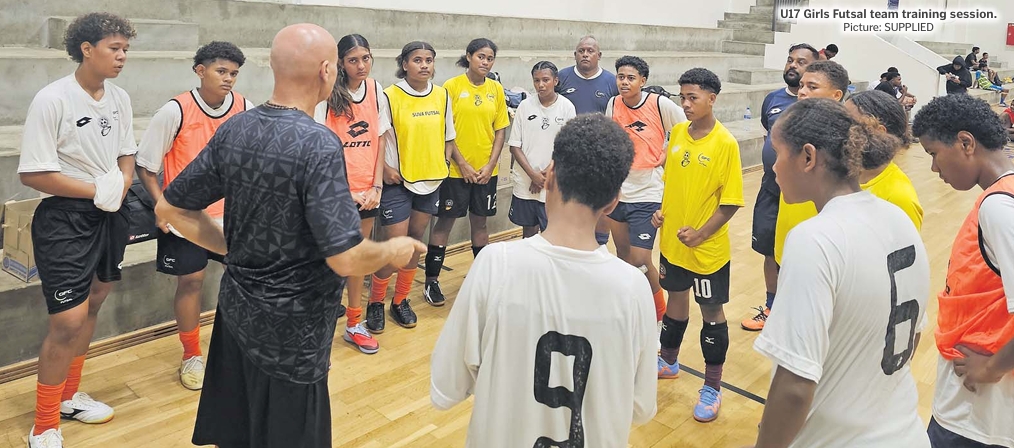
While Team Fiji athletes continue preparations for the 2026 Commonwealth Games in Glasgow, another group of young athletes is quietly working toward a historic international appearance on one of the world’s biggest youth sporting stages.
Fiji’s U17 Girls Futsal National Team has begun its journey towards the 2026 Summer Youth Olympic Games in Dakar, Senegal, where 2,700 athletes from around the world will compete across 25 sports from 31 October to 13 November 2026.
For Head Coach Jose Gerardo, the road to Dakar has already involved months of intensive planning, scouting, and development as Fiji looks to field a competitive team capable of representing the nation with pride.
With no active regional U17 girls’ futsal championship currently available, identifying potential players required a different approach.
The coaching staff launched a nationwide scouting programme, conducting observation trials across Fiji’s Southern, Western, and Northern divisions at academy futsal courts in Suva, Ba, and Labasa.
The search for talent continued through targeted training sessions in Suva, carefully scheduled during school holidays and weekends to ensure athletes could balance both education and sport.
A key part of the scouting process was the Fiji Secondary School Football Association’s annual futsal tournament, where coaches monitored performances across the U15, U17, and U19 boys’ and girls’ divisions. The three-day competition provided an opportunity to assess players from around the country competing at both the Fiji Football Academy Sports Court and the FMF Gymnasium.
Following a training camp in May, the coaching staff narrowed the squad to 14 promising athletes who now form the core of Fiji’s Youth Olympic Games preparation programme.
The next phase of preparation will see the squad participate in a series of mini weekend camps throughout June, July, and September.
Extended training camps are scheduled during the August school holidays, providing additional time for players to refine their skills and build team chemistry ahead of international competition.
Before departure for Dakar, the squad will be reduced from 14 players to the final 10-athletes who will travel under tournament regulations.
Training sessions are focusing heavily on futsal-specific technical and tactical development, while goalkeepers are receiving specialised coaching to prepare for the demands of elite international competition.
One of the biggest challenges facing the coaching staff is that many members of the current squad are also talented football players.
Several athletes are expected to be considered for selection to Fiji’s squad for the OFC U16 Women’s Championship later this year, creating a difficult balancing act between the two disciplines.
Although often linked, futsal and football require very different tactical systems, playing styles, physical demands, rules, equipment, and surfaces. Transitioning players between the two disciplines within a limited preparation window presents a significant challenge for both athletes and coaches.
Despite the obstacles, Coach Gerardo remains focused on ensuring the team is ready to compete on the international stage.
With more than three decades of coaching experience, his emphasis is not solely on results but on building a team that embodies discipline, resilience, positive attitude, and fair play.
The upcoming Youth Olympic Games presents a unique opportunity for Fiji’s next generation of female athletes to gain international exposure while continuing to grow the profile of futsal in the country.
As preparations intensify over the coming months, the U17 Girls Futsal Team joins the wider Team Fiji family in pursuing excellence on the global stage, carrying the hopes of the nation to Dakar and showcasing the talent, determination, and potential of Fiji’s young athletes.

