
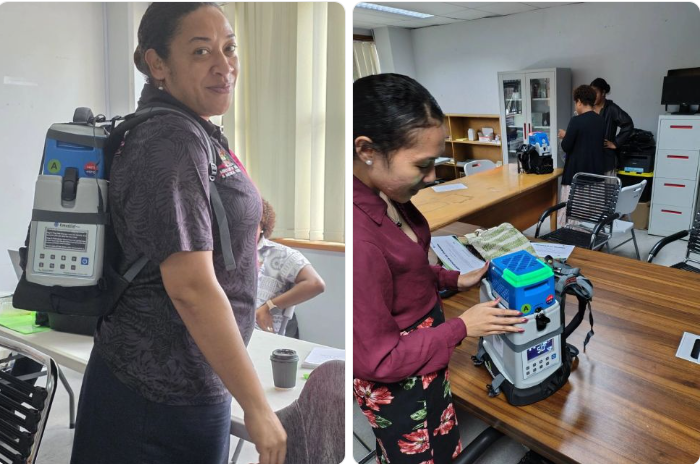
The Ministry of Health and Medical Services has launched a pilot programme that will deploy 65 solar-powered vaccine carriers across Fiji, aimed at improving vaccine delivery to remote communities and strengthening the country’s emergency preparedness.
Assistant Minister for Health Penioni Ravunawa launched the Solar Vaccine Carrier Pilot Programme, describing it as a major step towards improving the “last mile” of Fiji’s immunisation services.
The solar-powered carriers will be distributed to 65 health facilities and are designed to maintain the required vaccine cold chain temperature of between 2°C and 8°C for up to 12 hours.
“This pilot will assess the feasibility, acceptability, and operational effectiveness of the technology as we continue to strengthen the ‘last mile’ of immunization services and ensure every child has equitable access to life-saving vaccines.”
Designed specifically for Fiji’s conditions, the lightweight carriers can be worn as backpacks and include a dedicated compartment for a solar panel and charger. They can be powered by either electricity or solar energy, reducing reliance on conditioned ice packs during vaccine transport.
The Assistant Minister said the technology would also improve Fiji’s ability to maintain immunisation services during natural disasters.
“These solar-powered carriers will help maintain vaccine potency in the field, reducing disruption to immunization services and improving our resilience during emergencies.”
He noted that during cyclones, floods and other emergencies, vaccines often have to be relocated to prevent cold chain failures and wastage.
Mr Ravunawa commended the Ministry’s Expanded Programme on Immunization team, frontline healthcare workers and development partners for embracing the innovation.
“This is an important step towards a smarter, more resilient, and people-centred immunization system, with more sites planned in the future.”
He added that every child deserves access to safe and effective vaccines, regardless of where they live or the challenges faced in delivering healthcare services.

