A team appointed in 2025 to review Fiji’s electoral laws has proposed Fiji return to local constituencies and voters receive two ballot papers.
The system creates 25 local constituencies and a 71-member Parliament, combining directly elected local representatives with national proportional representation.
The recommendations are contained in the 232 page An Electoral System for the People, From the People, obtained by The Fiji Times.
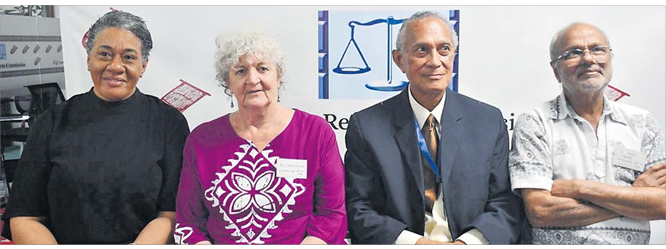
Led by former chief justice Daniel Fatiaki, the commission was appointed in 2025 to review key election-related laws, including the Electoral Act 2014, the Electoral (registration of voters) Act 2012, and the Political Parties (Registration, Conduct, Funding & Disclosures) Act 2013.
The Fiji Times understands this report has been superseded by the Constitution Review Report — compiled by the seven-member Constitution Review Commission that was appointed in March 2026 this year to review the 2013 Constitution.
The CRC report was considered by Cabinet last week and will go to Parliament soon.
The report calls for the return of local constituencies were persistent during public consultations, with people wanting MPs who could be directly identified with — and held accountable for — the needs of their communities.
“This was the most important failure of the current system raised by members of the public of all ethnicities, ages and educational background,” the report states.
The commissioners have proposed what they call a proportional open list constituency system (POLCS).
Under the model, 25 MPs would be elected to Open Seats across 25 local constituencies, while another 25 seats within the same constituencies would be reserved for women candidates.
The remaining 21 seats would come from an open list to maintain proportionality nationally.
Five of the 25 constituencies would be Maritime Constituencies covering Rotuma, Yasawa/Mamanuca, Kadavu, Levuka/Lomaiviti and Lau.
Each voter would receive two differently coloured ballot papers — one to elect a candidate for the open seat and another to elect a woman for the reserved seat for Women.
Both ballot papers would display the candidate’s name and photograph, along with a party symbol where applicable.
Voting would be simplified to a single tick beside the preferred candidate.
“Voting will be by a single tick placed beside the voter’s chosen candidate to ensure simplicity of voting,” the report states.
Votes for the constituency seats would be counted using the first past the post system.
The review says this would make counting simpler and more transparent because observers and voters could see the votes accumulating for individual candidates.
However, the proposed model would retain proportional representation nationally.
A political party’s overall entitlement to seats would be determined using the combined votes received by all its candidates contesting the 25 open seats.
The 21 open list seats would then be used to achieve proportionality.
The review says unsuccessful open seat candidates from parties receiving at least 5 per cent of votes nationally would be ranked for these seats after their constituency votes were standardised to account for differences in constituency size.
The commissioners argue the mixed system would restore local representation while preserving the principle of proportionality.
“We are confident that a mixed member proportional system will ensure representation at the local level whilst maintaining proportionality,” the report states.
“Local candidates will have the same opportunity to be elected in a constituency as will a candidate with national popularity.”
The review also argues that the proposed system would give independent candidates a more realistic opportunity to enter Parliament.
It says independents have struggled under the existing single national constituency because they must meet the national 5 per cent threshold despite potentially receiving thousands of votes.
Under the proposed model, the 5 per cent threshold for winning a constituency seat would apply to votes cast within that constituency rather than nationally.
The commissioners say this would significantly reduce the number of votes an individual candidate needs to cross the threshold.
Overall, the review describes the proposed system as creating “a more level and fairer playing field” while retaining proportionality at the national level.