
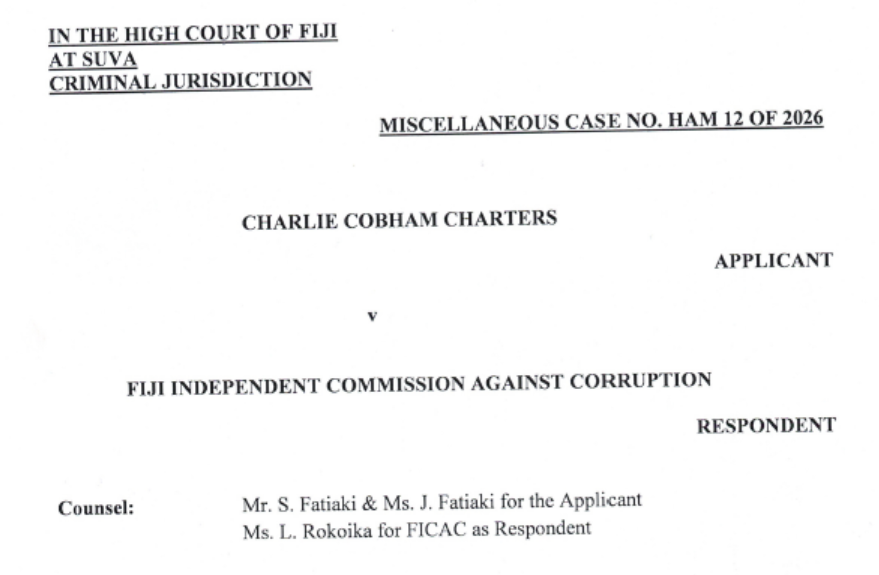
Political commentator and citizen journalist Charlie Charters has questioned the conduct of the Fiji Independent Commission Against Corruption (FICAC), saying the High Court’s decision to permanently stay the criminal proceedings against him exposes deeper issues within the anti-corruption agency.
In a statement posted on social media following today’s ruling, Mr Charters said the case demonstrated both the strength of Fiji’s justice system and what he described as serious failings in FICAC’s prosecution process.
“The good news is that the justice system may strain and stretch around the edges but it works. Today’s news validates that, for any of you who might have doubts,” Mr Charters said.
He thanked his legal team, Seforan Fatiaki and Juleen Jane Martha Fatiaki, saying he and his family were fortunate to have been able to secure experienced legal representation.
Mr Charters argued that the High Court should never have needed to intervene.
“It should not require the intervention of the High Court to correct the multiple and flagrant abuses of process that Judge Bulamainaivalu found I was subject to.”
He claimed the Court found that FICAC had denied him access to legal counsel and his right to remain silent, attempted to coerce him into revealing his sources, and brought retaliatory charges over his published commentary.
Mr Charters also alleged the ruling found the prosecution was an attempt to stifle freedom of expression, that the case should never have proceeded, and that one of the charges involved an apparent conflict of interest relating to the Acting FICAC Commissioner.
He questioned whether the issues identified by the Court were isolated or reflected a broader pattern within the Commission.
“It is reasonable to ask whether those prosecution guardrails were ignored only in this one case involving me or was it standard practice.”
Mr Charters said recent developments involving his case and that of former Deputy Prime Minister Biman Prasad had placed renewed scrutiny on FICAC, pointing to several past high-profile prosecutions that ended in nolle prosequi decisions, no-case-to-answer rulings or stayed proceedings.
“Clearly there is a systemic issue. To pretend otherwise is to deny reality.”
While acknowledging the personal impact of the prosecution, Mr Charters said Fiji should now focus on reform.
“That’s why it is impossible to draw any other conclusion than that, as currently structured and led, FICAC is not fit for the purpose of defeating corruption in Fiji and justifying its $8.5 million annual budget from the taxpayers.”
He noted that applications for the position of FICAC Commissioner closed on Friday, describing the timing as significant.

