
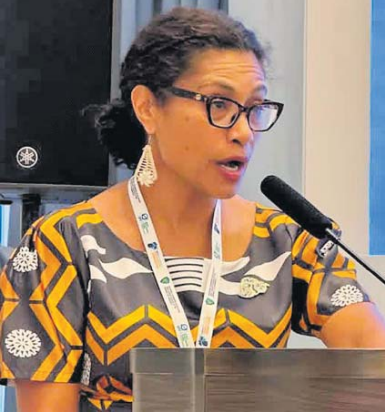
PACIFIC Island countries are facing a climate financing shortfall of nearly $US1billion ($F2.2b) every year, threatening efforts to build resilience against increasingly severe climate impacts, according to Minister for Information, Environment and Climate Change Lynda Tabuya.
Speaking at the Scaling Nature-Positive Solutions for Whole-of-Island Benefits side event during the Eighth Global Environment Facility Assembly in Samarkand, Uzbekistan, Ms Tabuya said Pacific nations required about $US1.5b ($F3.3b) annually for climate action but received only between $US200million ($F444m) and $US600m ($F1.3b) each year.
Ms Tabuya noted that adaptation needs alone were estimated at $US3.3b ($F7.3b) annually, underscoring the urgent need for greater financial support.
In response, Pacific nations are developing innovative financing mechanisms, including the Pacific Resilience Facility, the Fiji Rural Electrification Fund and the Sustainable Pacific Blue Circle Fund.
She said international funding mechanisms such as the Global Environment Facility continued to play a critical role in supporting policy reforms, strengthening institutions and helping governments attract further investment.
“Nature is central to the identity, economies and resilience of small island developing states.”
She said SIDS had become global leaders on climate change, ocean governance, plastic pollution and financial system reform.
Ms Tabuya also revealed that Fiji had mobilised $US32million ($F71m) for national environment and climate priorities and leveraged nearly five times that amount through co-financing.
She called for faster access to climate funds, stronger technology transfer and broader partnerships involving governments, communities, development partners and the private sector.

