The Taiwan Technical Mission (TTM) has taken a major step toward changing the way farming is done in Fiji by introducing modern, climate-smart methods that even local smallholders can easily see and understand.
On Tuesday early this week, the Mission held its annual field day at the Centre for Agriculture Technology Transfer (CATT) in Nausori – focused heavily on business survival and boosting crop yields under a special project called the ‘Resilient Cultivation Extension Project’.
To help everyday farmers compete in a changing market, the field day was themed: ‘Practices for Climate-Resilient Agriculture: Integrated Applications of Smart Irrigation, Pipeline Configurations, and mulching Techniques to Enhance Productivity’.
Show farmers, not just tell them
For many smallholder farmers, looking at complicated charts, percentages, and scientific data on paper does not mean much.
TTM specialist Edward Chen designed this year’s field day to fix that exact problem.
He transformed the Nausori research farm into a living commercial catalogue divided into different operational sections, running from Zone A to Zone F.
Each zone was given a different level of technology and care or treatment, so that farmers could visually compare the results.
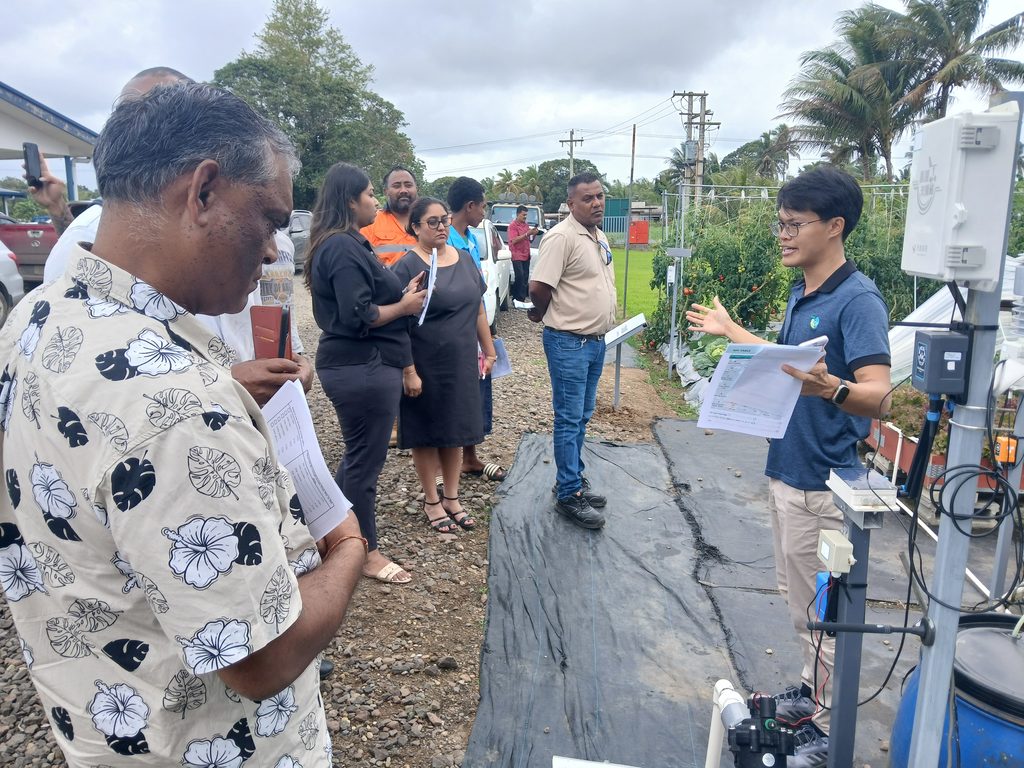
In Zone A, the mission set up a fully automated watering system.
This setup uses special sensors buried in the soil to read exactly how wet or dry the soil is, telling the system the best time to irrigate the crops without wasting water or human labour.
This zone also features greenhouse melons grown in crates and clean hydroponic systems.
On the other end of the spectrum, Zone E was left completely bare.
It had no silver plastic mulch covers to keep weeds down and no irrigation system installed.
By placing these fields side-by-side, visiting farmers could see the immediate business impacts of technology with their own eyes.
Crops grown with smart watering looked healthy and abundant, while the neglected zone showed poor growth and lower market value.
“The farmers won’t care too much about the data,” Mr Chen told this newspaper in an interview.
“They want to see with their own eyes what the difference is, so they can decide, comparing the cost, which one they will try to use,” he added.
A shift to interactive learning
In previous years, agricultural field days at the CATT in Nausori were mostly simple, one-way demonstrations.
This year, the field day involved an interactive, problem-solving journey that forced farmers to think outside their normal farming practices and opt for smarter options.
The participants spent time inspecting the different zones and talking directly with the field workers to figure out why certain zones produced better fruit than others.
“This year, I designed this program in way that it is more interactive, so people can interact with our labourers, inspect and ask questions about the different zones, and be able to see the differences in the results in each zone.
“And then after that, we come back to our hall, and we have a discussion together to see what the difference between the different treatment is.
Smart farming
Mr Chen said modern farming required a shift in mindset.
He said to survive unpredictable weather and rising costs, farmers could no longer just plant crops blindly and hope for rain.
He said by investing in basic pipeline configurations, plastic mulching, and targeted water systems, local farmers could save money on fertilizer, protect their soil from drying out, and bring much higher-quality vegetables to local markets.
The TTM plans to keep running the Resilient Cultivation Extension Project to ensure these smart tools become a normal part of Fijian agriculture. By giving farmers the power to discover these solutions on their own, the mission hopes the lessons from the field day will turn into practical, daily changes on local farms.
“I hope, after this field day, the people who attend have learned something and they can implement their preferred methods on their farm,” Mr Chen said.
Farmer Richard Fonorito of Oloolo in Sigatoka said he had learnt a lot from the training, particularly with smart agricultural methods.
“I have been working closely with TTM and most of my seedlings for banana, eggplant and English Cabbage were brought from here, and I follow their instructions on best and smart farming practices,” Mr Fonorito said in an interview.
He said he had recorded quality results with the agfricultural produces on his farm using smart methods from TTM.
Another farmer Alekiso Apisai of Koronivia echoed the same sentiments, saying his farming cluster comprising four farmers, have attended a number of trainings at TTM.
He said TTM specialists taught smart methods of agriculture that can be cost-effective in the long run.
He added they had always seen very good results when they followed farming methods learnt at the training.
Farm open for learning
The field day did not just attract farmers and crop growers.
Mr Chen said they opened their doors wide to educational institutions and private organisations to build a stronger network for the future of Fiji’s agricultural economy.
Among the more than 100 people who attended the training, a good attendance was noted among students and representatives from Fiji National University (FNU) and the University of the South Pacific (USP), including private training centres like Polytech Pacific.
By bringing in younger students and academic researchers, the TTM hopes to change the old stereotype that farming is just hard, routine manual labour with very little financial return.
During the field day, the Mission highlighted a collaborative composting machine project built with USP to show how waste management can reduce a farm’s overhead costs.
“We showcased that machine to let farmers know about the potential of this equipment or the future of doing smart agriculture, to do the farming smartly,” Mr Chen said.
The Mission is pushing to create a welcoming, open-source learning centre in Nausori where anyone looking to improve their commercial farming operations can get free guidance.
“I would like to say that, of course, we’re from Taiwan. And then the gate is always open for everyone. Your students from agriculture, even students from the other field, we always welcome you guys to come to learn, to have more new ideas.
“This place is always open to the public. It’s free to visit us, but we want everyone to come here with their own questions, and then we can try to collect these questions, and we hope we can try to solve those.”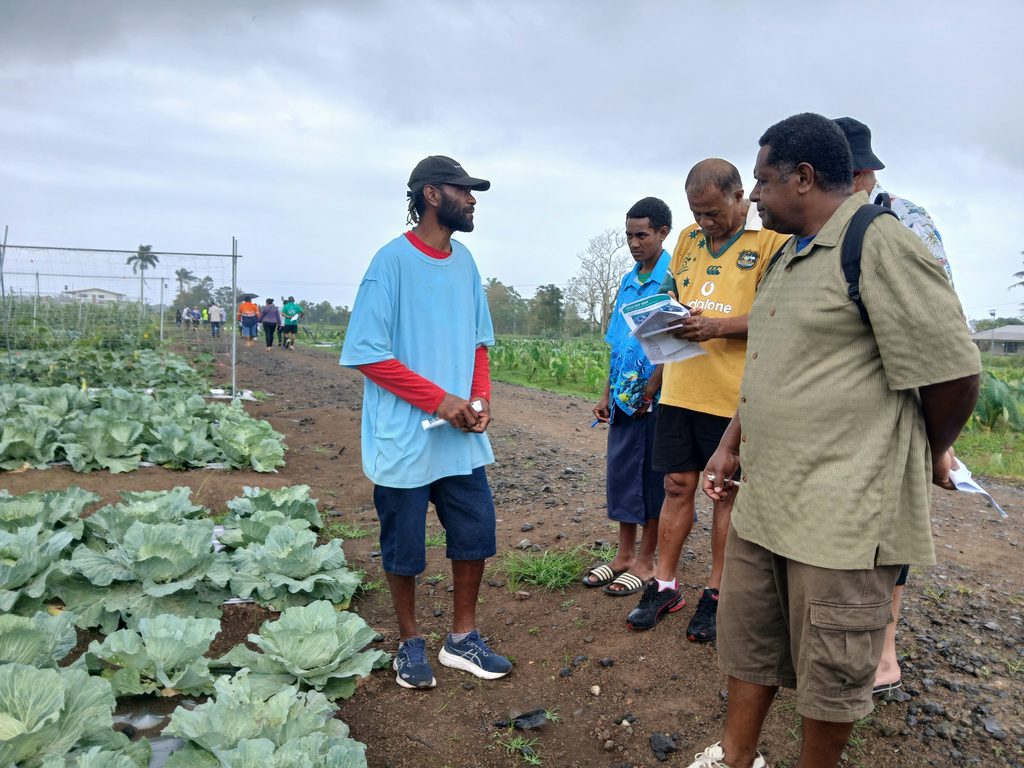
Training participants speak with farm labourers at the CATT research farm outside Nausori. Picture: TIMOCI VULA