
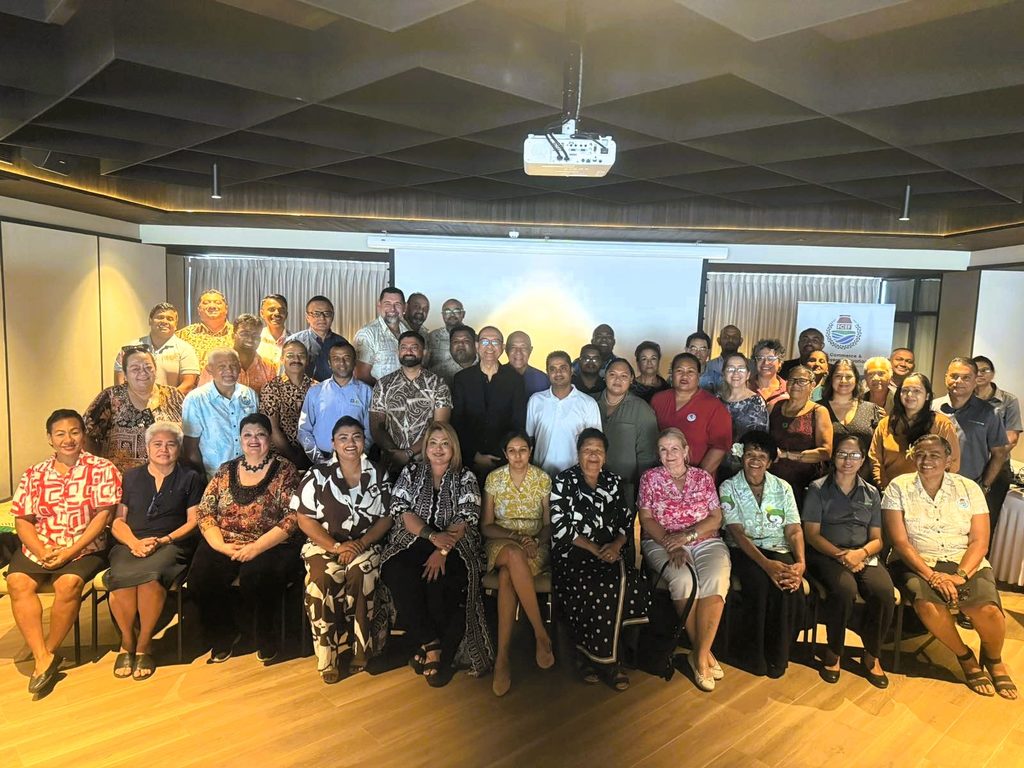
THE Fiji Commerce & Employers Federation (FCEF) convened its combined council meeting last Friday, bringing together nearly 50 representatives from across its councils to review progress, discuss priorities, and reinforce the collective voice of Fiji’s private sector. The meeting featured updates from the FCEF president, chief executive officer, and council chairs representing the Employment Relations Advisory Board (ERAB), Wages Council, Mining & Quarry Council (MQC), Business Strategy Council (BSC), Fiji Business Disaster Resilience Council (FBDRC), Women Entrepreneurs & Business Council (WEBC) and the Micro, Small and Medium Enterprise (MSME) Council.
“Bringing all our councils together is an important opportunity to share key activities, achievements, and the challenges each council is facing,” FCEF president Eldon Eastgate said.
“Our council chairs came well prepared and used the time to provide important updates. They also took the opportunity to highlight the common challenges that exist across all councils, which was great to share and I know other council chairs also appreciated. This will encourage more collaboration across councils.”
FCEF provided an overview of key achievements over the past year and outlined priorities for the new financial year, including continued investment in strengthening the secretariat to enhance its capacity and capability to serve members and councils into the future.
Recent initiatives highlighted included the launch of the Members Hub, improvements to digital platforms and ongoing efforts to strengthen engagement with members and stakeholders.
“Happy to announce that there is confidence in the membership with FCEF. Our council and council chairs are working in one eco-system towards better outcomes, looking forward to working for our members in the next financial year,” FCEF chief executive officer Edward Bernard said.
Council updates reflected strong activity across legislative reform, workforce development, business resilience, women’s entrepreneurship, MSME growth, and sector-specific advocacy.
Across all sectors, skills shortages, ease of doing business, and the rising cost of doing business remain among the most significant challenges facing members and continue to shape FCEF’s advocacy agenda.
The Mining & Quarry Council highlighted the sector’s role in supporting economic diversification and resilience, noting that employment growth in mining during the COVID-19 pandemic demonstrated the potential of non-tourism sectors to sustain jobs and contribute to long-term national stability.
“The commerce component of mining operations, as a highly capital-intensive sector, has never been properly captured,” Lion One Ltd mine manager Sakiusa Waqanisau said
“As a result, the Mining & Quarry Council’s contribution to Fiji’s GDP growth is consistently recorded at less than two per cent.
“For example, Lion One Pte Ltd currently spends around $10million a month on its capital operations, this highlights the scale of investment required in this sector. “Fiji should consider greater investment in the development of the mining sector, which has demonstrated resilience during health, natural disaster, and external shocks.
“Pre-COVID, Lion One employed 58 staff, and post-COVID this increased to over 300 employees.
“While many sectors slowed or came to a halt, Lion One continued to expand its workforce to meet operational and human resource needs,” Mr Waqanisau added.
The Business Strategy Council also raised questions around the effectiveness of the current excise tax on sugar in achieving intended public health outcomes, emphasising the importance of transparency around the use of revenues collected and whether the policy is delivering measurable health benefits while balancing impacts on businesses and consumers.
“We understand the excise tax was introduced with a specific purpose; however, there is a need to clearly demonstrate the impact of the funds collected to date. If the intent is to address public health challenges such as NCDs, then there must be greater transparency and clarity on outcomes,” BSC Council chair Viraaj Lad said.
“It is important to see whether these funds are being directed into preventative measures such as education, where meaningful long-term change begins. For example – the Food and School Canteen policy – is this still being monitored? What has been the result of this measure so far.”
The Fiji Business Disaster Resilience Council continued its work strengthening private sector engagement in national resilience planning, while the Women Entrepreneurs & Business Council and MSME Council highlighted ongoing efforts to improve access to finance, build capability, and expand opportunities for entrepreneurs and small businesses across Fiji.
Other challenges raised during the Q&A session included clarity around the five per cent tourism tax and in corporate cloud-based applications for VAT Monitoring Systems (VMS),
FCEF acknowledged the commitment of all council members and encouraged business leaders and professionals to consider joining its councils to contribute to policy dialogue, advocacy, and private sector leadership.
Across all sectors, skills shortages, ease of doing business and the rising cost of doing business remain important issues. Picture: FCEF/SUPPLIED

