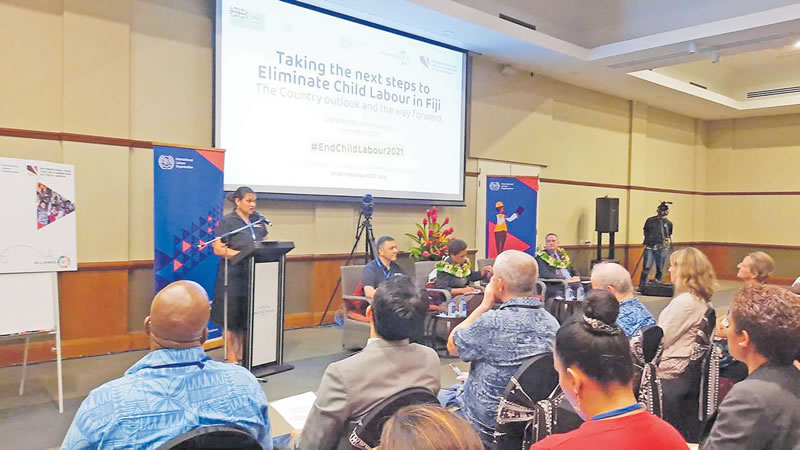
The Fiji Commerce & Employers Federation (FCEF), as Fiji’s national private sector organisation made an announcement on March 29, 2021 at an ILO meeting, where the theme was, “Taking the next steps to eliminate child labour in Fiji: The country outlook and the way forward”.
A key objective of this meeting was the “Pledge on 2021 UN International Year on the Elimination of Child Labour (IYEC)” to mark the International Year on the Elimination of Child Labour.
The pledge by FCEF as a tripartite constituent was, “Improved responsible business conducts to eliminate child labour in Fiji’s business practices”.
The United Nations General Assembly unanimously adopted a resolution declaring 2021 as the International Year for the Elimination of Child Labour, and the recognised lead UN Agency the International Labour Organisation will be leading the implementation of this commitment.
The commitments from member states, including FCEF at the national level was “to take immediate and effective measures to eradicate forced labour, end modern slavery and human trafficking and secure the prohibition and elimination of the worst forms of child labour, including recruitment and use of child soldiers.
That, by 2025, end child labour in all its forms” was the private sector’s commitment in contributing to this global call to turn commitment to action.
FCEF’s pledge is based on the evidence which clearly showed that child labour, forced labour and human trafficking in global supply chain can be traced to the interplay of three critical dimensions; a) gaps in statutory legislation, enforcement and access to justice that create space for non-compliance; b) socio-economic pressures facing individuals and workers; and c) business conduct and overall business environment.
It is important that more knowledgebased learnings, awareness and action on the part of businesses continues which will result in compliance and respecting the prohibition of child labour, forced labour and human trafficking during all phases of the business cycle.
Another significant opportunity that FCEF is pursuing is to advocate this message with the informal sector.
This is the sector that needs co-ordination efforts at community and national levels to strengthen monitoring, reporting, compliance and discuss further on how to curb the issue of child labour.
In some publications, the engagement of child labour is because of poverty, education and lack of other options. Few children work voluntarily.
This problem could further worsen during the COVID-19 pandemic in some of these developing nations.
Employers and business organisations can play a role in the global fight against child labour.
Employers can take responsible action to remove child labour from their workplaces, by refusing to hire children that fall below the statutory age requirements, and reduce the risk of hazards for adolescent workers.
The business communities play an important role to eliminate child labour through assessing their supply chains to ensure that children are not employed to manufacture goods that they purchase.
It is everyone’s business and requires the commitment of governments, workers and employers.
Key sectors that are exposed to such practices include agriculture, fishing, manufacturing, mining, services and construction.
The specific target (8.7) of the SGD Goal No.8 on decent work and economic growth calls for immediate measures to eradicate forced labour, end modern slavery and human trafficking and secure the prohibition and elimination of the worst forms of child labour, and by 2025, end all forms of child labour.
Through the support of ILO in 2013, FCEF developed an Employers Guide for Eliminating Child Labour.
The guide considers child labour from the perspective of employers and their organisation, while keeping the welfare of children and their families at the centre of the analysis.
The guide also offers practical ideas and advise drawing on the experiences of staff at a number of national employers’ organisation that have worked with the ILO over the past several years on child labour projects.
In June 2015, FCEF conducted an awareness raising session with part of its leadership group through the Tourism and Transport Council, where resource materials were provided for discussions on Commercial Sexual and Exploitation of Children and Safe Work for young people.
In 2016, FCEF implemented a mini-program conducting workplace-based training on the Child Labour Laws and the Safety of Young workers with members and focusing closely on retailers in the major centers in Fiji.
Employers were informed of the child labour laws through workplace-based training and encouraged to align their organisational policies to national legislations that govern the employment of children.
Training was conducted around the country targeting retailers and manufactures.
This year FCEF in collaboration with ILO will mark the Year of Eliminating Child Labour (IYEC).
Various seminars will be held at FCEF targeting key members and organization to create awareness, build knowledge and information sharing on the subject of child labour.