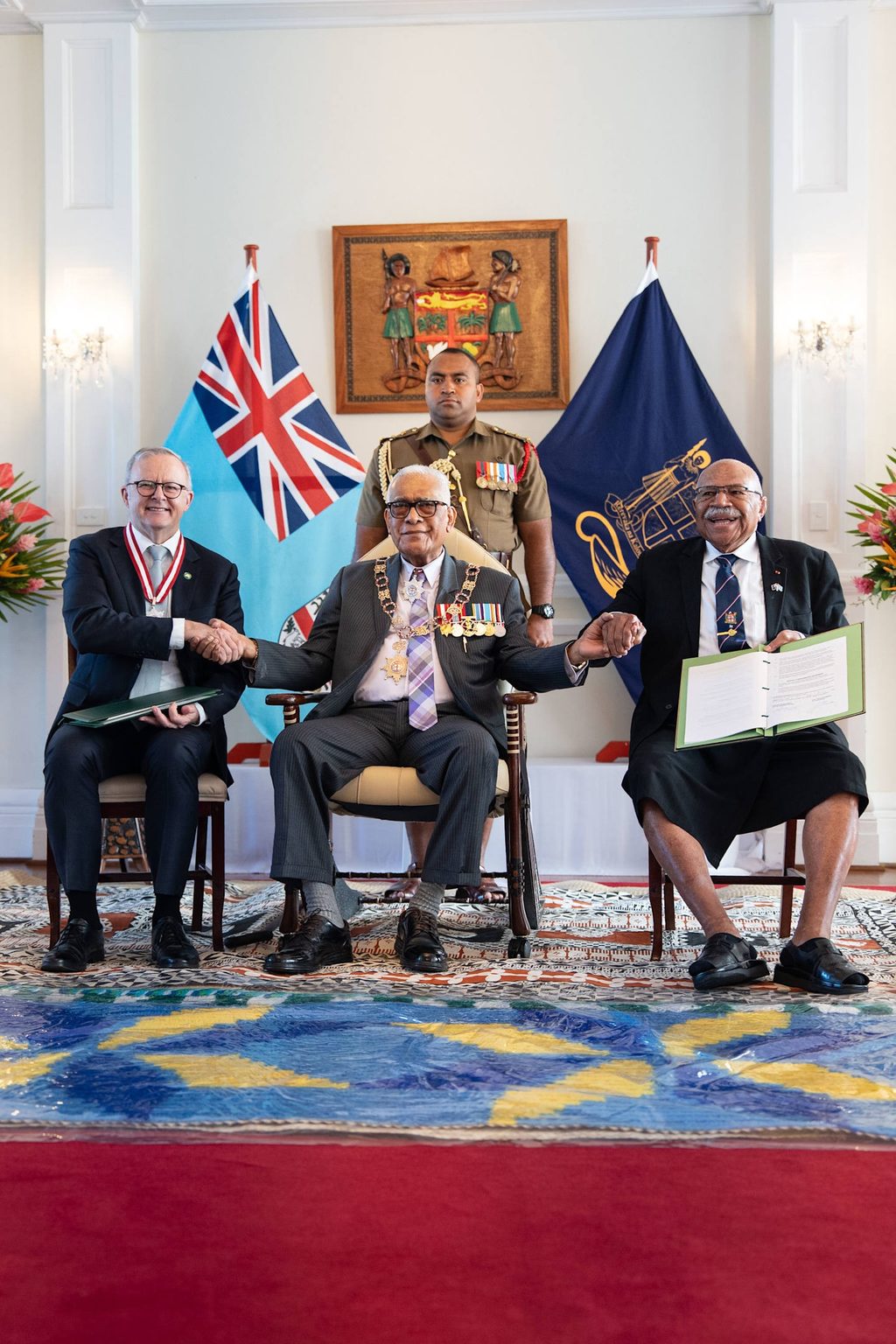
When Fiji signed the Ocean of Peace Alliance with Australia last month, it crossed a historic threshold. For the first time since independence, Fiji entered a formal mutual defence treaty which commits both nations to come to each other’s aid in times of greatest need.
It is, by any measure, a landmark agreement. The treaty elevates the Vuvale relationship beyond development assistance and military cooperation into something far more consequential: a reciprocal security commitment. Australia describes it as one of its formal alliances, while Fiji presents it as a partnership built on shared sovereignty and regional stability. The language is reassuring, the symbolism powerful. But behind the ceremony lies a serious question that deserves public discussion.
If Australia were attacked tomorrow, what exactly could Fiji contribute?
This is not a question of loyalty. It is a question of capability.
The meaning of “come to our aid”
Mutual defence treaties carry enormous political weight because they imply reciprocal obligations. The Australia–Fiji agreement states that both countries will come to one another’s assistance during their “times of greatest need”, reflecting the collective defence principle found in many military alliances around the world.
Yet reciprocity between unequal partners has always been complicated.
Australia possesses one of the Indo-Pacific’s most capable militaries: blue-water naval vessels, fighter aircraft, submarines, cyber capabilities and sophisticated intelligence networks. Its defence budget runs into tens of billions of dollars annually. Fiji’s Republic of Fiji Military Forces (RFMF), by contrast, has traditionally been structured around territorial security, peacekeeping and humanitarian response rather than conventional warfare.
The imbalance is obvious. An attack on Fiji would likely see Australia providing ships, aircraft, logistics, surveillance and intelligence almost immediately. But if Australia faced a comparable threat, Fiji cannot realistically offer equivalent military power.
That does not make the treaty meaningless. It simply raises the question of what reciprocity actually looks like.
Equality in law, inequality in practice
International treaties often treat states as juridically equal regardless of their size. A country of one million people signs alongside a nation of 27 million with equal sovereign status. Legally, that principle is important.
Operationally, however, equality becomes more nuanced.
Consider the hypothetical scenario that has lingered quietly since the treaty was announced. Australia comes under military attack. Its northern approaches are contested. Maritime supply routes require protection. Would Fiji dispatch troops? Patrol vessels? Engineers? Medical teams? Intelligence officers? Or would its contribution be largely symbolic — a political declaration of support alongside specialised assistance where possible?
The treaty does not erase the reality that Fiji’s armed forces were never designed to fight Australia’s wars.
Perhaps they were never intended to.
Beyond guns and warships
There is another way of viewing security altogether.
For decades, Fiji has earned international respect not because of overwhelming military strength, but because of disciplined peacekeepers. From the Middle East to Africa, Fijian soldiers have built a reputation for professionalism under United Nations mandates. Disaster response has become another defining strength, with the RFMF regularly deployed during cyclones, floods and regional emergencies.
Modern security is increasingly multidimensional. Cybersecurity, humanitarian assistance, maritime surveillance, illegal fishing, disaster logistics and infrastructure resilience are now as strategically important as tanks and missiles. Australia’s engagement with Pacific countries has increasingly focused on these areas rather than preparing island states for conventional interstate warfare.
If that is the true intention of the alliance, then public expectations should reflect it.
Because when ordinary citizens hear the phrase “mutual defence”, many understandably imagine soldiers defending each other’s territory in battle. The practical reality may be far broader — and far less dramatic.
The strategic dilemma for Fiji
The treaty also arrives during a period of intensifying geopolitical competition.
Australia has been strengthening defence partnerships across the Pacific, including agreements with Papua New Guinea, Vanuatu and now Fiji, as strategic rivalry between major powers becomes increasingly pronounced.
Prime Minister Sitiveni Rabuka has consistently argued that Fiji’s foreign policy remains one of friendship with all and enemies with none. The Ocean of Peace concept itself seeks to place Pacific priorities — not great-power rivalry — at the centre of regional security.
That aspiration is admirable. But bilateral defence alliances inevitably create perceptions. Whether intended or not, they are interpreted by larger powers as strategic alignment.
For Fiji, the challenge is maintaining strategic autonomy while benefiting from closer security cooperation. The stronger the alliance becomes, the more important it is for Suva to clearly articulate where its obligations begin and where they end.
Questions Parliament should ask
None of this is an argument against the treaty.
Australia has long been Fiji’s closest security partner. The two countries cooperate extensively on maritime surveillance, military training, humanitarian response and peacekeeping. Formalising that relationship may well enhance regional stability and improve Fiji’s own preparedness for natural disasters and emerging security threats.
But democratic oversight requires asking difficult questions before a crisis, not during one.
Among them:
What constitutes an “attack” that triggers mutual assistance?
Is military deployment automatic, or does each Parliament retain discretion?
What forms of assistance satisfy Fiji’s obligations — combat forces, logistics, intelligence or humanitarian support?
Would Fiji be expected to contribute beyond the Pacific if Australia were involved in a wider regional conflict?
How will the treaty protect Fiji’s longstanding commitment to an independent foreign policy?
These are not hostile questions. They are responsible ones.
A partnership that needs clarity
Perhaps the greatest strength of the Ocean of Peace Alliance is not its promise of military intervention but its promise of solidarity. Alliances often deter conflict precisely because they signal political unity rather than an eagerness for war.
Still, clarity matters.
Fiji’s people deserve to understand what has been signed in their name. Reciprocal defence sounds straightforward until one considers the enormous difference in capability between the two partners. Australia can project power across oceans. Fiji cannot — and has never claimed otherwise.
The real value of this alliance may ultimately lie in recognising that nations do not contribute equally; they contribute differently. Australia’s strength may be naval and aerial power. Fiji’s may be peacekeeping, regional legitimacy, humanitarian response and strategic geography.
If that is the vision, then it should be stated plainly. Because an alliance built on mutual respect will always be stronger than one built on misunderstood expectations.
-The following sources were consulted for the above commentary and analysis: Government of Fiji and Government of Australia, Ocean of Peace Alliance (Veitacini Mutual Defence Treaty), 2026; Australian Department of Defence, Australia and Fiji sign historic Vuvale Union and Ocean of Peace Alliance, July 6, 2026; Reuters, Australia signs major defence alliance with Fiji, seeking to counter China, July 6, 2026; ABC News, Prime Minister Anthony Albanese signs Ocean of Peace Alliance with Fiji, July 6, 2026; Pacific Islands Forum Secretariat, Ocean of Peace Declaration, 2025; Australian Government, Department of Defence, National Defence Strategy 2024; Reuters, China missile test deepens Pacific divide over growing militarisation, August 11, 2026.