
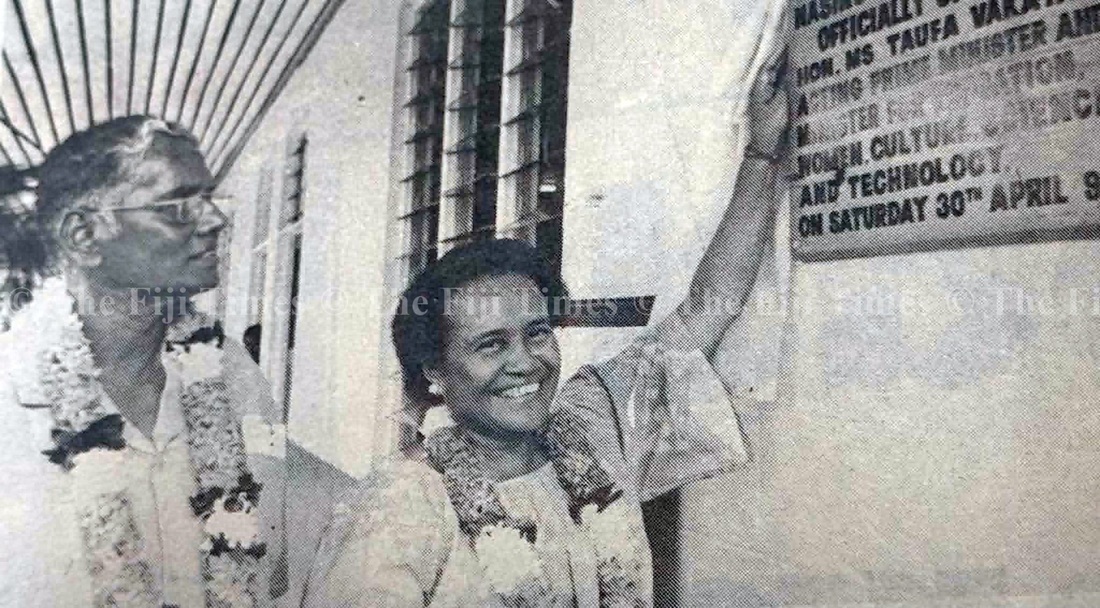
Good primary education is important because it lays a firm foundation for human development, Acting Prime Minister and Education Minister Taufa Vakatale said in 1994.
According to an article published by this newspaper on May 2 that year, Ms Vakatale spoke at the opening of Nasinu Sangam Primary School in Narere, where she said people must recognise that children and their education were key to building a better future.
“Economists generally agree that primary education offers the highest returns in terms of benefit to individuals and the nation,” she said.
“It is comparatively cheaper to provide and makes a far greater impact in reducing inequality and poverty.”
Ms Vakatale said primary education provided the basis for children’s learning skills and general education.
“It also lays the groundwork for students who will proceed to secondary and then tertiary education.”
The school run by the TISI Sangam Education Board – and managed by its Nasinu branch – had an enrolment of 281 children and six teachers.
TISI Sangam national president Yengtesh Permal Reddy said it was the first primary school the organisation opened in the Southern Division.
“Sangam has, over the years, built many schools. However, these were mainly in rural areas and smaller towns where the need was greater until the urban drift,” Mr Reddy said.
“With the growing population and the movement of people into urban areas, we found it necessary to extend our services to cater for the working class settling in the suburban areas of the capital city.”
Mr Reddy said there was also a need for a Sangam school in the Southern Division where children could be taught their mother tongues, particularly Tamil and Telugu, which were not offered by other primary schools in the area.
Ms Vakatale thanked the board for its initiative and hard work in building the school in the rapidly growing Narere settlement.
“The establishment of the school has benefited 281 children who otherwise would have had to travel further from their homes to gain admission,” she said.
She also commended the Sangam for its multiracial policy.
“This is very good for the nation as we continually strive for the integration of our people.”
Ms Vakatale praised the Sangam Education Board’s decision to teach the Fijian language in all its schools, describing it as a positive and farsighted policy.
She said the ministry encouraged the teaching of vernacular languages, including Tamil and Telugu, in Sangam-controlled schools.
The minister added the ministry had introduced a program of conversational Fijian in predominantly Indian schools, and conversational Hindi in predominantly Fijian schools, to promote greater cultural understanding between Fiji’s two major ethnic communities.

