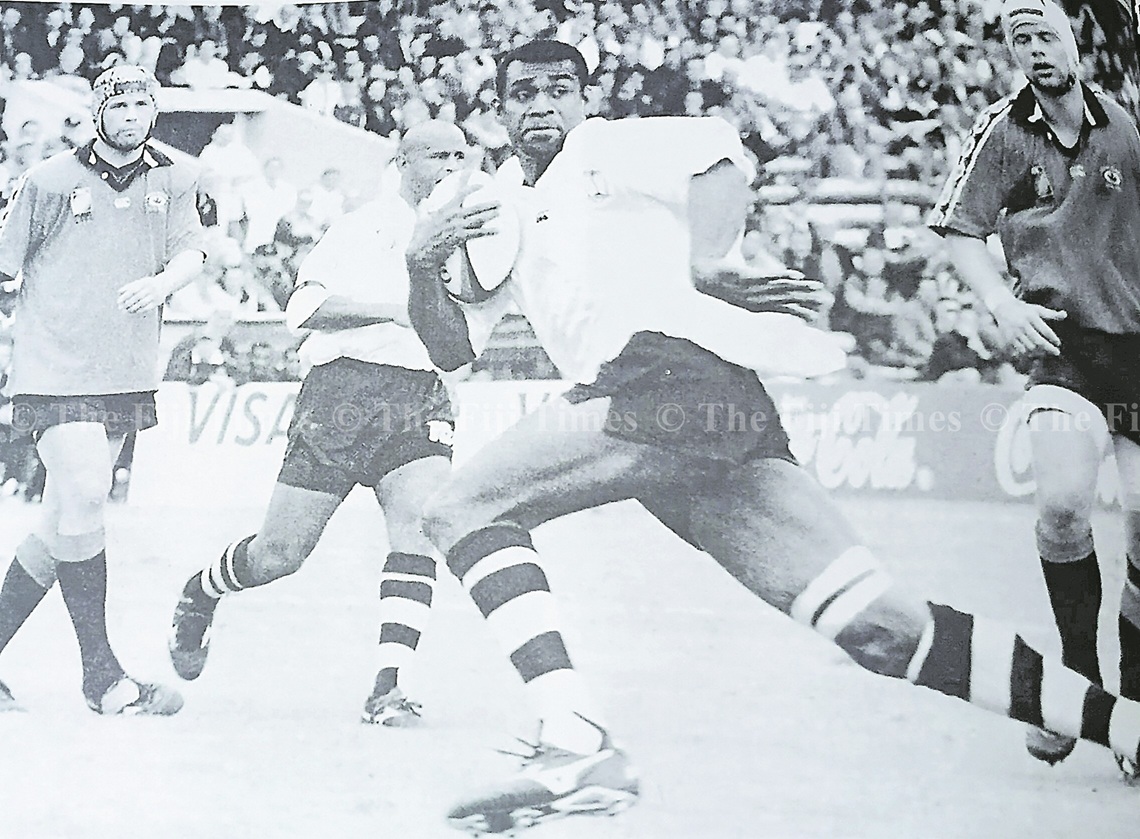
Viliame Satala, known as “The Stretcher” for his uncanny ability to flatten opponents on the rugby field, has become one of Fiji’s most celebrated athletes.
The Fiji Times shared his story on Sunday, October 17, 1999, detailing his rise from a shy village boy to an internationally sought-after centre.
The Namoli native first drew attention when Fiji played in Italy in August, and later when they thrashed Namibia in their opening Rugby World Cup match.
French clubs quickly recognised his talent for backline play.
The six-foot-two centre possessed all the attributes of a perfect centre three-quarter.
“I am tall, a great ball handler, and injury-free,” Satala said.
The French clubs began showing interest while Fiji was based at Banyuls in preparation for the Namibia match.
Their approach was secretive, “cloak-and-dagger stuff right from the pages of a thriller novel,” Satala recalled.
Club officials met him discreetly, and only two people knew the signing took place in a backstreet, inside a parked car.
“Nobody else knew except my close friend Api Naevo,” Satala shared.
“Even the Fiji team members don’t know I have signed.”
Satala’s athleticism began early.
“I played soccer and basketball in primary school and at Tilak High.
“Every afternoon when the Namoli boys played touch rugby, I would be playing soccer with the Indo-Fijian boys.
“I feared getting hurt in rugby from the physical contact, and the other thing was I hated training.”
His first taste of competitive rugby came when former Fiji winger Samu Yalayala formed a Lomavata team for the Batiri Sevens.
Satala joined as a reserve due to a shortage in the Namoli team.
“We played together in 1988 and lost all our matches – but the same set came back in 1989 and started winning.
“Then in 1990, we played the final against Nabua, the champions who had Small (Serevi).
“We lost, but from 1993, we started winning the Batiri Sevens, and I think we won it three or four times.
“Then we won all other tournaments.”
The Namoli team had since split, with players in Australia, Japan, and the US.
“Diri Yalayala is in Japan, Levi Tamaivena is in America, Naulivou plays for Randwick, Mala Yasa is playing rugby league in Sydney.”
Before making his mark in rugby, Satala said his Namoli mates often made fun of him.
“Now I make fun of them because they are still playing club rugby and I am playing for Fiji and touring the world.”
Satala credited his skills to self-teaching, studying videotapes, and imitating greats.
“I watched a lot of videotapes, and I imitated the sidestep of Noa Nadruku and Waisele Serevi.
“I copied Noa’s sidestep and his tackle, Serevi’s goose-step, and I like Sitiveni Matalutu’s ruggedness. I also applied it to my game.”
He first represented Fiji in Hong Kong in 1994, coached by Aliposo Waqaliti and managed by Savenca Draunidalo.
“There were six of us who were going for the first time. It was myself, Bari, Bolobolo, Jo Savou, Vidiri and Nawavo.
“The only old hands in the team were Serevi, Vonolagi, and Naruma.”
Satala’s avoidance of training kept him out of top-level play until 1997, when he joined the Dubai Sevens. In 1998, he toured France and Jerusalem and was selected for 15s during the UK tour before joining the Waikato Chiefs in 1999.
“I scored two tries, and from that point on, I was the first-choice centre.”
Satala and Fero Lasagavibau were also in Coach Brad Johnstone’s good books for 7s rugby in Hong Kong.
“He told us the door was always open to us.”
Former All Black Mark Donaldson accompanied Fiji on the UK tour.
“When Gary Cunningham came this year, he told me to look at the skills I have. When he saw me play, he was impressed.”
Off the field, Satala comes from a hardworking family in Lautoka, with a cane farm and taxis.
“We work hard on our farm. Even when we come back from touring overseas, we are taken by my dad to the cane field to cut cane or plough.”
Satala’s cousin Apolosi belongs to a cane-cutting gang with other family members.
“When we left Nadi, the whole gang turned up to farewell me at the airport. They said the cane truck lay empty in the fields because they decided to take a day off to farewell me.”
Many advised Satala to play as a loose forward for Fiji 15s.
“But I had set my eyes on the centre. I said once I got the spot, nobody was going to take it away from me.”
He credited the biggest influence on his career to his late grandfather, The Taukei Vidilo, Ratu Maleli Naulivou.
“He watched all our games with Apolosi. If we played in Suva, he waited for us to come back no matter what hour of the night.”
Satala became the first Namoli villager to represent Fiji in both 7s and 15s.
Just as French clubs once sought him out, The Fiji Times successfully secured an interview with the elusive Viliame Satala, providing fans a rare glimpse into the life of one of Fiji rugby’s finest.