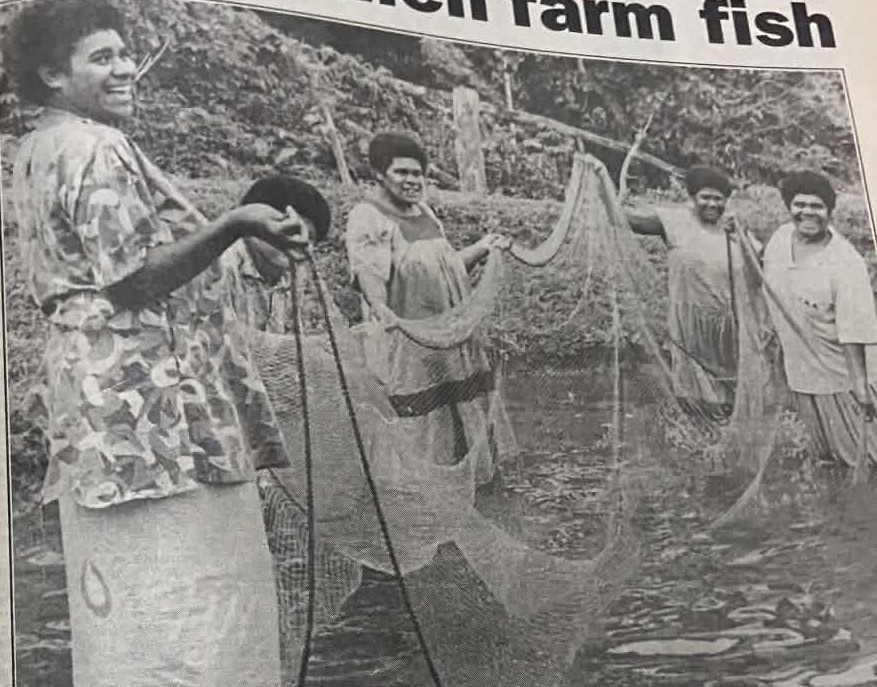
ON August 6, 1997, The Fiji Times carried a story about the women of Holy Cross at Navilawa Village, and their involvement in fish farming — an initiative that gave the women an opportunity to earn an income while also providing food for their families.
At the centre of the project was Peace Corps volunteer Sally Asikition, who was working with the women to develop fish farming as a small business.
“Our aim is to get women involved in business and make them more self-sufficient,” she said.
The Navilawa Village Women’s Club had established a fishpond and was running it on a cooperative basis.
“It is fantastic. It is around the year and there is very little maintenance involved. All we have available is the pond plus the feed.”
The women were enthusiastic about the project, but perhaps the most significant part of the initiative was the difference it was making inside their homes.
One woman told Miss Asikition she had started putting money into the bank and could now purchase things for her family without having to ask her husband.
The story also highlighted an important reality about the work behind the project.
“The men would put a few fish in the pond, but the women actually do the work.”
For the women, the pond was therefore not simply about producing fish. It was about having something of their own they could manage, develop and benefit from.
Miss Asikition believed Navilawa could become a model for other women’s clubs around Fiji and hoped to assist women in other villages to establish similar projects.
The newspaper also shared a rather unexpected story from Navunisua, where the women initially showed little interest when a fishpond was constructed.
But that changed one day when the men decided to drain the pond and eat all the fish.
“The women were so upset that they decided to take over the pond and run it themselves.”
From that point, the women took responsibility for the pond, raising and selling the fish and using the income to purchase things for their families.
Miss Asikition believed women were particularly successful because they were able to dedicate time to caring for the fish.
“Women usually have more time to make those feeding trips to the pond and we see that women are very dedicated and have more success.”
The benefits extended beyond food.
“Having their own fish means they save money for other things and if they sell some of the fish, they can make $3.50 a kilogram and contribute that to the family coffers.”
The project was also teaching valuable skills that could be passed on to the next generation.
“Furthermore, it teaches the owners good husbandry skills and acts as a model for children and young people to know there are things they can do in the village to raise money.”
The idea was not limited to women’s groups.
At Nakoro College, fish farming was incorporated into the agricultural science curriculum. The school’s fishpond was designed to give students practical experience in growing fish — knowledge they could eventually take back to their own families and communities.
The pond was approximately 300 square metres, with the aim of producing fish using locally available food.
It was another example of how a simple agricultural project could become a learning opportunity for young people while also generating income for the school.