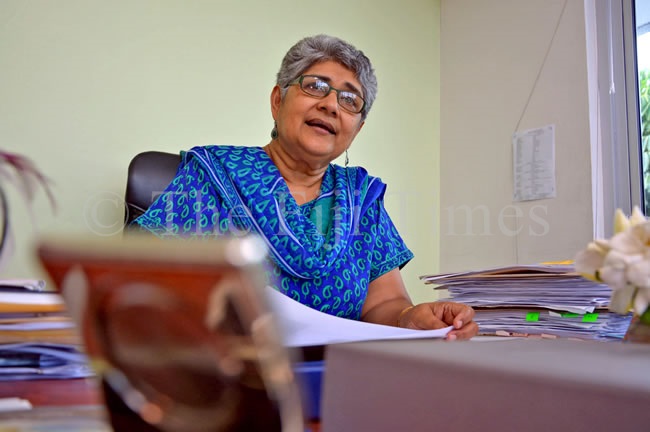
ShamimaAli is the co-ordinator of the Fiji Women’s Crisis Centre and has been so for the past 36 years.
She’s also the chairperson of the Pacific Women’s Network Against Violence Against Women and a founding member of the Fiji Women’s Rights Movement.
Shamima also served as a Human Rights Commissioner in Fiji from 2004 to 2006.
A feminist activist, Shamima is in her element working with women and community groups in Fiji and across the Pacific to raise awareness about gender inequality, violence against women and human rights.
Much of her work has been developing and conducting training with police and other service-providers in Fiji and the Pacific.
She has received recognition for her years of service in the Pacific region on behalf of women, which has included the US State Department’s inaugural Women of Courage Award in 2007, the Amnesty International Aotearoa New Zealand’s inaugural Human Rights Defender Award in 2009, being named a Paul Harris Fellow of the Rotary Foundation in 2009 and Pacific Person of the Year by Islands Business Magazine in 2011 for her work on the elimination of violence against women and human rights.
Named one of 100 influential persons of the last century in Fiji for the advancement of Women’s Rights (Twentieth Century Fiji – People Who Shaped this Nation ed Stewart Firth and Daryl Tarte).
What is your vision about Fiji?
A modern state built on democratic principles, human rights and the rule of law.
A country where everyone enjoys their full human rights, we live as equal human beings regardless of ethnicity, abilities, sexual orientation, religion and gender.
A multicultural Fiji where we celebrate our commonalities and respect our differences.
A country where there is no racial divisions, where there is not such a huge gap between the rich and the poor and where everybody has full access to the country’s resources.
We also acknowledge and appreciate our history and together forge our future.
What changes, if any, would you like to see as we progress as a nation?
At present, too many things have gone wrong.
As we progress, I would like to see a more democratic leadership in this country, a lot more bipartisanship – more inclusivity in terms of consultations and planning for the future.
I would definitely like to see a change in government and a new progressive leadership that embraces all the people and has respect for the people of this country and their contributions.
Also I would like to see a lot more of our own people, people from Fiji to hold leadership positions – that also ties in with respect for people’s contribution, education and experiences.
We have people who can move the country forward in a much better way then what we have at the moment.
We must demand the leadership of this country to embrace all these things.
We need more bipartisanship, including the CSOs, political parties, Opposition and the intelligentsia of the country, the farmers and rural dwellers – so people can take ownership of the country and they don’t feel disenfranchised.
Also, the deep racial divide that we are witnessing in recent years, I would like to see disappear and we live together as people of this united nation, with respect and dignity.
What do you think holds us together?
As a people, our past experiences – the sharing, caring, and the goodness of the people of this country, we can still come together.
At the moment we are living in a very fragile democracy, and a lot of things are not going right, our people, our spirits, celebrations – our experiences of suffering, have kept us together despite our sorry-state of democracy.
This year has been a challenging year for the country with the COVID-19 pandemic, people losing their jobs, increase in domestic violence cases as well as poverty rates in the country.
Moving forward what do you think are the biggest national lessons learnt here?
The biggest lesson learnt is that we need to plan a lot better.
During COVID-19, we did not plan well, mostly at the hands of the Government.
Going forward, we need to plan a lot better.
In these times it is so important to have bipartisanship using our own people, our own resources, human resources – we are so rich in terms of this and we did not make good use of it.
Another lesson learnt is that one person cannot run a country.
As the country prepares for the general election, what’s your message to voters?
Please choose carefully, we deserve the government that we choose.
We as the people of Fiji deserve a lot better.
All of us have a great opportunity here to exercise our right of choice.
Voters, demand what matters to you most.
When campaigning time comes, have your own manifesto – what matters to you most.
Talk to the politicians about this and we have the right to demand from our leaders.
We must demand to have a better life and to make our lives less difficult.
So exercise this choice wisely and carefully.
Do not get waylaid by all the goodies that will come your way as election approaches.
Think of the last 14 years and think what you have been through and what matters to you the most.
Use that right to vote wisely.
Any other comments?
Fiji’s Independence is very close to my heart, as it is to many of my generation and this day has been etched in our psyche.
I would really like to have the Fiji Day holiday back so that we can celebrate as a nation.
I wish everyone a great Fiji Day.