
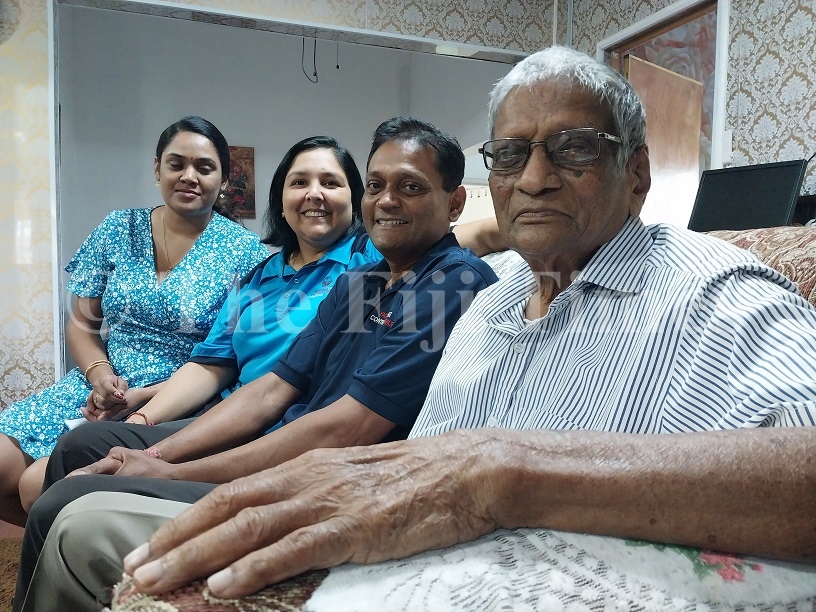
Amid a quiet neighbourhood in Samabula, an unassuming home sits, surrounded by a thick foliage that many would not give a second glance at.
Yet, it is this place that holds a lifetime of memories for nearly six generations of girmitiya descendants – living both in Fiji and abroad.
Family patriarch Rup Chand has lived a colourful life as the youngest of eight siblings and at 93 years of age, is now reflecting on his life and the struggles that his parents and grandparents had to endure just to create a lasting home in Fiji.
Mr Chand recalls the stories told to him by his paternal grandparents, Darshan Dass and Jayantri, both of whom were among the crop of indentured labourers who arrived in Fiji under the lure of a new and fulfilling life by their families when both were babies in their mother’s arms.
“They passed on when I was very young but they were born in India,” he says.
When he eventually traced his roots back to India, he discovered his grandparents were from Bihar, and he would later find out his wife’s family hailed from Basti, a district of Uttar Pradesh.
His grandmother’s family was taken to work on the farms of Taveuni, and his grandfather’s on Vanua Levu, before Darshan Dass moved to Samabula once the indentured period ended. And for well more than a century, this has been the Chand homestead.
Mr Chand says when he was a child, there were only a few houses in the area at the time, and his parents were heavily involved in cattle farming.
“Times were tough then. There was nothing here, everything was a jungle. My father also worked as a cook. We had a normal tin house.
“My father also used to be sickly. When I was eight years old, my father took me to Samabula Primary, which was a government school then and I only studied for two weeks because World War II broke out.
“The principal just told us not to come to school because there will be fighting and the Japanese are about to come.”
Navigating through the war that gripped the world was not easy, and Mr Chand says it was a time of great certainty where everyone feared for their lives.
Yet, they managed to make ends meet by catering to allied soldiers who bunked in camps nearby by washing their laundry – 15 cents to wash, dry and iron army uniforms — unimaginable in today’s world.
Gradually as the war ended after five years, Mr Chand turned 13 and resumed school from Class One.
“We were 12, 13-year-old children who were in class one, and we went up to class six but then we were told we were too old so I stopped.”
He later on started working at Morris Hedstrom, which owned a number of different businesses.
He started off in sales and worked his way up. At a certain point in time though, he decided he needed to stand on his own feet and invested in a lorry to open his own transport business.
This novel idea changed his life – and at a time when larger trucks to ferry goods were rare – his business blossomed from nothingness until such time when he secured permanent clients.
He decided to invest back into his family home and renovated in the memory of his late father.
The father of three says he has seen his fair share of hardships, which included financial difficulties and health issues, but he never let that waver him.
“I’ve lived so long that I’ve seen my grandchildren grow and have their own families. Now, I am just waiting to see what is in store for me next. It’s all in God’s hands.
“I am thankful that I live in Fiji. I love this country. I’ve been overseas and so many of my relatives tell me to move there permanently but I refuse. This is my home and I will stay here.”
He says his secret to longevity has been prayer, a good diet and spending time with his loved ones.
Even today, Mr Chand prefers to start his day with a prayer, before picking up a newspaper or book to read and enjoying meals of bhindi, karela, bhaji and roti.

