
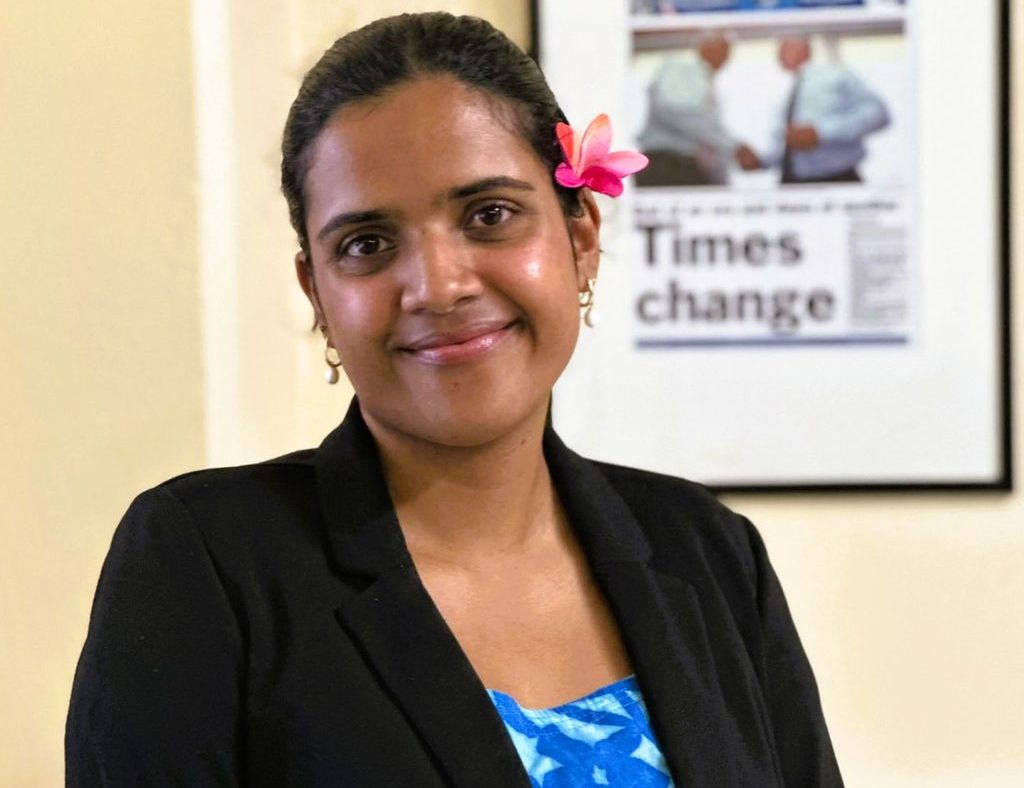
JANET Reddy still remembers one of the people who shaped the way she sees the world.
Growing up, the late Justice Jai Ram Reddy was more than a distinguished statesman, jurist and constitutional architect.
His granddaughter, embodied the values of service, unity and thoughtful leadership.
Among the many lessons he left behind were his passion for genuine national unity and finding common ground, ideals that remain etched in Janet’s mind.
Years later, those values continue to guide the young environmental scientist as she prepares to begin a fully funded PhD in Marine Science and Conservation at Duke University in the United States, following her graduation from Cornell University, where she became the first Fijian known to complete an undergraduate degree at the Ivy League institution.
Although the pursuit for knowledge has taken her from a small farm outside Lautoka to some of the world’s leading universities, Janet said her purpose has never changed.
It is about giving back to Fiji by protecting the oceans that have shaped both the country’s identity and its future.
Rooted in Fiji
Janet completed her primary education at Drasa Avenue Primary School before attending Natabua High School, where she excelled in the sciences.
Leaving Fiji after Year 12 to study in the United States was both exciting and daunting.
She enrolled in Cornell University’s Environment and Sustainability programme without knowing exactly where her journey would lead.
“I wasn’t completely sure what I wanted to specialise in,” she said.
Rather than choosing a single pathway, she designed her own interdisciplinary concentration in Marine Conservation and Management.
“I’ve always been interested in bringing together science, policy and community perspectives.
“I wanted to combine my science background with studies in policy and decision-making because it’s one thing to produce scientific knowledge, but it’s equally important that decision-makers understand that science and that scientists understand the realities of policy.”
She said researchers and policymakers often speak different technical languages.
“Good decisions require everyone to work from the same understanding.”
Inspired by legacy
While science has become her profession, public service has long been part of her family’s story.
She speaks warmly of her grandfather, Justice Jai Ram Reddy, whose speeches and commitment to national reconciliation continue to influence her thinking.
“Whenever I think about Fiji’s future, I often come back to that message,” she said.
“If I had to reduce Justice Jai Ram Reddy’s message to one word, it would be unity.”
For Janet, unity is not about ignoring differences but recognising that diversity strengthens a nation.
“We all have different histories, cultures and life experiences, but the important question is how those individual experiences contribute to a shared future.
“At the end of the day, we’re all Fijians.”
That philosophy was reinforced while representing Fiji and other Small Island Developing States as a United Nations Scotland Earth Ambassador.
Working alongside young leaders from around the world, she realised that diversity was not something that divided people but strengthened collective efforts towards a sustainable future.
Finding purpose overseas
Cornell challenged Janet academically and personally.
When she graduated earlier this year, she discovered she was believed to be the first Fiji-born student to graduate from the university.
“It filled me with immense pride, not simply as a personal achievement, but because of what it represented for Fiji and the Pacific.”
Initially searching for fellow Fijians and Pacific Islanders, she eventually realised that belonging extended beyond geography.
“My upbringing in Fiji gave me my foundation, while my experiences overseas broadened my perspective.
“Together, they have strengthened my commitment to serving both my country and the wider Pacific.”
Protecting what matters
Marine conservation soon became more than an academic interest.
Through research and fieldwork, Janet developed a fascination with coral reefs, coastal ecosystems and marine mammals.
Her doctoral research will focus on Fiji and the wider South Pacific, particularly humpback whales that migrate through Fijian waters each year.
“To my knowledge, no one is currently conducting dedicated research on the humpback whales that migrate through Fijian waters each year.
“We know they arrive during their migration, but beyond that, there is still so much we don’t understand.”
She hopes her work will strengthen marine conservation while informing policy and practical decision-making.
“I want my research to be practical and meaningful—something that can inform policy, support conservation efforts and help everyday decision-makers protect our ocean spaces.”
She is also determined to avoid what scientists describe as “parachute science”, where researchers collect data before leaving without creating lasting benefits for local communities.
“I don’t want my work to follow that model,” she said.
Instead, she believes research should begin by listening to communities and addressing the challenges they identify.
Small actions, big impact
Although climate change dominates international headlines, Janet believes meaningful environmental protection begins with personal responsibility.
“People often don’t realise that litter thrown on the roadside eventually finds its way into waterways, clogging drains and increasing the risk of flooding during the rainy season.”
She acknowledged it was easy to feel powerless, but insisted that individual actions still matter.
“But that’s where many people overlook the power of individual action.
“Every action counts.”
She pointed to the landmark International Court of Justice climate ruling, noting that what became a significant global legal decision began with just eight students at the University of the South Pacific wanting to make a difference.
For Janet, it demonstrated that lasting change often starts with ordinary people.
She also believes Fiji should have greater confidence in its own traditional knowledge.
“As a developing country, we often look overseas for solutions.
“Many of our traditional ways of living are inherently sustainable.”
Looking ahead
Next month, Janet begins another chapter at Duke University.
Only six students were admitted into this year’s doctoral programme, with Janet the youngest among them.
She credits her faith, parents, extended family and teachers at Natabua High School for helping her reach this point.
“They were there every step of the way,” she said.
Looking back, she hopes her own journey encourages other young Fijians to dream beyond what may seem possible.
“If I could offer one piece of advice, especially to young women, it would be never to take ‘no’ as the final answer.
“Life is full of rejection. You might hear ‘no’ 99 times, but all it takes is one ‘yes’ to change your life.”
When asked whether she ever imagined herself studying in the lecture halls and laboratories of some of America’s most prestigious universities, she smiled as she said “Never.”
Her humble beginnings from childhood on a small farm outside Lautoka to Cornell University and now Duke, exudes the values of perseverance, curiosity and purpose.
It is also a continuation of the legacy left by her grandfather, whose belief in unity, service and leaving the world better than you found it continues to inspire not only his granddaughter, but a new generation of young Fijians.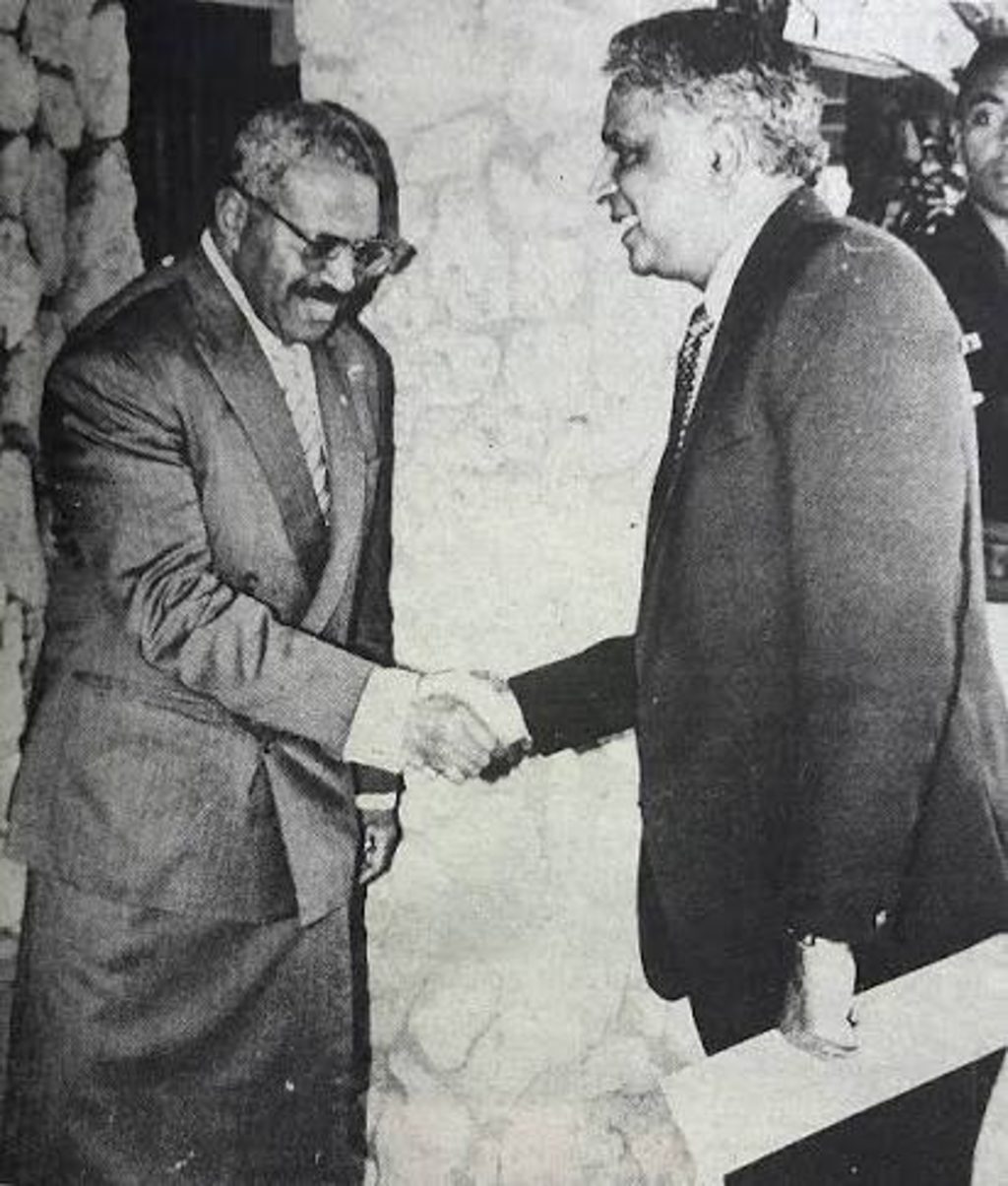
Janet’s grandfather, then Opposition leader Justice Jai Ram Reddy and Prime Minister Sitiveni Rabuka forged an unlikely political partnership that laid the foundation for Fiji’s widely acclaimed 1997 Constitution. Picture: FT FILE

