
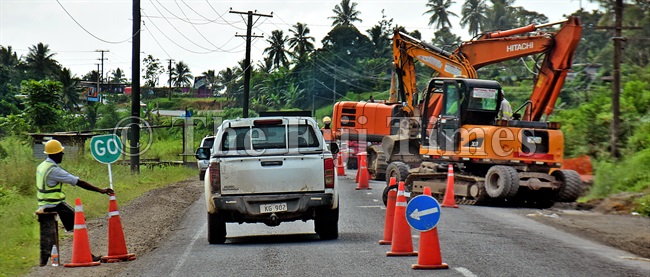
When I came to Fiji in 1961, I entered a world of unfamiliar initials — so many organisations were not known by their proper title but by initials — very confusing. I soon learnt that PWD stood for the Public Works Department. They seemed to be essential and very important and I soon realised why. They looked after the roads among other things.
Roads in Britain
I grew up in southern England during the Second World War.
There were not many vehicles on the roads and no crazy young men driving too fast. They were away fighting the war.
I never even thought about road maintenance. The roads were there and appeared to be everlasting!
All the roads in UK were sealed as far as I knew, until we moved to a village in North Devon where the next village had a little winding unmetalled road through beautiful countryside.
Fiji situation sixty years ago
I soon realised how different it is in Fiji.
My initial ride from Nausori Airport through to Suva was through beautiful countryside and, as far as I remember, on an unmetalled road for most of the way. It was very different from now.
There were only a few houses between Koronivia and Samabula.
So much has changed in the past sixty years.
At first, we were living in Nausori across the river from the town. My husband was an assistant to the district officer.
He would be sent out to the rural areas and when I was allowed, I went with him, exploring the countryside of my new home.
At one stage some farmers asked for a road to take their produce to market, so my husband, who had done the one-year “Devonshire” course in UK, that equipped young graduates to be district officers in the colonies, planned, designed and oversaw the work as the farmers bulldozed their little feeder road.
Years later it was completely re-designed by the PWD!
At that time Fiji had a good export trade in bananas, and they were transported by raft, bilibili and boat, using the Rewa River and its tributaries. Why don’t we use the rivers now?
Not so much maintenance needed!
After a few months we were moved to Sigatoka.
The road from Suva was a long unmetalled road needing constant grading.
I soon became used to the graders and their competent crews who would smooth out this and all the other roads, and driving would be easier for a short while.
To hear that graders and competent operators are in short supply is a great sadness and obviously a mistake as many rural roads in Fiji still need regular grading.
Many areas still need roads as they are a long way from the advantages that we in the urban areas enjoy. We in the urban areas should think of the situation of others before endlessly complaining of the potholes.
My husband, with his one year training in colonial district officer work was convinced that the problem with our roads is that the base course metal (the big chunky stuff) is not laid properly, but I tend to think that no one has yet discovered a way to build permanent roading in tropical climates like ours.
The heavy rain enjoys penetrating through the weak spots in the metalled and tarred surface and gouging out those infamous potholes.
I remember years ago, a prominent politician being accused of “driving while under the influence” when, as he declared, he was only trying to avoid the potholes!
Hazards of the old Queens Rd
I was just beginning my first pregnancy when we moved to Sigatoka.
This was no problem because the famous Dr Hands was there to watch over my health.
However we would go through to Suva once every six weeks or so and the baby in the womb got used to the hazards of rough road travel and grew up to be the most Fijian of our two European boys.
Maybe those early rides had an influence?! But the stories were that, the slow ride up the hills for lorries laden with goods from overseas, imported through the Port of Suva, were frequently raided as they slowly ground their way up through the Serua hills, the local village boys jumping on the back and throwing off boxes to their waiting companions.
When the time for the birth of our child drew near, I was despatched to stay with a friend in Suva, to be sure there were no problems! I was sad because I thought I would give birth without my husband, but the baby knew what to do. He arrived on a Sunday when my husband had joined me for the weekend. He was safely carried back to Sigatoka a week later.
The rebuilding of the Queens Rd
Since the sixties the Queens Rd underwent a complete rebuild that took some years. My husband was by then working in the ministry of communications and works.
So I was able to accompany him sometimes on tours of inspection, and we became very happy and proud of the development taking place in Fiji.
Meanwhile roads that were already metalled in Suva and surrounding areas including Nausori-Suva, were constantly under repair and the great piles of gravel at the PWD depot along the Nausori road were in constant use.
More cars were added and it became common for potholes to form. The PWD became the butt of many jokes.
Increasing traffic and the more recent changes
With the huge increase in the number of vehicles in the last ten years, because someone (not to mention his name) wanted everyone to be able to own a vehicle, the situation has become far, far worse. Also long trailer lorries fully loaded with goods seem too heavy for our roads and certainly contribute to the rapid deterioration of the road surfaces.
Potholes form so frequently and become so huge, and the PWD has no longer been available, so we have lost the art of laughing at our misfortunes.
We have got used to foreign contractors working on our roads with seemingly endless very modern machinery.
Because I walk as much as I can, I notice that when roads are re-sealed or repaired there is a large amount of excess gravel of medium to small sizes left at the sides of the road, making it inconvenient for walking when no thought had been given to providing for pedestrians.
What a waste of good materials! And do not forget the damage that gravel extraction does to some of our rivers and streams.
Better road designs possible?
As I said, it has seemed to me that the design of our roads and the materials we use are not suitable for the hot, wet climate of Fiji.
Can the engineers and inventors with their skills come up with something better? Years ago, when on holiday in UK, I was taken across the English Channel to France for a day’s outing.
We travelled by hovercraft that apparently skimmed over the waters. Why not hovercraft to travel on our roads?
Don’t they work in the same manner as the drones that are new toys for some people and dangerous weapons of war in Ukraine and elsewhere.
In the meantime, I am glad to see our own people employed and the Government taking responsibility with the PWD again in action to mend our roads.
PWD more than just roads
This article has concentrated about our roads, but the PWD did much more.
We lived in government quarters from 1960 until 1984 while the British government, who for fourteen years after Fiji gained Independence, had so generously continued his employment as an overseas civil servant, finally untied the strings. We were no longer entitled to free housing in government quarters.
My husband took a local contract and bought our current house in Suva, on the edge of the Domain, the area we have lived in since 1964.
During those 24 years, the PWD came every three years to do thorough maintenance.
We grew used to the inconvenience and respected those wonderful workers, as we cleared our rooms at their command for them to do repairs and repaint!
Once the PWD was gone, it seems the maintenance ceased.
Government quarters deteriorated because of needless neglect.
Other government buildings like hospitals and schools evidently suffered the same.
Conclusion
It is comforting to know that our Government has now taken steps to restore this invaluable department, now a ministry.
It is a useful employer giving work to many who can become skilled in many ways.
I expect to see women employed, which did not seem to be the case in the past.
I would love to see a woman managing a grader on a rural unmetalled road.
Welcome back the Public Works. It is good to know that our country is safe on the road into the future.

