
IN a world still arguing over targets and timelines, Pacific voices are asking a far more urgent question: who pays for a crisis they did not create and how long must they wait?
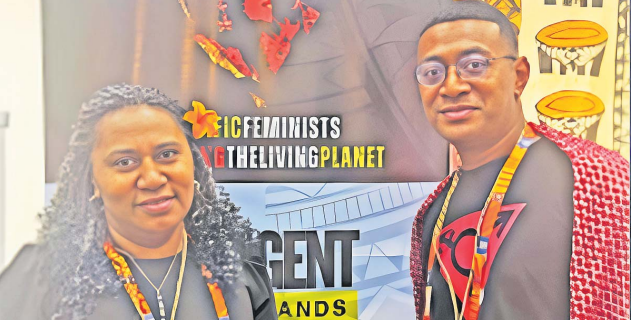
At the Women Deliver Conference 2026 in Melbourne, Ilaisa Kauyaca is not mincing his words.
As a project officer with the DEEP Ecology Network and campaign officer for Pacific Feminists Defending the Living Planet, he is part of a growing movement demanding that climate justice be grounded in truth, accountability, and lived realities.
For Mr Kauyaca, the science is already settled. What remains unsettled is the political will.
“We are clear,” he said.
“We have already crossed seven of the nine planetary boundaries.”
A crisis not of their making
Mr Kauyaca points to global scientific assessments particularly from the Intergovernmental Panel on Climate Change (IPCC) to underscore the scale of the crisis.
“Carbon emissions right now are higher than anything we’ve ever experienced.
“And that is the biggest threat.”
Yet the injustice lies in who is suffering the most.
“In the Pacific, we contribute so little to global emissions.
“But we experience the worst impacts.”
Those impacts are not abstract. They are immediate and devastating – cyclones, prolonged droughts, rising seas, and displacement.
“It affects how we live, how we move.
“And it disproportionately impacts women, young girls, and gender-diverse people.”
For Pacific communities, climate change is not a future scenario – it is a daily reality.
Holding governments to their word
For Mr Kauyaca, the path forward begins with accountability — starting with governments that have already made commitments under global agreements like the Paris Agreement.
“When governments agree to something, they must act.
“They need to show where they are now and how they are actually reducing emissions.”
This is not about vague promises. It is about measurable action.
“For Pacific feminists, it’s about being real and honest.
“This is about our survival.”
That urgency reflects a growing frustration across the region — one that sees international commitments often falling short of real change on the ground.
The politics of exclusion
But climate justice, Mr Kauyaca argues, is not just about emissions. It is also about power and whose voices are included in global decision-making.
“One thing we must be clear about is how political this space is.
He points to global developments that have shaped the climate discourse, including shifts in support for gender equality and reproductive rights.
“When major players pull back from agreements or funding, it shows how exclusionary the system can be.”
That exclusion extends to language — what is included, and what is deliberately left out of global agreements.
“The Pacific fought hard for ‘loss and damage’ to be recognised.
“We fought for 30 years for climate finance linked to that to become operational.”
For him, language is not symbolic — it is powerful.
“It determines who is seen, who is heard, and who is supported.”
That is why Pacific advocates continue to push for inclusive language — ensuring that women, gender-diverse people, and young people are explicitly recognised.
“They are trying to remove that language.
“But it should be non-negotiable.”
“We are big ocean states”
Too often, Mr Kauyaca says, Pacific nations are dismissed as small and vulnerable.
“They treat us as small island states.
“But we are big ocean states.”
It is a reframing that carries both pride and defiance.
“We have been champions of climate justice.
“We are not just victims – we are leaders in this space.”
That leadership is evident in the region’s persistent advocacy – from pushing for stronger climate commitments to shaping global conversations around justice and equity.
Grants, not loans
One of the most contentious issues in climate finance is how support is delivered and for Mr Kauyaca, the answer is clear.
“Why should we apply for loans?” he asks.
He points to Tropical Cyclone Winston, one of the strongest storms ever recorded in the Southern Hemisphere, which devastated Fiji in 2016.
“Years later, people are still recovering.
“And yet they are expected to take on loans.”
For Mr Kauyaca, that is fundamentally unjust.
“We did not cause this crisis.
“Why should we go into debt because of it?”
Instead, he is calling for grant-based financing — direct, accessible, and designed to reach those most affected.
“This is not aid.
“This is what is owed to us.”
Breaking a colonial cycle
The issue of loans, Mr Kauyaca argues, is rooted in a deeper system — one shaped by colonial histories and unequal power dynamics.
“It’s a very colonial, neoliberal system.
“It creates this idea that someone is saving us by giving money.”
But in reality, he says, it reinforces dependency and control.
“They are not saving us.
“They are giving back what is owed.”
That distinction matters because it shifts the narrative from charity to justice.
Funding that reaches the grassroots
Even when climate finance is available, Mr Kauyaca says it often fails to reach those who need it most.
“Money is being moved through big institutions like development banks and governments.
“But it doesn’t always reach the grassroots.”
For Pacific feminists, that is unacceptable.
“The funds must go directly to communities.
“To the women, to the grassroots organisations that are already doing the work.”
He criticises bureaucratic processes that make funding inaccessible.
“It shouldn’t require a 20-page application.
“People on the ground need support, not paperwork.”
Instead, he envisions a system where resources flow directly to those affected – empowering them to design and implement their own solutions.
“They know what works for their communities.
“They should be the ones leading.”
People power and political accountability
Mr Kauyaca’s message is not only directed at global institutions — it is also aimed at citizens.
“Personal is political, and political is personal,” he says.
For him, accountability begins at home — with voters.
“We have the power to choose who governs us.
“And we have the power to hold them accountable.”
That accountability can take many forms — from voting to public advocacy.
“We can call them out respectfully. We can protest. We can demand better.”
But it requires a shift in mindset.
“Too often, we think leaders are above us. But they are there because of us.”
Reclaiming that power, he argues, is essential for driving change.
“People are power.
“That is where our strength and our hope lies.”
Climate, gender, and inequality: one struggle
Perhaps Mr Kauyaca’s most powerful message is about connection — how climate change intersects with gender, human rights, and economic systems.
“In the Pacific, we already see high rates of domestic violence.
“And climate change makes it worse.”
He describes how disasters such as cyclones, force families into evacuation centres, where pressures can escalate.
“Women experience increased violence.
“Not just physical, but sexual.”
For gender-diverse people, the risks can be even greater.
“Their rights are violated.
“They face harm and discrimination in these spaces.”
These realities highlight a critical point: climate change is not just an environmental issue.
“It is deeply connected to gender justice.
“To human rights. To economic inequality.”
Survival strategies and systemic failure
Mr Kauyaca also speaks candidly about the economic pressures faced by vulnerable communities.
In some cases, he says, individuals, particularly young women and gender-diverse people are forced into exploitative situations to survive.
“I grew up in areas where this happens. Where bodies are used as a means of negotiation – just to get basic needs.”
It is a stark illustration of how climate impacts ripple through every aspect of life.
“Everything is interconnected.
“You cannot separate climate from these realities.”
A call for intersectional action
For Pacific feminists, this interconnectedness demands a different approach to climate action — one that is holistic and inclusive.
“We cannot talk about climate justice without talking about gender justice. “Or economic justice.”
This intersectional framing is not just theoretical – it is practical.
“It shapes how we respond,” he says. “How we design policies. How we support communities.”
Without it, he warns, climate solutions risk reinforcing existing inequalities.
Reclaiming dignity and demanding justice
As the Women Deliver Conference 2026 continues, Kauyaca’s message resonates far beyond the Pacific.
It is a message of urgency but also of clarity.
Pacific communities are not asking for sympathy. They are demanding justice.
They are demanding that governments honour their commitments.
That funding be fair and accessible.
That language be inclusive.
And that those most affected are not left behind.
“This is about our lives.
“Our safety. Our dignity.”
In Melbourne, those demands are being heard.
The question now is whether the world is ready to respond – not with words, but with action.
n Cheeriann Wilson is a communications consultant. She is attending the Women Deliver 2026 Conference in Melbourne as a scholarship awardee.

