
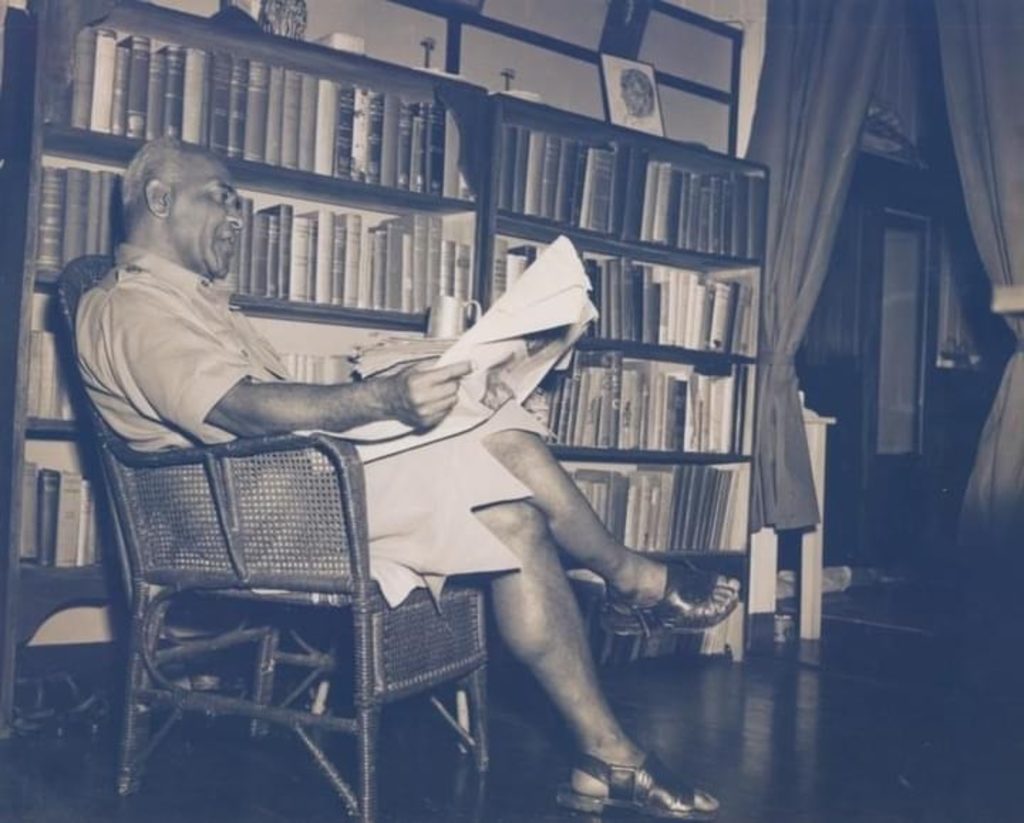
Part 2
The biography — Ratu Sukuna: Soldier, Statesman.
Man of Two Worlds attempts to pull together the multiplicity of social, cultural, political, class and personal factors and forces that shaped Ratu Sukuna’s privileged life as a Taukei chief, intellectual, colonial bureaucrat, soldier, politician and statesman.
It is an official biography4 of a man who put Fiji on the regional and global map through his academic achievements, military service and professional demeanour.
Author and research scholar Deryck Scarr fuses together real life experiences of Ratu Sukuna as well as of others he came into contact with, either directly or indirectly, using the historical narrative method.
Although this method has often been criticised as positivistic because of its tendency to be merely descriptive of surface manifestations of a social phenomenon, it nevertheless helps to provide a broad account that can inform us of the occurring sequence of events.
It is thus not surprising that while the book provides a commendable historical narrative of Ratu Sukuna’s life, it does not fully explore the deeper thoughts and philosophies of the man as well as his influence in modern day postcolonial Fiji.
There is also no discussion of Ratu Sukuna’s Oxford experience and how this shaped his future philosophy and ideology.
Most biographies or autobiographies of important people emphasise the impact and influence of their university education on their professional lives, vision and achievements.
This is a major drawback of the book. Nevertheless, Scarr’s role as official biographer also extended to editing The Three-Legged Stool: Selected Writings of Ratu Sir Lala Sukuna (1984), a collection of speeches by Sukuna over the span of a number of years since his experiences in the First World War trench warfare as a member of the French Foreign Legion.
Contrary to mainstream assumptions, historical narrative method is neither ‘objective’ nor empirically irrefutable, but is based on implicit or explicit political, cultural and ideological conceptualisation, framing and interpretations of events and issues, articulated in a variety of historiographic texts and analysis.
Some of these are imperial historiography, which deals with stories of colonial conquest and glory; nationalist history, which attempts to provide a local narrative of a group’s struggle against external forces; elite history, which focuses more on the ruling classes; and social history, which is the story of ordinary people in everyday life.
Scarr’s biography of Ratu Sukuna is an interesting mixture of imperial and elite histories. Much of the book revolves around Sukuna’s life as a chief and his colonial experience. Ratu Sukuna loyally relished his chiefly position and thoroughly fetishised British imperial culture.
The book weaves together Taukei chiefly narrative and British imperial discourse, intertwined in a rather odd symbiotic embrace and does not really reflect Fiji’s social history.
In fact ordinary Fijians, the very people who helped create the Sukuna myth, only exist as near invisible players in a class-based chess game.
The chieftocratic narrative
Fiji’s chiefly aristocracy, which I refer to here as ‘chieftocracy’, was co–opted by the British colonial regime into their fold and in turn acted faithfully as trusted compradors between the colonial state and the Taukeis.
Ratu Sukuna’s father and later Ratu Sukuna himself, were part of this chieftocratic class, whose members were mostly related by blood and were drawn from loyal tribal groups that were considered politically reliable by the colonial state.
While Sukuna himself was an intelligent and visionary individual, his chiefly background and his father’s connections to the colonial state provided him with the privilege and means for upward social mobility within the British imperial system.
He was sent with his brother to study in Wanganui in New Zealand, and he later studied at Oxford. Ratu Sukuna’s chiefly position and the British patronage of the chiefly system gave Ratu Sukuna a head start and commoners who were more academically inclined but did not have similar opportunities could not make it far enough and many remained disgruntled proletariats.
Because of his education, he stood out from other chiefs and was constantly pushing for the virtue of hard work by chiefs as a means of asserting their legitimacy. One of his most famous adages was ai tutu sa sega ni itekiteki (rank is not an ornament) to inspire chieftocrats to work hard and prove their worth as chiefs (Scarr 1980:125).
Two or multiple worlds
In his busy life, Ratu Sukuna had to deal with a complex world, not just ‘two worlds’ as Scarr’s title deceptively suggests.
The British world at the time of Sukuna was not a homogenous one but a conglomeration of multiple subworlds consisting of the vestiges of the feudal order in the form of the royalty, sub-royals and lords who maintained unquestioned hegemony in the British class structure; an expanding corporate and merchant class that controlled the economy; an educated and globalised professional class; and a large working class. Britain was also a growing multiethnic society with people from other parts of the world, including the colonies, making the country their home.
These were multiple worlds, not a single world. Fiji, although much smaller geographically and demographically, was equally complex.
The Taukei community, contrary to what Scarr assumed, was far from homogenous given its vertical divisions between chiefs and commoners and divisions between regional and tribal groups based on distinctive locally defined identities and loyalties, a situation which Frances Stewart (2008) referred to as ‘horizontal inequality’.
A number of chiefdoms in the western and central Viti Levu attempted to assert their political and sociocultural distinctiveness by rebelling against the colonial state and the comprador chiefly class.
The punitive response by the colonial state, supported by the comprador chiefs, in repressing the rebellion was to redefine the future dynamics and configuration of the Taukei community as the comprador chiefs exerted their hegemony and became the ‘legitimate’ representatives of the Taukei people.
In addition to these complexities was the multicultural, multireligious and multiethnic nature of the colony. All in all, Ratu Sukuna had to deal with these diverse groups living in multiple worlds, often ‘separated’ from each other.
STEVEN RATUVA is a distinguished Professor, author, an award-winning political sociologist and global interdisciplinary scholar. This article was sourced from: Ratuva, S. 2017. Man vs Myth: The Life and Times of Ratu Sukuna. Fijian Studies: A Journal of Contemporary Fiji 13:3–15. Republished with the kind permission of the Fiji Institute of Applied Studies.Note from the author: I took leave from the University of the South Pacific (USP) in 2002–03 to take up a fellowship position in the State, Society and Governance in Melanesia program (now the Department of Pacific Affairs) at The Australian National University (ANU). I returned to USP to join the Pacific Institute of Advanced Studies in Development and Governance. Since then, and even after leaving USP for New Zealand, I have maintained a close relationship with ANU.
Part 3 continues next week

