
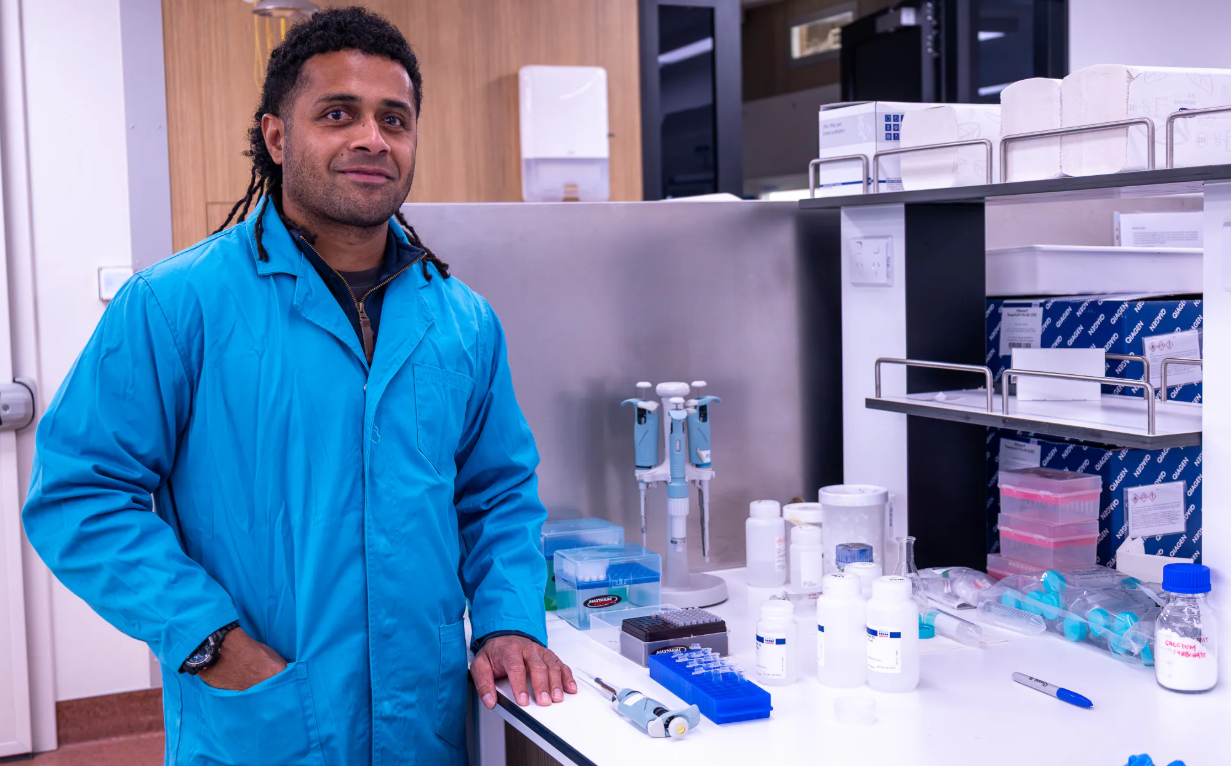
A childhood spent working in Fiji’s sugarcane fields has come full circle for Fijian researcher Mesu Tora, who is now leading scientific research into the health of the very soils that sustained his family for generations.
Tora, whose story has been highlighted by Bioprotection Aotearoa, says his journey into science began with advice from his grandfather while growing up on the family’s sugarcane farm in Nadi.
“If you don’t like working in the sugarcane fields, go study! Study hard, so you don’t come back to this job!” his grandfather told him.
Coming from three generations of sugarcane farmers, Tora’s childhood revolved around farm life. His mornings began before dawn watering vegetable crops before helping deliver tea to cane cutters, while afternoons and weekends were spent tending sugarcane and vegetable fields.
Determined to pursue a different future, he completed a Bachelor of Environmental Studies at the University of the South Pacific before working in Fiji’s forestry sector. A chance encounter with researchers from the University of Hawai’i studying agroforestry systems across Fiji changed the direction of his career.
Travelling throughout Fiji exposed him to farming systems beyond sugarcane.
“I would wake up and look outside and all I could see was sugarcane. Yet on the other side of the island it is trees, it is mixed, the farms are integrated in the forest as agroforestry systems,” Tora said.
The experience inspired him to complete a Master’s degree at Massey University, where he researched seeds and Indigenous plants while studying the impacts of myrtle rust.
Now undertaking a PhD at Lincoln University through a Bioprotection Aotearoa scholarship, Tora has shifted his focus from plants to soils after discussions with communities in Fiji highlighted widespread concerns about declining soil health.
“People in Fiji were telling us they have a big issue with their soils,” he said.
His research examines soil microbial communities across Fiji’s agricultural systems and how they contribute to ecosystem stability and productivity.
“Soil microbial communities play a fundamental role in driving key processes that are essential for the functioning of our agroecosystems,” he said.
Tora says little is known about soil microbes across Fiji and other Pacific Island countries, despite increasing pressures from agricultural intensification, deforestation and climate change.
“Very little is known about the diversity of microbial communities in our soils, not only in Fiji but across Pacific Island Countries and Territories. How these communities respond to land use change and climate pressures has never been examined in our region.”
For Tora, the research is deeply personal.
“This work is critical in establishing not only baseline information but also providing scientific data to support the principles already embedded in our traditional stewardship as Indigenous landowners and guardians of the vanua,” he said.
Returning home regularly to share his findings with family, Tora says his research is beginning to answer questions that generations of farmers have long asked, including why sugarcane quality has declined and why some crops thrive only in certain soils.
“Now that I am completing my PhD, I can answer those questions they would otherwise seek from government ministries,” he said.
He hopes the knowledge gained through science, combined with traditional farming experience passed down through generations, will help protect Fiji’s soils and ensure a more sustainable future for Pacific agriculture.

