
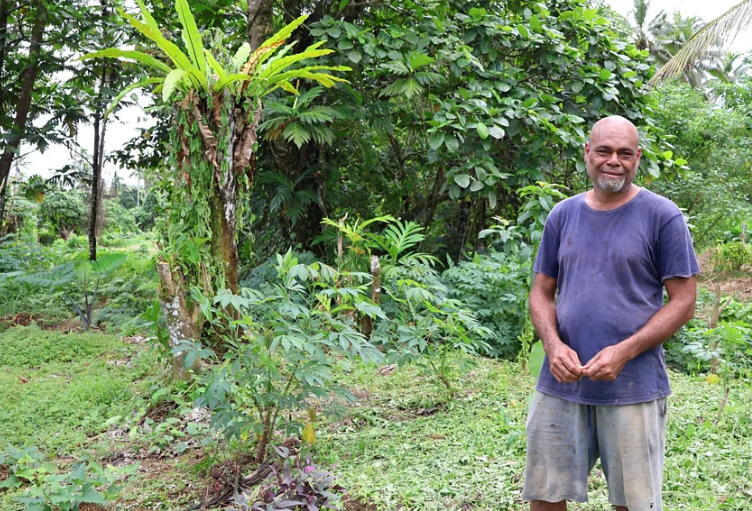
Creeping yams and bees behaving strangely – in Fiji, farmers read nature’s warning signs to predict hurricane season.
It’s July, a month when Fijian farmers begin watching wild yams closely. “If they see wild yam vines creeping along the ground, there’s going to be a hurricane in between November and April – the hurricane season,” says farmer Marika Radua. If the vines shoot upwards, it’s unlikely a hurricane will hit, he says.
In the dense jungle on Vanua Levu, Fiji’s second largest island, Radua’s farm is a riot of green. Every plant has its place – from rows of delicate lettuce, to sturdy taro and cassava. For years, Radua has read the signs in nature to know when, and where, to plant his crops to ensure they thrive each season.
Yam vines are natural indicators of extreme weather, according to Fijian traditional ecological knowledge. This environmental knowledge comprises ancient traditions held and practiced by indigenous peoples. When the vines hug the ground, “they are already trying to protect themselves from the wind. It’s nature,” Radua says.
Many Fijians – especially those from older generations who are more likely to use traditional farming methods – believe other organisms act as natural weather forecasts, such as bananas, bees and breadfruit.
Before modern technology, environmental indicators like these were used across the world to predict natural disasters. But in the last century, data from satellites, weather radars and computers has provided increasingly precise monitoring and forecasting.
In the Pacific, communities are returning to ancient wisdom to anticipate extreme weather, to enhance modern methods. Scientific studies and Fiji’s meteorological service are recording these local “early warning signs” of tropical cyclones and flooding. As climate-change-driven disasters pick up pace in the Pacific, traditional knowledge might buy communities more time to prepare.
A total package
In 2024, the Fijian Meteorological Service announced it would integrate traditional environmental knowledge into its scientific forecasting – describing the pair as “a total package”.
Fiji follows in the footsteps of Vanuatu, Tonga, Samoa, Niue and the Solomon Islands – Pacific nations participating in an ongoing project to integrate traditional knowledge in their early-warning systems.
Siosinamele Lui, the climate traditional knowledge officer at Secretariat of the Pacific Regional Environment Programme (SPREP), an intergovernmental body, says natural indicators are key to helping remote communities can prepare for weather events.
“In most parts of the world, traditional knowledge and national services are not mentioned in the same sentence,” says Lui. “But in the Pacific, it’s now becoming the go to. It’s normal practice.”
Since 2016, the SPREP project has been researching natural indicators, with Pacific islanders reporting early warning signs directly to the Pacific Meteorological Desk via calls, messages, social media or local climate centres.
Vanuatu is “leading the way” with an app named ClimateWatch, says Lui. The app has a database of crowd-sourced natural indicators – for example, green turtles nesting further inland suggests a cyclone may be approaching.
However, using traditional knowledge to preempt weather events is not an instant process, says Lui.
“You cannot integrate a data set that’s only five years old with a data set that’s 100 years old. At the moment, most of our monitoring data is not old enough for us to build it into the climate forecast,” she adds. Therefore, the government is studying the correlation of traditional indicators with weather events, before building this into their climate forecasting model.
However Lui says that promoting traditional weather knowledge can help people in secluded areas.
“To put it in context, you’re looking at the biggest ocean in the world, and you have thousands of islands that are widespread. You don’t have monitoring equipment on every island,” says Lui. This technology is expensive and sparsely located, leading to gaps in meteorological data, she adds.
Not everyone will be able to get critical warning information on time, if at all. “That’s where this programme comes in,” says Lui. “Whether it’s from the Meteorological Service or whether it’s traditional warning systems. The goal is for people to respond and be prepared,” she says.
For Fijian people, traditional knowledge such as how the seasons change isn’t “black and white”, Radua says. “We don’t write things down – they are translated from one generation to the next through stories, songs, dances and idioms,” he says.
Radua, who is a climate resilience expert on Vanua Levu, began compiling this cultural wisdom into a seasonal calendar available for farmers on the island. Many farms, both commercial and family-run, in Fiji have converted to modern ways of farming – for example monoculture, planting and cultivating a singular crop. Radua teaches subsistence farmers how to return to traditional agricultural methods, such as planting multiple crops at different times of the year.
Not only is this better for nature, but it means farmers can listen to the land for early warning signs, says Radua. “The trees will tell them, when something flowers, it tells them,” he says, explaining how farmers keep an eye on shifts beyond normal seasonal patterns. “That’s preparedness and resilience,” he adds.

