
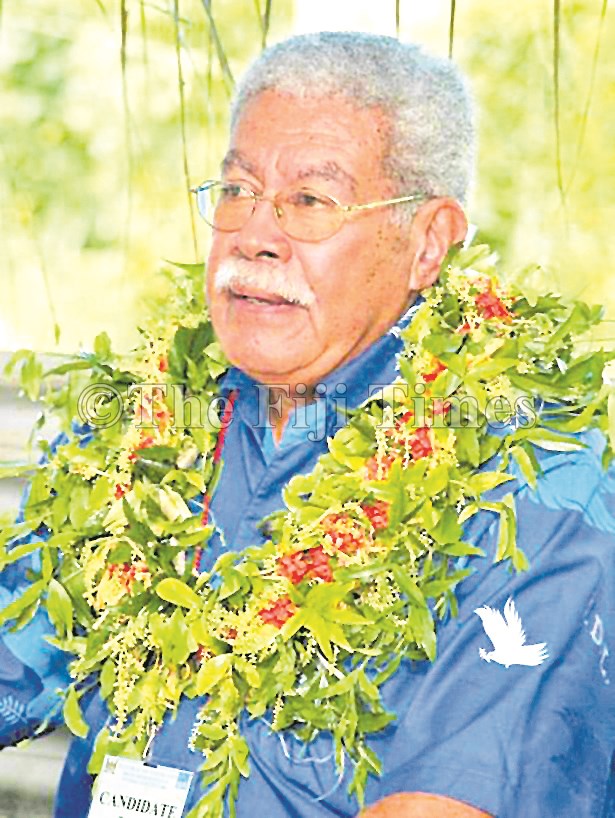
Since his sad passing, there have been many genuine heartfelt tributes given for the late Laisenia Qarase, his fundamental integrity and unwavering commitment to Fiji and the rule of law.
There has been virtually no criticism of his performance as a Prime Minister.
While we all know that eulogies tend to go overboard, my personal assessment as a critical observer of (and sometimes participant in) Fiji’s national politics over the decades, is that most of the tributes had little exaggeration. But they also raise two huge “elephant in the room” questions.
International observers would know that that after the 2006 elections (as required by the 1997 Constitution), Mr Qarase had formed a historic Multi-party Government, a partnership between Fiji Labour Party (which obtained more than 80 per cent of Fijians of Indian descent) and his Soqosoqo Duavata ni Lewenivanua (SDL) party (which won more than 80 per cent of iTaukei votes).
Hence, together they had obtained more than 83 per cent of Fiji’s voters, a massive majority by any standard.
So such international observers would be dumbfounded enough to ask: how could this popular, ethical, hardworking Prime Minister, also passionate about the development of the indigenous people of Fiji, be removed from office by Fiji’s military (comprising mostly indigenous Fijians) with the police force (mostly indigenous Fijians) idly standing by?
Just as importantly, why did the massive majority of people of Fiji (83 per cent after all), ultimately, just stand by while “their” Prime Minister and government were removed from offi ce, without any widespread popular protest or uprising?
These are the two “elephant in the room” questions that this article. Part 1 (here) tries to address these with respect to the late Laisenia Qarase. Part 2 of this article (next week) widens the questions to other Fijian leaders who have suffered the same fate as Mr Qarase.
Prime Minister Qarase 2001-2006
As many writers have related, Mr Qarase was not a career politician but pulled into politics by being appointed as Interim Prime Minister by Commodore Bainimarama, after the RFMF had regained control following the 2000 coup.
For the 2001 Elections, Mr Qarase bravely chose not to ride on the SVT bandwagon, but formed a new political party (the SDL) which surprisingly won the majority of the seats with FLP coming a close second.
For any number of reasons, including Mr Qarase’s offer of unimportant ministries to FLP, a multi-party cabinet with FLP was not formed.
But I can personally vouch as a senior USP economist, that PM Qarase ran a solid and honest government which consulted widely and was always open to alternative views and evidence.
At his request in 2001, I prepared a major paper on “Financing Fijians in Development” which can be read on my website: https://narseyonfiji.wordpress.com/2012/04/04/financing-fijians-in-business-suggestions-tothe-qarase-government-taskforce-for-accelerating-fiji-business-development-2001/.
In 2005, I gave a presentation to the Qarase Cabinet on national development projects which could be fostered for the good of Fiji and also indigenous Fijian entrepreneurs (this paper is Reading 3 in my book The Challenges of Growing the Fiji Economy, available at Hot Bread Kitchen outlets throughout Fiji).
At the request of the Board of Indigenous Fijian Business Council, I gave a keynote presentation at their AGM in Sigatoka in March 2006, again on key strategies to finance indigenous Fijian development.
Around that time, I presented to Mr Qarase’s Cabinet some of the key findings of the detailed poverty analysis that I had conducted for the Fiji Bureau of Statistics based on a solid national household income and expenditure survey.
I thought this information should inform the Government’s poverty alleviation policies, including the better targeting of affirmative action, while being fair to all communities (this was also published as my Fiji Times article of 11 June 2007).
First, the hard evidence indicated that by far the “most poor” (i.e. percentage wise) by ethnicity and region were rural Indo-Fijians of whom 47 per cent were below the Basic Needs Poverty Line. I reiterated that Government could not ignore this problem.
Second, in terms of the total quantity of poverty alleviation resources required to lift the poor above the poverty line (the “Poverty Gap”) some 54 per cent of the poverty alleviation resources would deservedly go to indigenous Fijians (who were now the majority of the poor) while the Indo-Fijian poor would receive a lower 43 per cent.
In other words, there was no need at all for poverty alleviation policies to be based on ethnicity while still satisfying the objectives of “affirmative action”.
But third, I pointed out that if you compared the two ethnic groups, it was only at the top 10 per cent of the income groups that indigenous Fijians were really lagging behind the other ethnic groups.
Hence, however much such a recommendation would rankle with the purists, the government had to “make rich Fijians richer” at the top 10 per cent if society was to close the economic gap between indigenous Fijians and others.
Of course, I pointed out that this did not mean giving the elite Fijians handouts, but helping indigenous Fijian entrepreneurs and business people wherever possible and helping them to overcome whatever constraints they faced as entrepreneurs and business persons.
In all of these presentations, Mr Qarase showed great understanding and willingness to consider views which did not totally coincide with his own.
Mr Qarase’s Government also appointed me to the Board of Fiji Revenue and Customs Authority (as it was called then) where I served until it became difficult because of unacceptable management politics.
Largely because of the many unresolved “loose ends” (yes, I know it is a shocking euphemism) resulting from the 2000 coup and mutiny, Mr Qarase’s Government had a stormy five years until the May 2006 elections.
By that time Mr Qarase had matured as a politician and was more cognisant of national interests.
2006 multi-party government
It is a tragedy that it is not recognised enough that the Government that was removed by the 2006 coup was not Mr Qarase’s SDL Party alone, but a multi-party Government with the Fiji Labour Party as a partner, holding solid ministries.
That may partly be due to strange choice of the leader of the FLP (Mahendra Chaudhry) to remain outside Cabinet, to try to become leader of the Opposition, and eventually to join Bainimarama’s post-coup government as Finance Minister.
Nevetheless, Mr Qarase with his understandable strong desire for affirmative action for indigenous Fijians in business, had the total support of powerful Fijian institutions like the Great Council of Chiefs and the Methodist Church (both proven by the Bainimarama coup to have no courageous power at all).
But history records that the Commander Bainimarama of the RFMF had little difficulty in conducting his coup in December 2006, with the Fiji Commissioner of Police (Australian Andrew Hughes) having to flee with his family back to Australia.
Commodore Bainimarama justified his coup by alleging that there was widespread corruption in the Qarase Government but to date, no substantial evidence has ever been provided to the public of that government being corrupt in any way.
What the public saw was that Mr Qarase was convicted of “abuse of office”, for failing to disclose publicly that he, his family and village had financial interests in companies being allocated shares in Fijian Holdings Ltd. Not everyone considered this conviction to be correct.
Jailed for two years with the sentence reduced to six months, Mr Qarase served his time with great dignity and integrity.
But it just so happened that the 2013 Constitution, imposed on Fiji by the Bainimarama Government ensured that this conviction prevented Mr Qarase (and also FLP leader Mahendra Chaudhry, convicted on foreign exchange misdemeanours) from standing in the 2014 elections.
The glowing tributes
Of course, one would not expect there to be any glowing tributes to the former prime minister from the FijiFirst party and Government.
But, sadly, there was little acknowledgement either of the passing of this former PM who had served Fiji for six years during troubled times.
To its credit as an objective and courageous national newspaper, The Fiji Times has printed many glowing tributes to the late prime minister.
Some were from those that Mr Qarase was closely associated with, such as with Sakiasi Ditoka (his press secretary at the time), Matt Wilson (a major speech writer at the time) and Jioji Kotabalavu (his permanent secretary at the time).
Mr Ditoka wrote (FT 25/4/2020) of Qarase’s deep commitment to God, family and education which he saw as absolutely vital for indigenous Fijians if they were to achieve economic parity with other races in Fiji.
He said Mr Qarase saw that this economic parity was the best guarantee of reduced political tensions and civil unrest that Fiji had been plagued by for decades. He believed in merit driven public service policies and absolute commitment to disciplined hard work for himself and his ministers.
He noted while Mr Qarase freely delegated authority to his ministers, he refused to approve any unnecessary overseas trips for any of them, and he applied the same rigid standards to himself.
Jioji Kotobalavu pointed to Mr Qarase’s huge contribution to the advancement of indigenous Fijians in business through the incredibly profitable Fijian Holdings Ltd (which was returning more than 12 per cent in annual dividends to its shareholders including and all the provincial councils as well as individual Fijians) and the Methodist Church of Fiji (which became debt free for the fi rst times in its history).
Mr Kotobalavu noted that “iTaukei and Rotuman communities showed their appreciation to Mr Qarase and his government by giving them more than 83 per cent of their votes in the general election of May 2006”.
Matt Wilson (FT 25/4/2020) wrote that Qarase despite being fundamentally quiet, reserved and shy eventually became an “astute, visionary and reforming politician who won the confidence of large sections of the populace”.
Sadly, there are those in a section of the Fiji media who do themselves little credit by trying to discredit such tributes as coming only from those whose bread was buttered by being associated with the former PM.
But no one could accuse Leadership Fiji of bias. Its CEO (Sharyne Fong), no doubt with the approval of its apolitical Board, gave out a statement that the former prime minister “inspired young Fijian leaders to build loving and kind relationships in the communities they served in… [his] humanity extended to his family, friends and anyone else who knew him… was a great leader and son of Fiji .
She said “…his legacy will live on with our leadership alumni and fellows and all our leaders who he had inspired to do good for our communities” (Fiji Times 26/4/2020).
Similar tributes also came from politicians who also did not benefi t personally from the late prime minister.
Mahendra Chaudhry (leader of the Fiji Labor Party Leader and former prime minister), while pointing to Mr Qarase’s strong commitment to indigenous Fijian development, said Mr Qarase “had strong moral principles” (FT 22/4/2020).
The undeniably neutral Professor Biman Prasad, leader of the National Federation Party, noted that Mr Qarase “was always transparent and conducted himself ethnically in all his dealings.
He accepted constructive criticism and alternative ideas both as CEO and as PM. … (and he led) a genuine power-sharing (government) for the fi rst time in our independent history” (FT 22/4/2020).
Unfortunately, none of the glowing tributes dared to ask the “elephant in the room” question: why then would such a good PM and his presumably equally committed SDL/FLP Government be removed from office?
Matt Wilson wrote only that “it was Fiji’s tangled, divisive and often toxic politics”.
Sakiasi Ditoka demanded more when he wrote (Fiji Times, 25/4/2020) that Mr Qarase “trusted that the laws and institutions of the nation would protect democracy and the people’s government.
“His trust unfortunately was misplaced and I believe that Fiji owes him and his wife, Leba and their family apologies”.
But I would suggest far more than just “apologise” and move on, Fiji needs to do some deep, honest and painful soul-searching about our own sad behavior when their leaders are illegally removed.
Where were the followers?
Of course, as Mr Ditoka has pointed out, the fundamental institutions of state (the military, police and the judiciary) were found wanting at the illegal removal of a lawfully elected government and prime minister.
But there is a second and just as important “elephant in the room” question that all Fiji must ask: Where were all the 83 per cent of Fiji’s voters whose two parties (SDL and FLP) were in the Multi-Party Qarase Government that was removed by the 2006 military coup?
Did they think that their responsibilities ended the day they put their pieces of paper into the ballot box? Did they think that they had no responsibility to defend the government they elected who served them so well?
While the much publicised 2006 coup was in progress and PM Qarase was besieged in his house, I expected there to be widespread social protest and hundreds of thousands of Mr Qarase’s followers, including the powerful Methodist Church, would march to his home and confront any soldiers who dared to “arrest” their elected leader.
But there was no such popular uprising among the followers of Mr Qarase.
They were “followers” as long as the “goodies” kept coming – but they promptly charged to the next winning bandwagon when the late Mr Qarase was gone from the reins and corridors of power.
In Part 2 of this article, I suggest that Fiji’s sad treatment of Mr Qarase is not an isolated phenomenon but a debilitating cancer that has eaten away at Fiji society for decades, still preventing the creation of a true, accountable and honest democracy, in which a revered people’s constitution is just a symbol, though that is also yet to be created.
- This article was written before the Fiji Government announced its drastic measures after a case of COVID-19 was identified. Prof Wadan Narsey is an Adjunct Professor at James Cook University and a former Professor of Economics at the University of the South Pacific where he worked for more than 40 years. The views expressed are the author’s and not necessarily of this newspaper.

