
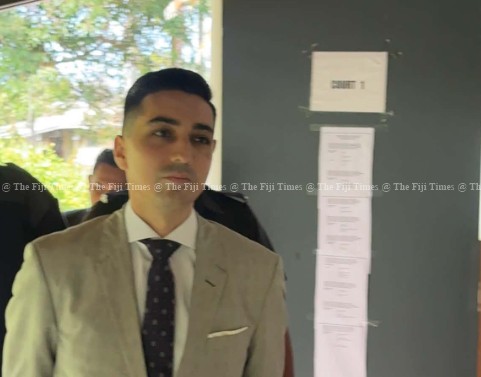
The Supreme Court has restored the conviction and sentence of Joshua Rahman after allowing the State’s petition against a Court of Appeal decision that had quashed his conviction and ordered a retrial.
Supreme Court Justice Anthony Gates delivered the judgment in Suva today.
Rahman had been convicted under Section 5A of the Illicit Drugs Control Act 2004 and Section 46 of the Crimes Act 2009.
In its earlier ruling, the High Court had imposed a 23-year prison sentence, which, after taking into account the time he had already spent in custody, resulted in a total non-parole period of 14 years.
The Court of Appeal later quashed the conviction and sentence and ordered that Rahman be retried as soon as possible.
On April 10, 2026, Rahman’s lawyers lodged a petition in the Supreme Court seeking to have the retrial order set aside and, instead, an order of acquittal.
The State had lodged its own petition on March 13, 2026.
A central issue before the Supreme Court concerned Section 32 of the Illicit Drugs Control Act, which provides for a factual presumption of possession.
The court heard that once it was proved that drugs found on premises were under the control of an accused, the law raised a presumption that the accused was in possession of those drugs until the presumption was rebutted.
Under the approach applied at the time of the High Court judgment, the burden placed on the accused was on the balance of probabilities.
However, the Court of Appeal, after considering decisions from other jurisdictions, subsequently determined that Section 32 had to be read down to impose a lesser burden, so that it was consistent with the Constitution.
In effect, the accused only had to discharge an evidential burden by calling or pointing to evidence capable of raising a reasonable doubt as to whether he was in possession of the illicit drugs.
The Court of Appeal found that the High Court judge had applied the incorrect burden to the defence and, as a result, quashed Rahman’s conviction and sentence and ordered an expedited retrial.
The Supreme Court, however, found that the High Court judge had been correct on the evidence in finding against Rahman and that the prosecution had proved its case against him beyond reasonable doubt.
The case concerned 39 kilograms of cocaine found during a police raid at premises where Rahman and his father, Talat Rahman, were living.
Evidence was led that Talat had pleaded guilty in New Zealand in two cases involving the importation of drugs into that country. The issue before the court was whether Rahman had lent support or assistance to his father in the possession of the cocaine and whether joint control of the Caubati Road premises had been established.
The Supreme Court found that, on the evidence, the High Court judge was correct in finding against Rahman and that the case had been proved beyond reasonable doubt.
The court noted that the judge had approached the case with the prosecution’s burden in mind.
anThe Supreme Court consequently made five orders. It granted special leave for both petitions, dismissed Rahman’s petition, allowed the State’s petition, quashed the decision of the Court of Appeal, and restored Rahman’s conviction and sentence in the High Court.

