
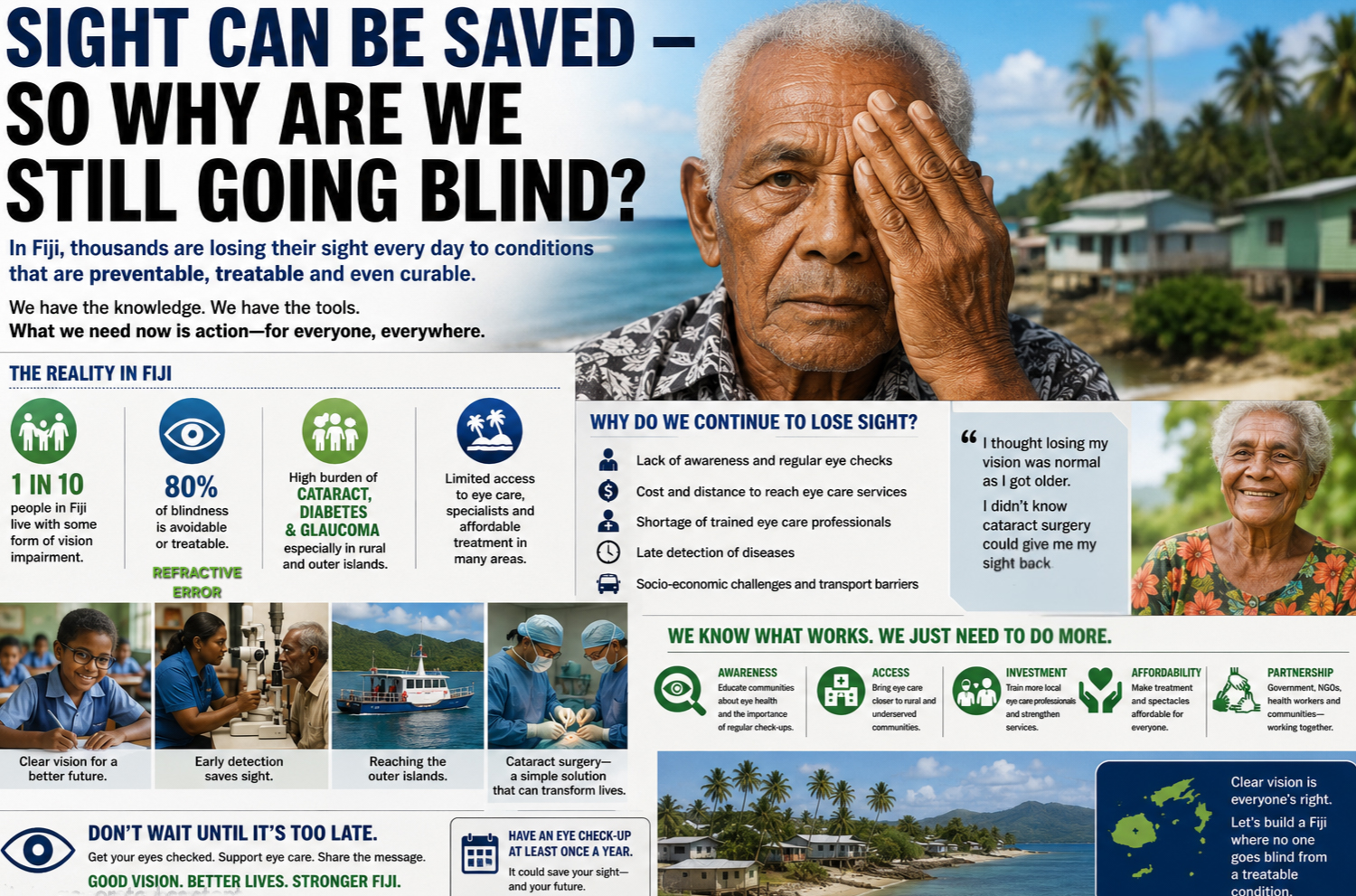
There’s a strange kind of tragedy buried inside the world’s eye health numbers. It isn’t that we lack the medicine. It’s that we have it, and still don’t get it to everyone who needs it.
According to the World Health Organization, around 2.2 billion people around the globe are living with some form of vision loss. That’s more than a quarter of humanity. And here’s the part that should really stop you: nearly half of those cases — close to 1 billion people — didn’t have to happen. Their sight loss was either preventable in the first place, or is still treatable today, if someone reaches them in time.
So, what’s actually stealing people’s vision? Not exotic, cutting-edge diseases. Mostly ordinary, fixable stuff. Uncorrected refractive error — meaning someone simply needs glasses — and unoperated cataracts are, by a wide margin, the two biggest culprits worldwide. Glaucoma, diabetic retinopathy and age-related macular degeneration round out the list. A shocking amount of blindness on this planet traces back not to unsolved science, but to unsolved logistics: who can reach a clinic, who can afford a basic pair of glasses, who lives near a surgeon trained to remove a cataract.
And that gap isn’t evenly spread. It falls hardest on lower-income countries. Global eye-health surveys show that in low-income nations, about 80% of blindness comes from causes that could have been prevented or treated, compared with about 40% in wealthier countries. The same surveys found that vision impairment overall is estimated to be about four times more common in low- and middle-income regions than in high-income ones. This isn’t really a story about disease. It’s a story about distance — between people and the care that already exists.
Fiji’s own version of this story
You don’t have to look at the whole world to see this pattern. It’s playing out here at home, too.
A population survey of Fijian adults aged 40 and over found blindness affected about 2.6% of that group, with a further 7.2% living with low vision. Cataract was overwhelmingly the biggest driver — responsible for roughly 71% of bilateral blindness in the study — while among people with low vision, uncorrected refractive error accounted for about 63% of cases, with cataract behind another quarter. In other words: glasses and a routine operation, not rare or untreatable disease, sit behind most vision loss among older Fijians. (Source: International Agency for the Prevention of Blindness (IAPB) Vision Atlas/ Fred Hollows Foundation)
Fiji’s cataract surgery story, then, is one of genuine, documented improvement — from a system that lagged its Pacific neighbours to one that now trains those neighbours’ surgeons and treats their patients. The harder work of ensuring the right patients actually reach that system, and reach it early enough to benefit, is where the next chapter has to be written.
Then there’s diabetes, which is reshaping Fiji’s eye health crisis in real time. The Pacific has some of the highest diabetes rates anywhere on Earth, and Fiji is no exception. Reporting from The Fiji Times, drawing on local research, found diabetes prevalence among Fijians aged 40 and over sits at around 41%, once adjusted for age, ethnicity and gender — with an estimated 60% of those cases going undiagnosed, especially in rural areas where testing is harder to reach. That matters enormously for eyesight, because diabetic retinopathy — damage to the blood vessels at the back of the eye — has become one of the leading causes of vision loss tied to the disease. Separate research across Fiji, Samoa, Tonga and the Cook Islands similarly identified diabetic retinopathy as a major contributor to visual impairment almost everywhere it looked, and found that not all of it was being treated with laser therapy even when it was caught.
The frustrating part is that the barrier often isn’t what you’d expect. A household survey in Fiji’s Central Division found that 86% of people knew of at least one place to get their eyes checked, yet only 66% of those who actually had an eye problem had ever gone. Older Fijians — precisely the group most at risk of cataract, glaucoma and diabetes-related vision loss — were the least likely of all to seek care. It isn’t only distance to a hospital or the cost of treatment that’s keeping people in the dark. Often, it’s simply not knowing help exists, or not believing it’s worth the trip.
Fiji hasn’t ignored the problem. Programs run with the Pacific Eye Institute and the Fred Hollows Foundation have trained hundreds of community health workers to screen for diabetic retinopathy and refer patients before damage becomes permanent, an approach designed specifically to reach rural and remote communities that clinics struggle to serve on their own. It’s a promising model. It just needs to reach a lot more villages.
The bigger picture
Age plays a role in the global numbers too, but not always the one you’d expect. Diabetic retinopathy has become one of the leading causes of blindness among working-age adults worldwide — people losing their sight in the middle of their careers and their parenting years, often because a manageable chronic condition went unmonitored.
Children carry a cost as well. A global analysis from the International Agency for the Prevention of Blindness estimated that uncorrected refractive errors among school-age children cost the world roughly 6.3 million equivalent school years and around $173 billion in lost economic productivity every year. A pair of glasses isn’t a small thing. For a child who can’t see the blackboard, it can be the difference between keeping up in school and quietly falling behind for reasons no one bothers to diagnose.
Here’s the part that ought to make health planners everywhere sit up: fixing this isn’t even expensive, as global health problems go. Research compiled by the same organisation found that eye care interventions return roughly $28 in economic benefit for every dollar spent — outperforming many other major health investments. Cataract surgery is one of the most cost-effective procedures in all of medicine. Glasses are cheap to produce and distribute. This isn’t a case of waiting on a scientific breakthrough. It’s a case of waiting on distribution, funding, and the political will to prioritise it.
Meanwhile, the numbers are still growing in raw terms, even as rates improve. Aging populations and the rising tide of diabetes mean the pool of people at risk keeps expanding, and some projections suggest the number of people blind from cataracts alone could climb by more than a third by 2040.
So why are we still going blind, in a world — and a country — that already knows how to stop most of it? Mostly because prevention isn’t glamorous. It doesn’t make headlines the way a new treatment does. It looks like training more community health workers, subsidising basic glasses, screening diabetics before damage sets in, and getting surgical teams into rural clinics and outer islands instead of only the main hospitals. It’s unglamorous work. But for a grandmother in a rural village with a cataract a twenty-minute operation could fix, it’s the only thing standing between her and a world going dark for no good reason.
Bikash Gyawali is a consultant optometrist & public health expertise at Asgar Eye Clinic

