
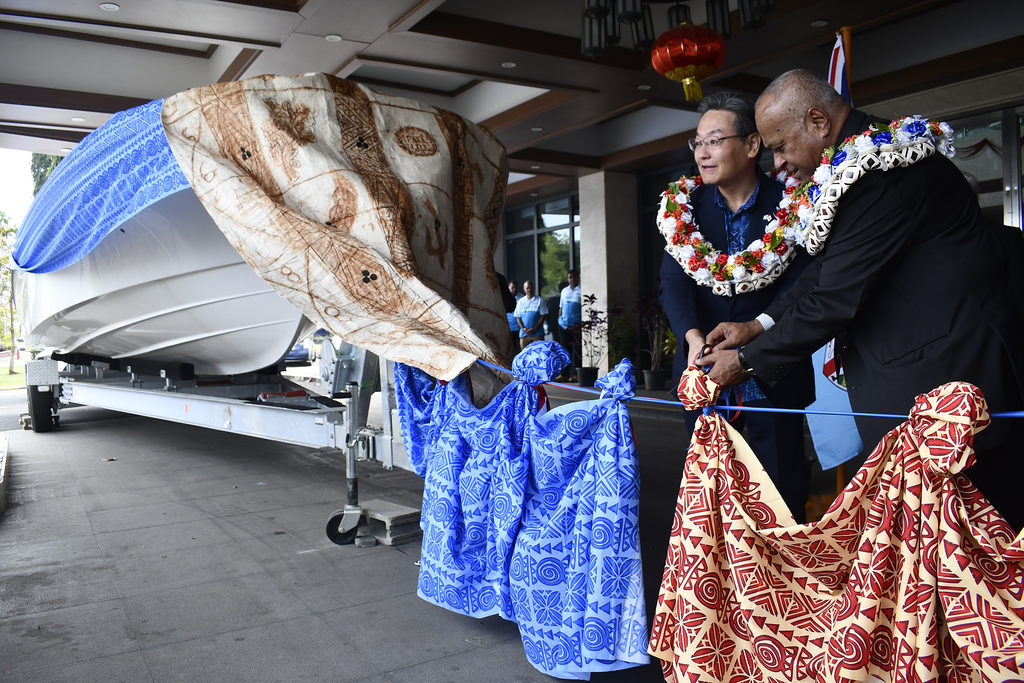
FIJI’S capacity to respond to oil spills at sea is being strengthened with a package of specialised equipment from Japan worth with $F1.6 million, aimed at reducing response times and protecting the country’s marine environment.
The equipment was officially handed over by Japan’s Ambassador, Hiroshi Tajima, to Assistant Minister for Public Works, Meteorological Services and Transport Naisa Tuinaceva.
Provided under Japan’s Economic and Social Development Program (ESDP), the grant is designed to equip the Maritime Safety Authority of Fiji (MSAF) to respond more rapidly to marine pollution threats across Fijian waters.
The handover comes as Fiji records an average of three marine spill incidents each year, highlighting the need for specialised equipment and operational readiness.
For MSAF, the equipment represents more than an addition to its inventory. It is intended to strengthen the authority’s ability to contain and respond to spills when they occur.
Mr Tajima said recent oil-spill incidents in Fiji had demonstrated the operational challenges faced by MSAF and reinforced the need to strengthen national preparedness.
“Oil spills pose a serious threat to Fiji’s precious maritime environment, coastal communities, and economy. Without adequate equipment and preparedness, they can cause severe and long-lasting environmental and economic damage,” he said.
The project, he said, would support MSAF carry out its mandate to protect Fiji’s maritime environment and ensure maritime safety.
The ESDP grant package includes specialised oil-spill response machinery and containment equipment, a dedicated marine response boat, a heavy-duty crane truck, as well as supporting operational assets and maintenance tools.
Together, the equipment are expected to significantly reduce containment and response times.
For the Fiji Government, the equipment also provide practical support for the country’s existing maritime and environmental responsibilities.
Mr Tuinaceva said the grant represented a significant investment in maritime safety, environmental protection and national disaster preparedness.
“This assistance represents a significant investment by the Japanese Government in Fiji’s maritime safety, environmental protection, and national disaster preparedness,” he said.
“Today’s handover translates our legal obligations under international conventions such as MARPOL and our Maritime Transport Act 2013 into tangible operational capabilities that protect our ocean, coral reefs, mangroves, and coastal communities.”
The specialised equipment therefore strengthens the link between Fiji’s legal commitments and its ability to act when marine pollution occurs.
The effectiveness of the new assets will depend not only on their availability, but on their maintenance and regular use.
MSAF’s executive chairman Savenaca Cavalevu said the authority is committed to ensuring the equipment remained operational and ready for deployment.
“MSAF is fully committed to ensuring that this equipment is properly maintained, regularly used in training, and kept ready for deployment when required,” he said.
Mr Cavalevu said the assistance would strengthen MSAF’s ability to respond to oil spills while protecting the marine environment, coastal communities and maritime livelihoods.
He also acknowledged the support of the Government and people of Japan, the assistant minister, government agencies and other stakeholders involved in the project.
The handover fulfils commitments established under an Exchange of Notes signed between Fiji and Japan in October 2023.
It also reinforces the Japan-Fiji Lomavata Kizuna Partnership, supporting the Blue Pacific vision and Japan’s commitment to a Free and Open Indo-Pacific.
The technical specifications, procurement, shipment and coordination of the equipment were facilitated through close collaboration with the Japan International Cooperation System.
For Fiji, the arrival of the specialised assets means a stronger operational foundation for responding to marine pollution threats, and another step towards protecting the waters, communities and maritime livelihoods that depend on them.

