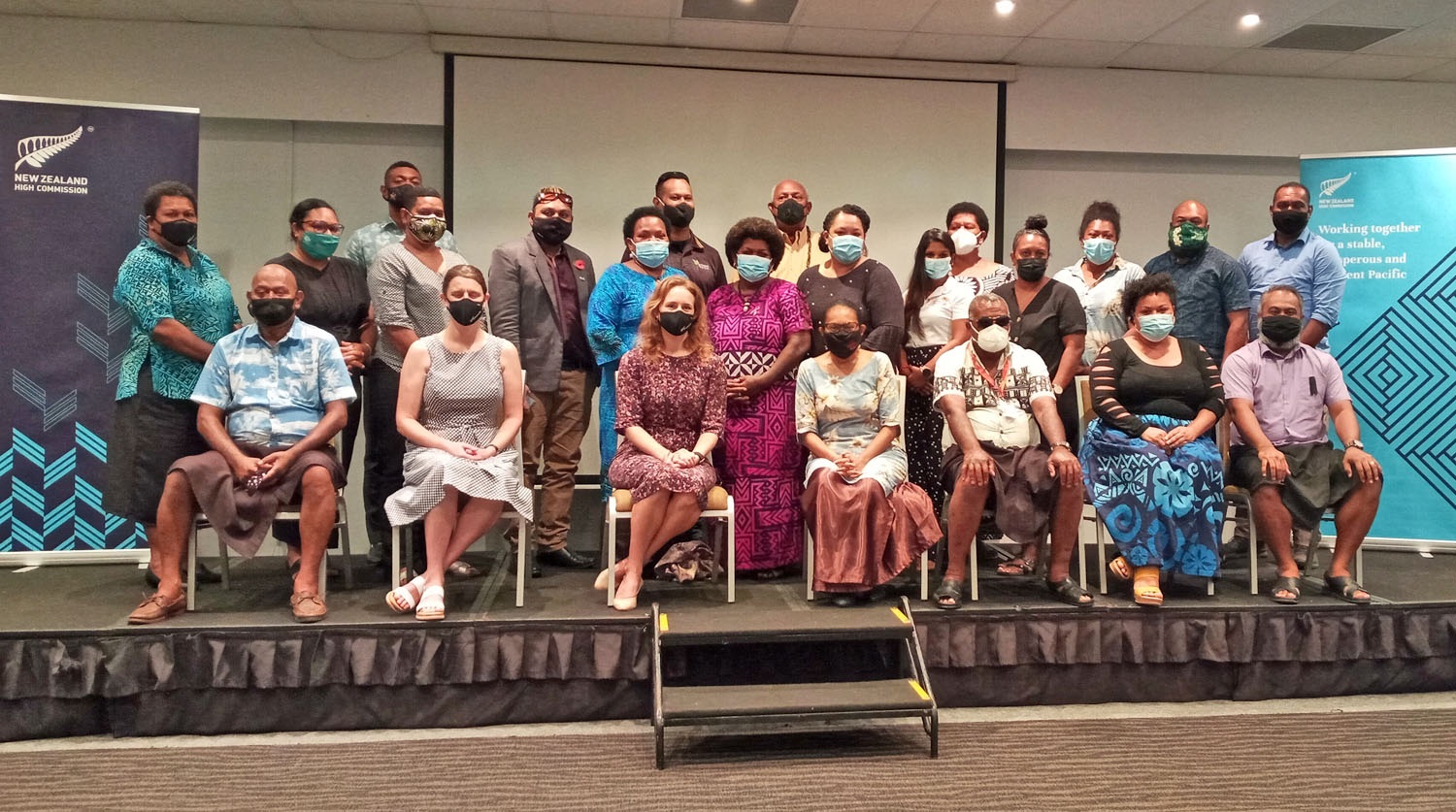
Last week, about 40 civil society representatives converged at the Holiday Inn in Suva to discuss their experiences and effectiveness in the past two years responding to three cyclones and two waves of COVID-19.
The event may not have garnered as much attention as other National Disaster Awareness Week activities – usually held to coincide with International Day of Disaster Risk Reduction on 13th October – running parallel, but its significance is in its potential to improve the humanitarian landscape and national community of practice.
Ambiguous co-ordination in multiple crises
If one considers that Fiji’s second wave of COVID-19 arrived on the heels of Tropical Cyclones Ana and Yasa, one would be able to imagine the unprecedented pressure put on the humanitarian response mechanisms we all know as DISMAC and how that devastated Fijian communities.
Fijian media carried stories of communities in Fiji’s Northern, and parts of the Eastern and Central divisions that had copped the fury of Category 5 TC Yasa in mid-December 2020 which followed with extensive flooding brought on by the arrival of TC Ana in January 2021.
It was unfortunate that the Government’s efforts to coordinate effective response and recovery works in these areas lost momentum when just three months later, Fiji’s second wave of COVID-19 began.
Furthermore, changes that had brought clarity to the DISMAC structure for many CSOs had been initiated, beginning with the deployment of a centralised reporting dashboard and linkages to the sub national level before this was stalled with the onset of Fiji’s second wave of COVID-19 in mid-April 2021.
With the Ministry of Health and Medical Services leading the response through the Incident Management Team – a relatively new and unfamiliar mechanism in local crisis response – the majority of NGOs active in the humanitarian space were temporarily disabled.
In the confusion and amidst the rising COVID-19 death toll, the Fiji Council of Social Services attempted to bridge the gap by facilitating requests for dialogue by CSOs with the Ministry of Rural Development, Ministry of Health, UNDP Pacific Office, World Health Organization Pacific.
CSO commitment to the humanitarian imperative
As an outcome of the various discussions held over the last few months and their experiences during the height of the second wave of COVID-19 and driven by the fundamental humanitarian principle, “the right to receive humanitarian assistance, and to offer it”, CSOs resolved to draw up their own Fiji CSO contingency plan.
The plan looks to ensure Fijian communities’ right to receive humanitarian assistance, and for CSO to offer it if national coordination mechanisms fail.
Through it, participating Fiji CSOs propose a guide to co-ordinate their sector’s support and response to impacted communities in a timely, efficient and effective manner if a scenario similar to or worse then what Fiji experienced during the height of the COVID-19 second wave occurred.
Evidence drives CSO humanitarian policy developments
The draft Fiji CSO Contingency Plan, Fiji CSO Protocol and Directory and a Fiji CSO Humanitarian Code of Conduct are just one of the many policy guides that Fijian CSOs and NGOs working in the humanitarian space like FCOSS have produced over the past few years.
Other policy documents produced to suggest improvements to the disaster risk reduction and response space include a Fiji Shelter Guide, a GIS mapping of all potential evacuation centres with church and community properties across the four divisions, Psychosocial First Aid (PFA) manual, Gender Equality, Disability and Social Inclusion Manual to name just a few.
Complimenting this are the efforts of some CSO actors to ensure evidenced based approaches through researches conducted in various aspects of humanitarian response including gender equality and social inclusion, locally led and community volunteers humanitarian action and accountability and effectiveness of humanitarian aid.
NGOs such as the Adventist Development Relief Agency’s CANDO Network, Habitat for Humanity Fiji, Live and Learn Fiji, Care Australia, Rainbow Pride Fiji, Pacific Islands Association of NGOs, Save the Children Fiji, Fiji Disabled People’s Federation and others have worked with the support of the National Disaster Management Office and other government agencies to do this.
It is because of these efforts that these CSOs have recognised the need to leverage global humanitarian principles and standards such as the Core Humanitarian Standards even in a health crisis such as the one Fiji has endured since April 2021.
This is a key learning from CSO’s experiences during this second wave and their commitment to ensuring responses to future humanitarian events are inclusive, and inculcate safety and protection approaches that leaves no one behind.
Multisectoral partnerships for effective humanitarian response
It goes without saying that much of the change mooted in this space has been possible with the support of the Ministry of Rural Development and Disaster Management, United Nations and donor partners.
For instance, the Fiji CSO Humanitarian Coordination Workshop was held last week with the support of the New Zealand’s Ministry of Foreign Affairs and Trade (MFAT) and the Australian Department of Foreign Affairs and Trade (DFAT) through the Plan International Australia led Australian Humanitarian Partnership consortium. It is no wonder then that this year’s International Day for DRR theme is “International cooperation for developing countries to reduce their disaster risk and disaster losses”.
It was fitting that the three-day event culminated with a closed CSO, UN and Fijian Government Talanoa and of which CSOs took the opportunity to address some of the challenges they faced in carrying out their humanitarian response.
Fijian Government participants including the Ministry of Education, Ministry of Defence, Ministry of Lands, Ministry of iTaukei Affairs, the National Disaster Management Office, the Fiji Meteorological Service and a lone private sector representative from Telecom Fiji – counterparts in past humanitarian response efforts – responded as well with concerns about the need to improve CSO coordination in the space.
It was heartening to note the attendance of relevant UN agencies mobilised by the UNOCHA and led by UNDP Resident Representative, Levan Bouadze, the Pacific Humanitarian Team, DFAT and MFAT officials at the Talanoa.
If anything, the talanoa proved that hope is not all lost when it comes to working multisectorally in responding to national crises, that there is certainly an appetite for collaboration, particularly with CSOs in improving humanitarian practice and action in Fiji.
Fiji NDMO director Vasiti Soko’s recent win of the 2021 Women’s International Network for DRR Leadership Award for Excellence in the field of disaster risk reduction should serve to inspire national stakeholders to do exactly this.
- VANI CATANASIGA is the executive director at Fiji Council of Social Services. The views expressed in this article are the author’s and not of this newspaper.