
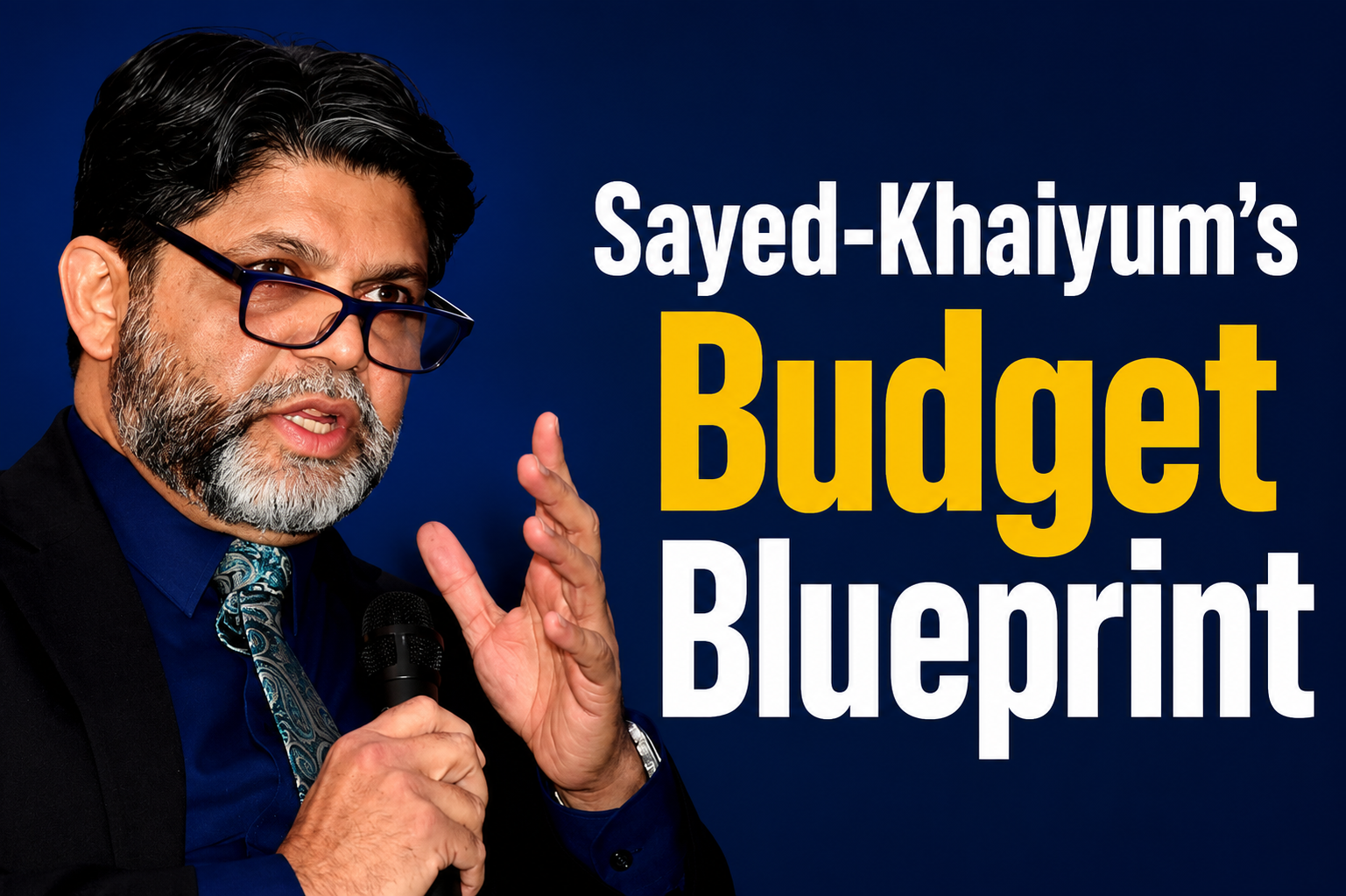
Former Attorney-General and Finance Minister Aiyaz Sayed-Khaiyum has released 30 proposals ahead of today’s budget, urging the Coalition Government to focus on raising revenue, cutting expenditure and stimulating economic activity without increasing the cost of living for ordinary Fijians.
Among his recommendations are the introduction of a temporary hotel tax, the reinstatement of a higher social responsibility levy on high-income earners, the removal of tax concessions for Fiji Water and Pacific Koro Park, and an increase in the Water Resource Tax for large extractors.
Sayed-Khaiyum also called for significant reductions in government expenditure, including cutting the number of ministers and assistant ministers by two-thirds, freezing unfilled civil service positions, halting funding for the Truth and Reconciliation Commission, Constitutional Review Commission and Electoral Law Review Committee, and limiting Parliament to budget-related legislation during the campaign period.
“Immediately cut back by two thirds the size of the ministerial and assistant ministerial positions. This will make a real change in saving money and help divert funds to critical areas to provide assistance to ordinary Fijians.”
To boost revenue, he proposed a temporary fuel surcharge of about FJD30 on airline tickets purchased offshore by non-Fijian residents, with the proceeds potentially used to support Fiji Airways, subject to governance and operational reforms.
Sayed-Khaiyum also urged the Government to accelerate major infrastructure projects, including the Nadi-Lautoka four-lane highway, the cross-Viti Levu highway, the Nadi River project, bridge replacements and the new hospital at Tamavua.
He further recommended expanding public-private partnerships, reinstating direct bus subsidies to consumers instead of operators, reversing restrictions on taxi permits, fast-tracking the National ID Card project and improving the efficiency of work permit processing.
On taxation, he argued that duties on essential imported food items should remain low or be reduced to 5 per cent, while protection measures benefiting selected local manufacturers should be removed to encourage competition and reduce consumer prices.
Corporate tax rates and income tax thresholds, however, should remain unchanged except for the reintroduction of the social responsibility levy on higher-income earners.
Sayed-Khaiyum also called for targeted assistance for vulnerable families, the gradual return of free education, increased electricity subsidies for working households, investment in court technology, and an independent review of Fiji’s wage structure.
“Government should appoint an independent expert from outside Fiji to carry out nationwide consultations and assessment of the minimum wage and all the different wage sectors.”
He said the proposals were intended to help Government manage limited fiscal space while providing greater support for households, encouraging investment and preparing the economy for the next phase of growth.

