
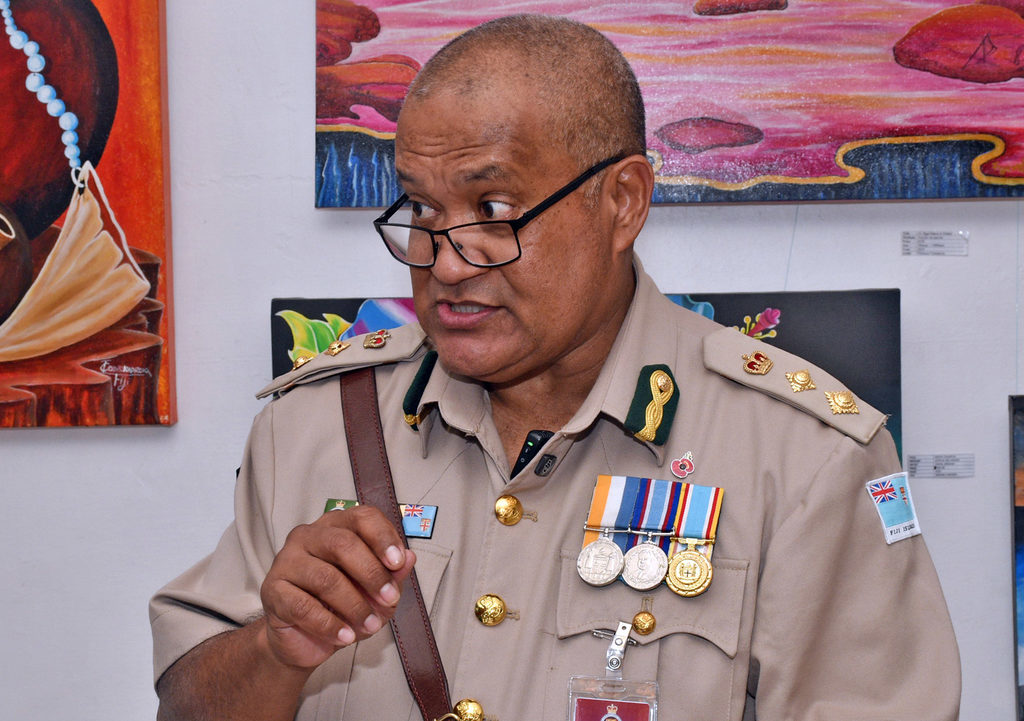
EVERY prison sentence eventually comes to an end.
Superintendent Isireli Dausiga, on the contrary, believes that the real test begins the moment an inmate walks back through the prison gates and into society.
After more than 30 years with the Fiji Corrections Service (FCS), Dausiga has come to believe that rehabilitation is measured not by the time served, but by whether a former offender is accepted by family, embraced by the vanua, and given a genuine opportunity to rebuild a life within the Fijian Scoiety.
As Director of Rehabilitation, Education and Training, he has become one of the driving forces behind a philosophy that places people—not punishment—at the centre of Fiji’s corrections system.
It is a philosophy shaped by decades of frontline experience, but also by lessons learned beyond the prison walls.
A graduate of the 2008 Leadership Fiji program, the Tovu, Totoya, Lau, native credits the experience with broadening his understanding of leadership by exposing him to professionals from industries far removed from the disciplined forces.
“The program allowed me to connect with people from the private sector and other professions,” he said.
Those relationships offered valuable perspectives on solving complex problems and reinforced the importance of partnerships in tackling challenges that no single institution can solve.
A broader view of leadership
That collaborative approach has become the cornerstone of Dausiga’s leadership philosophy.
Having also served in the private sector as Manager of the Wellbeing Unit at the iTaukei Affairs Board, and previously as Chief Officer Operations & Administration for Maximum- and Minimum-Security Prisons at Naboro, he has developed a leadership style that values cooperation across institutions as much as discipline within them.
Dausiga shared that rehabilitation begins by restoring dignity and creating opportunity. While imprisonment removes liberty, he believes it should never remove hope.
“People do change! Time is of the essence,” he said.
Dausiga has contributed alot in the rehabilitation program and the Yellow Ribbon Project since their inception in 2008.
Until today, the FCS has expanded programs that equip inmates with practical skills before they return to society. Partnerships with the Fiji High Education Commission for program and facility accreditation, the Fiji National University provide accredited Class Two Certification to inmates from Medium Corrections Centre for Cabinet Makers & Joiners qualifications, Training of Trainers Level 3 and 2 for officers, while correctional enterprises offer hands-on experience in commercial farming, poultry, piggery and garment manufacturing.
Financial literacy programmes prepare inmates for employment and entrepreneurship, while counselling, behavioral modification and specialized drug rehabilitation seek to address the underlying causes of offending. The above came through the hard work of the Rehab Unit under Dausiga’s command. Collaborations was key!
Rehabilitation through opportunity
Yet Dausiga is convinced that no rehabilitation programme can succeed if society refuses to give former offenders a second chance.
“The FCS can prepare an individual for release, but successful reintegration depends on the family, the Vanua and faith-based organizations, employment providers and whole of society,” he said.
This belief has shaped the Yellow Ribbon Project, a reintegration framework built on a “whole-of-society” philosophy that seeks to remove the stigma often faced by former offenders, often labeled as rejects of society or Ex convicts!
Through Community Action for the Rehabilitation of Ex-Offenders (CARE) Network committees established with the (14) provincial councils, reintegration planning begins long before an inmate is released. Traditional leaders, churches and community, non-governmental organizations work alongside the FCS to ensure accommodation, mentorship and local support systems are in place before inmates return home.
The FCS, through the arts exhibitions and employment expos, connect skilled former inmates with prospective employers. Together, these initiatives seek to replace rejection with opportunity.
Breaking the cycle of reoffending
The results suggest the approach is making a difference.
The FCS reports that under its structured rehabilitation model, Fiji’s national recidivism rate has fallen to just 1.66 per cent. Employment expos have also secured 52 corporate job placements for former offenders, demonstrating the value of involving the private sector in rehabilitation.
Still, Dausiga is careful not to present rehabilitation as a complete success story.
Instead, he views it as an evolving challenge requiring constant adaptation as the crime landscape itself changes dramatically overtime.
Confronting Fiji’s drug crisis
One of his greatest concerns is the growing impact of illicit drugs on Fiji’s criminal justice system.
According to Dausiga, about 40 per cent of offences leading to imprisonment are now drug-related, involving trafficking, possession or crimes committed under the influence of illicit substances.
He believes the country’s ageing prison infrastructure, much of it dating back to the colonial era, is no longer suitable for treating addiction as a complex medical and psychological condition.
Rather than simply expanding prison capacity, Dausiga reiterated that the FCS advocated for specialised rehabilitation facilities capable of addressing addiction more effectively. Plans to establish dedicated drug rehabilitation centers in the southern division, alongside the long-term transition from the ageing Suva Prison, reflect FCS conviction that recovery requires purpose-built environments rather than punishment alone.
Reaching young people before prison does
Dausiga is equally concerned by changing crime patterns among Fiji’s youth.
He has described rising youth offending as a national wake-up call, warning that inadequate parental guidance, weakening traditional values and increasing exposure to drugs are placing many young people on a pathway into the criminal justice system.
Instead of waiting until young people enter prison, the FCS has expanded its outreach into schools, faith-based organizations, etc.
Student mentor programmes are helping provide emotional support to vulnerable young people, while awareness campaigns challenge misconceptions about prison life and encourage students to consider the lifelong consequences of criminal convictions, informing students that there is nothing glamorous about life in prison.
Dausiga emphasised that prevention is every bit as important as rehabilitation.
Leadership beyond prison walls
Operational challenges continue to test the corrections system.
Dausiga has publicly warned about increasingly dangerous attempts by inmates to smuggle contraband into correctional facilities, including life-threatening cases involving internally concealed mobile phones and other prohibited items into body cavities.
In response, the FCS has strengthened visitor screening procedures, increased awareness campaigns within correctional facilities, and worked closely with the Fiji Police Force to prosecute individuals found assisting in smuggling operations.
Yet even these security measures reinforce a broader lesson.
Corrections, Dausiga believes, cannot rely solely on walls, fences and surveillance. Lasting change comes from addressing the social conditions that contribute to offending in the first place.
A shared responsibility
Despite the many challenges confronting Fiji’s corrections system, Dausiga continues to return to one central belief, which is that rehabilitation cannot succeed within FCS facilities alone; society needs to rehabilitate themselves psychologically. That one day these inmates will be discharged, then what?
He believes communities must become active participants in helping former offenders rebuild productive lives. That commitment has seen him engage directly with provincial forums, church congregations and community leaders to encourage acceptance and establish local support networks before inmates return home.
It reflects a style of leadership grounded not in authority, but in influence—bringing together Government agencies, businesses, faith groups, traditional leaders and families around a common purpose.
For Superintendent Dausiga, that is leadership in its truest sense, not simply protecting society from offenders, but helping society become strong enough to welcome them home.
“The best school is at home. If we nurture our kids right, teach them, listen to them, show them the way, lead the way, leave a footprint as parents which combines physical, mental and, most importantly, the spiritual aspect of living, Fiji will once again sing, ‘we are Fiji, we are the way the world should be.’”

