
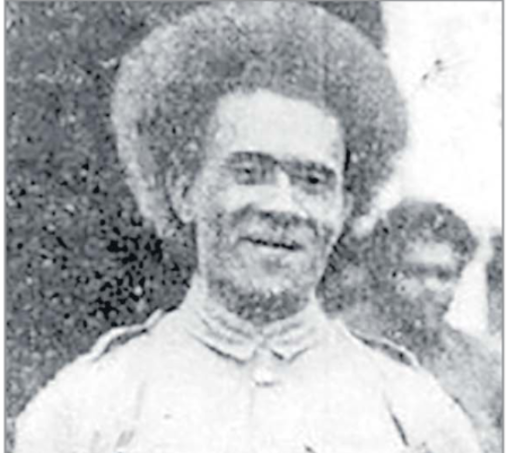
As Fiji honours Ratu Sukuna Day, the French Embassy in Suva pays tribute to the father of modern Fiji – paramount chief, Oxford scholar, but also French Foreign Legionnaire. Wounded on the Western Front in 1915 on the very day the future famous poet Blaise Cendrars lost his arm and his American comrade Henry Farnsworth was killed, Ratu Sir Josefa Sukuna’s extraordinary courage forged a lasting bond between Fiji and France that endures to this day.
Today, as Fiji observes Ratu Sukuna Day, we remember and honour one of the nation’s greatest figures: Ratu Sir Josefa Lalabalavu Vanayaliyali Sukuna (1888–1958). Paramount chief, Oxford scholar, decorated soldier, and visionary statesman, Ratu Sukuna is rightly regarded as the father of modern Fiji. His lifelong work on land reform, education, governance, and the careful blending of tradition with progress continues to shape the country today.
On this special day, when Fijians across the islands and abroad reflect on his remarkable contributions, the French Embassy in Suva is pleased to recall a lesser-known but deeply meaningful part of his story – his brave service in the French Foreign Legion during the World War I. It is a chapter that still binds Fiji and France together more than a century later.
A Pacific chief in the trenches
While studying at Oxford in 1914, the young Ratu Sukuna was determined to serve. Turned away by restrictions on non-European volunteers in the British Army, he made his way to France and, on January 8, 1915, he reported to the military sub-intendant in Paris to enlist “for the duration of the war” in the Foreign Legion. There, men from every corner of the world stood side by side. Ratu Sukuna was assigned, effective January 8, 1915, to the 3rd Marching Regiment of the first Foreign Regiment, arriving at the unit on January 11, 1915. Promoted to private first class on February 12, 1915, he distinguished himself with his regiment in the North of France. On May 9, 1915, the “prince as black as ink” (as his very close American friend Henry Farnsworth put it) and his fellows legionnaires launched an assault near Neuville-Saint-Vaast, in northern France. It was then that he received his first citation for acts of bravery.
On July 14, 1915, he was assigned to the 2nd Marching Regiment and promoted to private first class on July 15. He fought with great courage, particularly during the intense fighting of the Second Battle of Champagne in September 1915 (which saw some of the bloodiest days in French history, with up to 23,000 French casualties in a single day). Ratu Sukuna wrote about this action in a document entitled “With the Legion in the Champagne”:
“It was now near 4pm, and at this juncture no further advance could possibly have been undertaken in the face of converging machine gun fire from the wood on the half-left front, from the Ferme de Navarin [Navarin’s farm], and from the wood on the right flank. The leading files suffered severely. Of the officers the best had already fallen. The Commandant was dead. Pine leaves and branches cut off by bullets were falling like rain. The groans of the wounded and the cries of the dying sickened and weakened one. Still no orders came. Through it all, when the fire was at its heaviest, could be heard the voice of Captain Sunod, upon whom had developed the command of the Battalion: ‘Ne bougez pas, mes enfants!’ [“Do not move, my children!”] And there the Legion stayed until far into the night”.
Ratu Sukuna’s experience of the Front ended that day, on 28 September 1915, near Souain in the Marne, where he was shot in the temple and in the arms. The official record of his enlistment in the Légion étrangère confirms both the date and the place. These injuries were suffered during operations for which his regiment was awarded a second mention in dispatch:
“On September 28, with an admirable spirit of sacrifice, rushed to a position which had to be taken at any cost. In spite of the heavy fire from the enemy machine gun, was able to break through the German trenches”.
On that day, about half of the regiment’s active strength was wiped out. It was one of the bloodiest days in the history of the Foreign Legion during the Great War. Hospitalized in Lyon, he wrote to his family: “I am aware that I am doing my duty, but war is hell. The sight of blood makes me nauseous; the effects of the conflict on the people bring tears to my eyes.”
Did the future statesman Ratu Sukuna know the future poet Blaise Cendrars? An unexplored possibility
What makes that day even more remarkable is that, on the very same date and in the same bitterly contested sector around Souain-Navarin Farm, a future legend of French literature was gravely wounded while serving in the Legion: the Swiss-born writer Blaise Cendrars (then still Frédéric Sauser). Cendrars lost his right arm that day. The experience would later inspire his powerful autobiographical work La Main coupée.
Cendrars’ writings do not mention Ratu Sukuna by name. Yet the coincidence of dates, the shared Legion units involved in that offensive, and the geography of the battlefield have led us to consider a hypothesis that, as far as we know, has never been put forward before: that the Fijian chief and the Swiss-French poet may well have well known each other, even if only briefly, as brothers-in-arms in the chaos of war.
This possibility gains weight from the letters of their possible mutual comrade, the young American Henry Farnsworth. In his published correspondence (Letters of Henry Weston Farnsworth from the Foreign Legion), the Harvard-educated adventurer – who became close friends with Ratu Sukuna – left us some of the most vivid descriptions of Legion life. One passage in particular stands out:
“Sukuna is in the kitchen persuading the slavey to make cocoa for us, and standing near me, smoking, eating an orange, and talking, is a young Swiss from Montmartre, putting the finishing touches to a clay head which he began to model in the trenches.”
In 1915, Cendrars – a Swiss national who had lived in Montmartre since 1907 and was not yet a naturalised Frenchman – matches this description closely: artistic, creative, and serving in the Legion. While we may never have definitive proof, the circumstances strongly suggest that these three very different men – a Fijian chief, an American idealist, and a Swiss poet – crossed paths in the crucible of that September fighting in the trenches of northern France.
A brotherhood across continents
Farnsworth clearly held Ratu Sukuna in high regard. He wrote warmly of his Fijian friend, even suggesting he might bring him back to America once the war ended. Tragically, Farnsworth himself was killed in action on that same day, 28 September 1915 – the very day Ratu Sukuna was wounded and Cendrars lost his arm. It is said that Ratu Sukuna witnessed the death of his American comrade.
A powerful set of photographs taken the very next day, 29 September 1915, shows the shattered battlefield around Souain in the immediate aftermath of the offensive. It offers a sobering glimpse of the conditions in which Ratu Sukuna and his comrades fought.
In 1920, Henry’s father, overcoming considerable difficulties, arranged for the construction of an ossuary at Souain to honour his son and the many other Legionnaires who fell there. Built with limestone from the same quarry used for the Arc de Triomphe (up the Champs-Elysées, the second most famous monument of Paris after the Eiffel Tower, where lays the tomb of the unknown soldier), it is still known locally as the American Monument — a lasting tribute to the international sacrifice in that corner of the French Champagne region.
A lasting bond between France and Fiji
Ratu Sukuna’s service in the Legion, followed later by his work with the Fiji Labour Corps in France, created a bridge between our two countries that endures to this day. He was awarded with one of the most prestigious French military decorations. His experiences abroad clearly deepened his vision for Fiji and his commitment to its future.
On this Ratu Sukuna Day, the French Embassy offers its sincere tribute to this great Fijian leader – a true brother-in-arms of France. His story beautifully illustrates how the Great War brought together Pacific Islanders, Frenchmen, Swiss, Americans and many others in a shared struggle, forging bonds of friendship that have outlasted the conflict itself.
Over the last years, nearly twenty Fijians have served with the French Foreign Legion. In 2026, two Fijians have already knocked at the door of the French Embassy to join the French Foreign Legion.
France is proud to acknowledge their commitment, as well as the dedication and gallantry of other Fijians towards the French military. After he saved the life of a French Colonel in Lebanon in 1982, the Honourable Prime Minister Rabuka was made a Grand Officier de la Légion d’Honneur, the second most prestigious reward in the highest order of the French Republic, by the French President. In December 2024, the Commander of the Republic of Fiji Military Forces, Major General Ro Jone Kalouniwai, was made an Officier de l’Ordre National du Mérite by his French counterpart, General of the Army Thierry Burkhard.
May the example of Ratu Sukuna – his courage, wisdom, and dedication to service – continue to inspire new generations of Fijians.
Happy Ratu Sukuna Day to all.

