Leadership Fiji co-founder William Parkinson has challenged the country’s emerging leaders to take greater responsibility in shaping Fiji’s future, saying the nation may be approaching the end of a turbulent political era and must prepare for generational change.
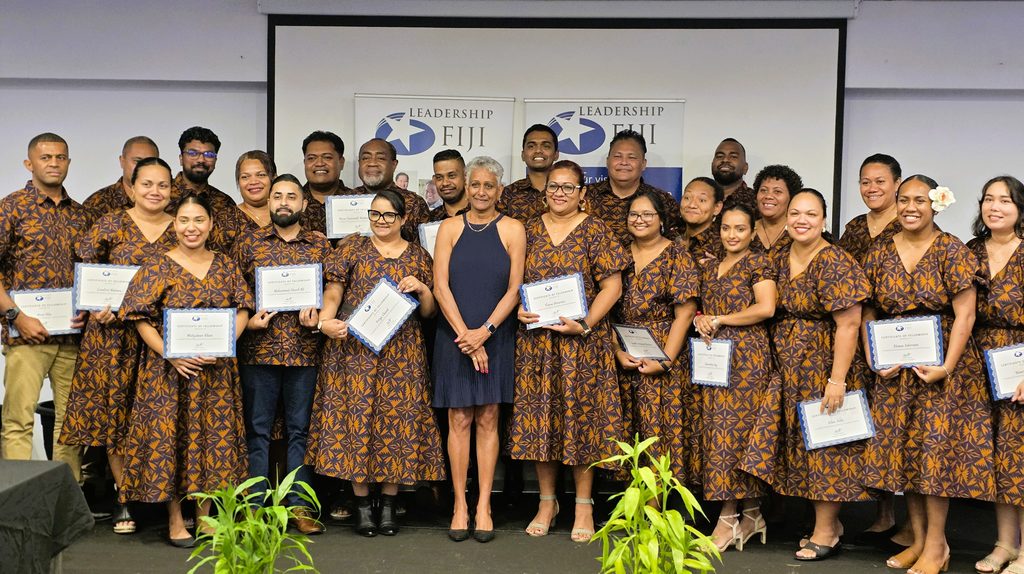
Mr Parkinson made the remarks during the organisation’s 25th anniversary launch in Suva this week, an event that also introduced the LF2026 cohort, recognised the LF2024 Fellows who have completed the two-year leadership programme, and acknowledged all corporate and institutional partners supporting the initiative.
In a reflective address marking the milestone, Mr Parkinson spoke candidly about leadership in Fiji and the responsibilities that come with it, both for the current generation and those who will follow.
Now aged 64 and a long-serving figure in Fiji’s media and business sectors, he said recent anniversaries in other organisations he helped establish had prompted him to reflect deeply on his own leadership journey and the finite nature of influence.
“I’ve been thinking a lot about my own role as a leader and about where leadership in Fiji has come from and where it is heading,” he said.
“When you reach a certain stage in life you begin to realise that your time as a leader is finite. There is only so much longer you can expect to contribute as a relevant and effective leader, and coming to terms with that can be difficult.”
End of a turbulent era
Mr Parkinson said this reflection extended beyond individuals to the nation as a whole.
He believes Fiji may be approaching the end of a challenging chapter that has shaped the leadership style of an entire generation.
He described the period from the 1980s through to the present as one marked by turbulence, political instability and moments of deep division.
“It has been an era of incredible turbulence at times,” he said.
“For many of us who lived through those events, we were scarred by them in some way. Those experiences shaped how we approach leadership today.”
He suggested that some of the tensions and frustrations seen in the country’s political and social landscape could be the result of what he described as the “death throes” of that generation.
“As we approach another election cycle, I believe we are at an important moment in history — a cusp where one era begins to give way to another,” he said.
“But while our generation has played its role, it cannot be the one that fully carries Fiji forward into the future.”
Creating space for new leaders
Mr Parkinson said the responsibility of older leaders was now to help create the conditions for the next generation to step forward.
“Our task is to set the platform — to ensure Fiji is a safe, prosperous, open and transparent society built on competence and accountability,” he said.
“Once that platform is there, we must have the humility and the courage to step aside and allow the next generation the space to lead.”
He reflected on how rapidly the world had changed during his own career, using the evolution of communication technology as an example.
“When we first started FM96, our primary form of communication was a teleprinter,” he said.
“Then came the fax machine, which we thought was revolutionary, followed by the internet, social media and now artificial intelligence.
“These are changes that require a new generation to take the lead.”
Born out of crisis
Leadership Fiji itself was born during one of the most difficult periods in the country’s modern history.
Mr Parkinson recalled the atmosphere in 2000, when the country faced a major political crisis that deeply unsettled the nation.
“It was a frightening and disturbing time,” he said.
“There was a group of leaders who came together and asked themselves what could be done to ensure that Fiji did not continue down a path defined by chaos, ethnic division and hatred.”
At the time, an Australian colleague introduced the founders to the Victorian Leadership Program, which later served as a model for what would become Leadership Fiji.
With the support of the organisation’s first chairman, Daryl Tarte, and its first executive officer Sufi Dean, the programme was established with a clear mission.
“Our goal from the beginning was to create a new generation of leaders who could lead Fiji forward as a democratic, multi-racial and multi-religious nation,” Mr Parkinson said.
The programme’s first intake in 2002 consisted of just 21 participants. Since then, hundreds of professionals from across different sectors have passed through the initiative.
Impact across sectors
According to Mr Parkinson, the impact of the programme can already be seen in the number of alumni occupying influential roles across the country.
“We are seeing graduates of Leadership Fiji in some of the most senior positions in the country — in Cabinet, in the judiciary, in the public service and in the corporate sector,” he said.
But he said leadership was not confined to high office.
One of the core principles of Leadership Fiji, he explained, was the belief that leadership could be exercised by anyone at any level of society.
“Leadership is not just about prime ministers and ministers,” he said.
“It can happen anywhere — in communities, workplaces, churches and youth groups.”
Leaders already emerging
Mr Parkinson said he had witnessed encouraging examples of leadership in everyday settings.
He cited the work of young medical staff at St Giles Hospital, innovative community policing initiatives using social media platforms, and the growing success of cultural organisations such as VOU.
In many cases, he said, these efforts were driven by young people who were capable, motivated and determined to make a difference despite limited resources.
“I see young, dynamic and multi-racial teams doing incredible work,” he said.
“They are intelligent, capable and committed. The leaders are already there.”
A challenge to the next generation
However, he warned that leadership requires courage and initiative, not simply opportunity.
“You cannot expect leadership to be handed to you,” he said.
“You have to earn it. You have to take it.”
He challenged alumni of the Leadership Fiji programme to reflect on the vision they had set for themselves when they first entered the course and to consider how they were contributing to their communities beyond their professional careers.
Each cohort of participants, he noted, develops a shared vision during their initial leadership retreat — a vision that he believes should continue guiding their actions long after the programme ends.
“Go back and look at that vision,” he urged.
“Ask yourselves what you are doing to achieve it.”
Ultimately, he said, leadership is about action and responsibility, no matter how small the initiative may appear.
“Whether it is standing for election, helping your local school, tackling social issues or even getting involved in a community programme — it is all leadership,” he said.
“It is about solving problems and driving change.”
As Leadership Fiji celebrates its 25th anniversary, Mr Parkinson said the organisation’s future success will depend not only on the programme itself, but on whether the next generation is willing to step forward and lead.
“The opportunity is there,” he said.
“The question is whether the next generation has the courage to take it.”