
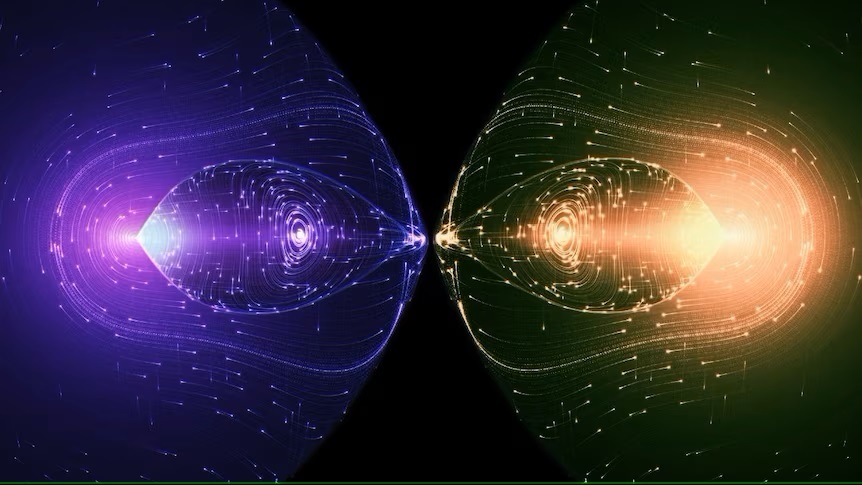
On September 28, 2023, the Australian ABC TV Antimatter and Dark Energy science reporter Belinda Smith reported on an experiment at the CERN particle accelerator facility on antihydrogen that took many physicists investigating the nature of our universe by surprise. (See https://www.abc.net. au/news/science/2023-09-28/antimattergravity-graviational-repulsionexperimentphysics/102900592 ).
The aim of the experiment carried out at CERN’s ALPHA-g device was to ascertain how antihydrogen (the antimatter companion of normal hydrogen), behaved in the earth’s gravitational field.
The result of the experiment, published in Nature journal (see https://www.nature.com/articles/ s41586-023- 06527-1 ) showed that antihydrogen falls under the earth’s gravity just as hydrogen does, revealing that antimatter is attracted by a gravitational field just as matter is. This was a source of some disappointment to physicists who have been trying to explain why our universe is made up predominantly of matter (with only a sprinkling of antimatter found under specific conditions).
Why the disappointment?
According to the Big Bang theory, our universe was created about 14 billion years ago in a big bang, in which energy was converted into matter and antimatter.
To understand what happened during the earliest stages of this theory, physicists appeal to the Standard Model of particle physics, and assume that equal amounts of matter and antimatter were produced at the moment of the Big Bang.
But according to this model, the matter and antimatter that was formed should have all recombined to yield pure energy again (see, e.g. the ABC Science report by Bernie Hobbs at https://www.abc.net.au/news/ science/2016-06- 23/antimatter-explainer/7487354 ) So why do we still have a universe containing matter in it?
A possible explanation for this matter-antimatter asymmetry was that, contrary to the assertions of earlier physicists, antimatter was repelled by matter (and thus escaped the known universe after the moment of creation).
Therefore, there was an expectation by some that antihydrogen would not fall towards the earth (which is made of matter), but be pushed upwards, away from it when it was released in the AL- PHA-g experiment.
It did not. And so the mystery of the missing antimatter in the universe remains unsolved. And the situation calls for new physics to provide the answer to the matterantimatter asymmetry.
Issues with the standard model
There are several serious issues with the Standard Model. Perhaps the most serious is that it does not include gravitation. So it does not (and cannot) explain how the gravitational force (one of the two longrange forces out of the four fundamental forces of nature), works.
The typical explanation given by physicists is that, compared to the other forces of nature, gravitation is extremely weak (and evidently, this justifies its non-treatment by the Standard Model).
This (otherwise highly successful model) has also not had much success with explaining the nature of Dark Matter (which is needed to account for 85 per cent of the gravitational force within the universe), or Dark Energy (which explains why the universe is expanding at a faster and faster rate).
Despite these serious limitations, this model is still used to provide the theoretical basis for the scientific research to explain mysteries such as the matter-antimatter asymmetry.
There are four approaches being investigated, the most promising being the violation of CP symmetry in matterenergy processes.
A new insight
There is clearly a need for a more encompassing theory/model to account for the mystery surrounding the asymmetry and dark matter/energy.
An obvious strategy to adopt in formulating such a theory/model is to start by establishing a conceptual framework that includes the gravitational force as a first requirement.
Insights into such an approach is provided in the book Concepts and the Foundations of Physics, published by AIP Publishing in 2021 (see https://pubs.aip.org/books/ 11/4/23, 2:37 PM The Fiji Times https://edition.fijitimes.com.fj/html5/reader/production/default.aspx?pubname=&pubid=e4fad093-33c6-4e8c-8f9d-b19c68c8b31a 6/7 monograph/37/Concepts-and-the- Foundationsof-Physics ).
In Chapter 7, the book points out that the energy-mass transformation equation E = mc2 derived by Einstein should be accorded a central role in physics, and treated as a foundational pillar of physics and cosmology.
Such a Fundamental Energy-Mass Transformation (FEMT) Model is used to reveal insights into the nature of the matter-energy duality that have seemingly not been explored before.
One revelation of the model is that there could be more than one type of “antimatter” that contributes to a more holistic picture of the universe. And we could be looking at the wrong one!
The FEMT Model proceeds by treating the conversion of the energy in gravitational waves into “matter-antimatter” pairs in a strong gravitational field in the same way as electromagnetic waves are known to be transformed into matter-antimatter pairs in strong electromagnetic fields.
The properties of the new hypothetical particles could well account for the absence of the “antimatter” in the universe. This model suggests possible explanations for both the matter-antimatter asymmetry and dark energy mysteries.
The validity of any scientific hypothesis must be tested by experiment. In the case of the behaviour of antihydrogen in a gravitational field, the ALPHA-g experiment revealed that antihydrogen behaves in the same way as its particle counterpart.
Whether particleantiparticle pairs of the gravitational variety are possible must await similar experimental test. To see a fuller version of this article on this possible new explanation, please go to https://pacspectrum.com/?p=657
- The views expressed in this article are those of PROF ANIRUDH SINGH and do not reflect the views of the institutions that the author is associated with and this newspaper. Prof Singh is Adjunct Professor at the University of Southern Queensland and former Associate Professor in Physics at USP. Readers may share their views by emailing Anirudh_singh2005@gmail.com

