LAST week we looked at the numbers the Catholic missionaries had managed to attain by the end of 1858.
Those numbers told us that the progress of the Catholic mission in Fiji meant a mission that had endured countless trials and tribulations, facing hardship, hostility and persecution at every turn.
As we continue this journey, we now turn our attention to a darker chapter in 1858.
Catholic-Wesleyan rivalry
Father Breheret identified five things he believed had contributed to the Wesleyans’ rapid expansion throughout Fiji — their style of preaching, their extensive network of catechists, the military support of Tongan warriors, their considerable financial resources, and what he described as their use of calumny — spreading false accusations against their Catholic rivals.
He described Wesleyan ministers as relentless in their efforts to win converts, claiming that they would approach people with persuasion, emotional appeals, pleading and even dramatic displays of distress.
According to Father Breheret, their sermons could continue for hours, sometimes accompanied by shouting, crying and physical demonstrations intended to overwhelm their listeners.
He recalled several incidents to illustrate what he believed were the extremes of these methods.
In 1848, he claimed that Wesleyan minister Mr Watford held a container of burning alcohol in front of the chief of Lakeba after the chief resisted his preaching about hell.
In 1856, another minister, frustrated by the people of Vutia, was reportedly fired upon, although Father Breheret suggested that the minister dismissed the incident as nothing more than the shooter’s poor aim.
Then there was Mr Moore, whose methods in Rewa in 1855 were particularly memorable. Unable to persuade the people through ordinary preaching, he reportedly began using his horse as a travelling pulpit.
Every morning, he would ride from house to house shouting, “Repent, or you will all be lost!”
The noise and commotion terrified the villagers, especially the women and children, who according to the Catholic records fell into fear and struggled to find somewhere to hide.
The influence of wealth & gifts
But perhaps the most troubling issue was the connection between religion and military power.
Father Breheret further accused the Wesleyan mission of using gifts and material wealth to attract converts.
Calico, axes, knives, cooking pots and other valuable goods were distributed throughout to the Fijian people.
He claimed that chiefs who resisted their preaching could be approached with presents until they eventually agreed to cooperate.
Catholics were also allegedly approached with offers of gifts in exchange for abandoning their faith. One account describes Mr Waterhouse asking a Catholic what religion he followed. When the man replied that he was Catholic, Mr Waterhouse reportedly offered him tabua and a knife, telling him that his religion was wrong and inviting him to join the Wesleyans.
The fifth accusation concerned the spread of rumours about the Catholic missionaries. Father Breheret claimed that even before their arrival in 1844, Wesleyan ministers had portrayed them to Fijians as dangerous outsiders, accusing them of carrying daggers, violating women and drinking human blood.
He also described the circulation of a pamphlet known as “A Taro ka Kaya”.
And it was against this background of religious rivalry, political ambition and growing tension that one of the most disturbing incidents of 1858 unfolded in the Yasawa Islands.
By this time, Ma’afu was working to extend Tongan influence throughout Fiji, following instructions he had received from King George Tupou towards the end of 1857.
His ambition was to make Bua another Tongan province.
Yasawa – A community under threat
At the beginning of 1858, men were sent to bring Yasawa under the Tongan cause.
The situation was made easier by Tui Bua, who had Tongan ancestry through his father and was supportive of Ma’afu’s plans.
But there was a problem. Among the people of Yasawa were Catholics, and their presence became the centre of a terrible persecution.
Despite the treaty previously signed by Commandant Le Bris for their protection, Catholic communities were subjected to intimidation and violence.
Unable to ignore what was happening, several people from Yasawa travelled to seek the assistance of Father Breheret.
Disturbed by their complaints, he approached the British Consul and requested an official investigation.
He wanted the truth established so that a formal complaint could be presented to the first French warship arriving in Fiji.
The consul agreed to investigate. What he uncovered was deeply disturbing.
His report included the testimony of Moi Togitogi, chief of Nacula in Yasawa, who described what happened when a Tongan chief named Semisi arrived at Tamasua.
The chief explained that Semisi had summoned him, along with other Catholic chiefs.
When they arrived, they found Semisi, the king of Bua and a Tongan catechist named Maika waiting for them. They were armed.
According to Togitogi, Maika pointed at him, and Semisi immediately accused him of being a wicked man for refusing to follow the Wesleyan religion.
“You are bad, and it is necessary that you be flogged.”
Before Togitogi could do anything, several Tongans seized him.
They pulled his arms behind his back, tied his wrists and held him firmly on either side.
Semisi then demanded that he abandon Catholicism and follow the religion of the Wesleyan catechist Maika.
Togitogi refused.
That single refusal brought a brutal punishment.
A Tongan named Lawaki took five vines and fashioned them into a whip.
As he began striking Togitogi, the men holding him kicked him repeatedly in the kidneys.
The beating continued until he lost consciousness and collapsed.
His blood flowed across his body and onto the men beating him.
According to his testimony, he was picked up and beaten again until he was completely unconscious.
When he eventually regained consciousness, he reached towards his back and discovered that his skin had been torn away, and his flesh left hanging in pieces.
He then told the consul, “I had more marks than the others. See for yourself, Mr. Consul.”
And he was not the only one.
According to two other chiefs Riga and Tabualevu, they were subjected to the same treatment.
When religious conversion became political submission
But even after this brutal punishment, Semisi was not finished. When Togitogi regained consciousness, he was presented with three demands — one was to give the Yasawa Islands to King George Tupou, two to obey the Wesleyan catechist Maika, and three to reject the Catholic religion and embrace what Semisi called the true religion — Wesleyanism.
In that moment, the connection between religious conversion and political submission became impossible to ignore.
These men were not simply being asked to change their beliefs. They were being pressured to surrender their land, their allegiance and their religious identity.
Fortunately, an Englishman named Mr Hicks arrived during the incident. Seeing what was happening, he confronted Semisi and condemned the violence.
He told him that it was wrong to flog these people simply because they were Catholics, refused to follow his catechist and would not surrender their land to Tonga.
He reminded Semisi that every individual had the freedom to follow whatever religion they wished.
Semisi defended his actions, claiming that the men had misbehaved and that he was only trying to make them good by converting them to the true religion.
Mr Hicks was having none of it. He warned that if another Fijian was tied up, he would personally intervene and place himself between the victim and those carrying out the beating.
Maika then advised Semisi that they should not involve white people in the matter.
Semisi announced that he would send for Ma’afu, who would personally judge the men. But according to Togitogi, that was not what happened.
Instead of sending for Ma’afu, Semisi ordered the village of Nacula to be looted.
Mats, tapa cloth, pigs, chickens, yams, taro, boxes, fishing nets, axes, knives, sails and canoes were taken away.
The possessions of the villagers were stripped from them, leaving their community to suffer yet another form of punishment.
Even after Mr Hicks departed, the violence continued.
Tabualevu was ordered to kneel as though he were praying. While he remained on his knees, he was flogged until he fainted. Five other men were also beaten.
The cost of religious freedom in Fiji
The physical evidence of what had happened was still visible when Consul Pritchard investigated.
In his written report, Consul Pritchard stated that he personally examined the backs of the injured men 18 days after the beatings.
What he saw, he said, was still horrifying.
The victims could barely hold themselves upright, and the vines used as whips were stained with blood.
He added, “All this had been done in the name of religion, and the murderers have found their defenders, Fijian and non-Fijian.”
Pritchard later confronted Semisi in Levuka and demanded an explanation. Semisi’s response was that the violence had been necessary to convert the people.
“How can we convert these pagans to the true religion? We have done this to convert them. It is not as some people say, that we did it to conquer Fiji and give it to Tonga.”
Consul Pritchard personally delivered his report to Father Breheret, who kept it in preparation for the arrival of a French warship.
The consul promised that when such a vessel arrived, he would provide his testimony and any further evidence required.
He even assured Father Breheret that he had many other depositions to give.
And so, as we look back at 1858, we begin to understand that the history of Christianity in Fiji was not simply a story of missionaries arriving, preaching and winning converts. It was a story where ordinary Fijians whose freedom to choose their faith came at an extraordinary cost.
Next week, we will look at Bishop Bataillon’s fourth visit to Fiji where the missionaries made another effort to reopen the mission in Rewa.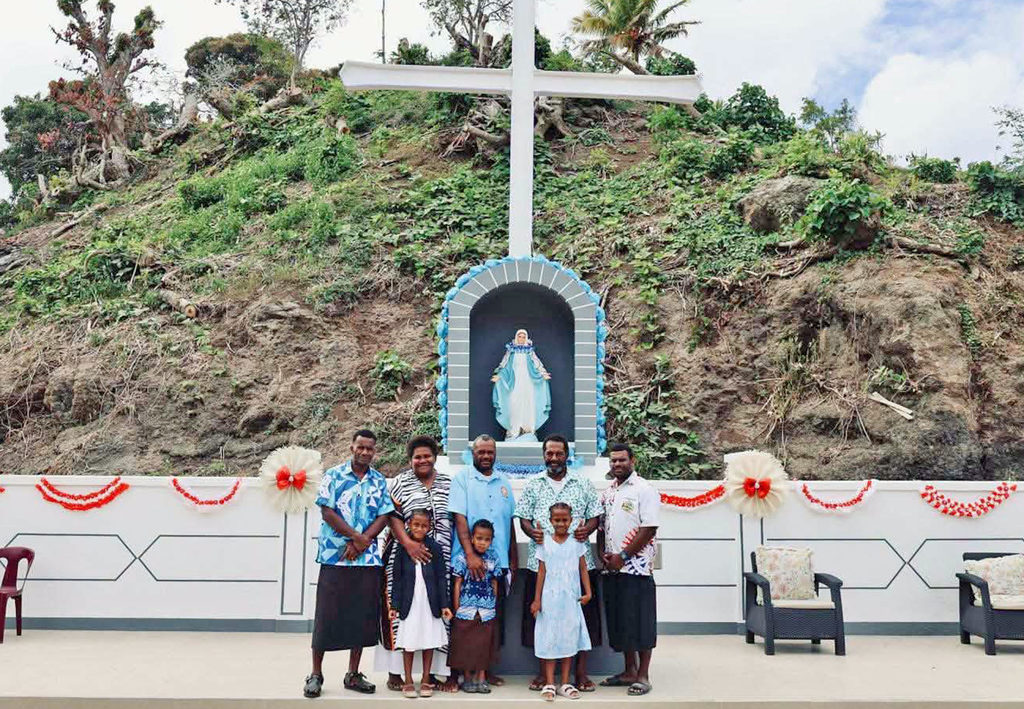
Members of the Catholic community in Tubou during the 182nd celebrations in August this year. Picture: PHYLLIS SIMPSON