Last week, we ended with the beginnings of the Catholic faith in Kadavu, after Father Matthieu secured permission from Ratu Cakobau for the people of Ono to embrace the religion. But while the faith was finding its way into new communities, the Catholic mission in Fiji was facing one of its darkest periods. Behind the growing influence of the Wesleyan Church, political rivalries and military campaigns, a small group of Catholic missionaries were struggling to hold on to the work they had spent years establishing. Some were being forced to leave, others were losing their communities, and the future of the Church in Fiji was becoming increasingly uncertain. It all began with a decision that would have lasting consequences.
The missionary who brought the Catholic faith to Rewa and Kadavu
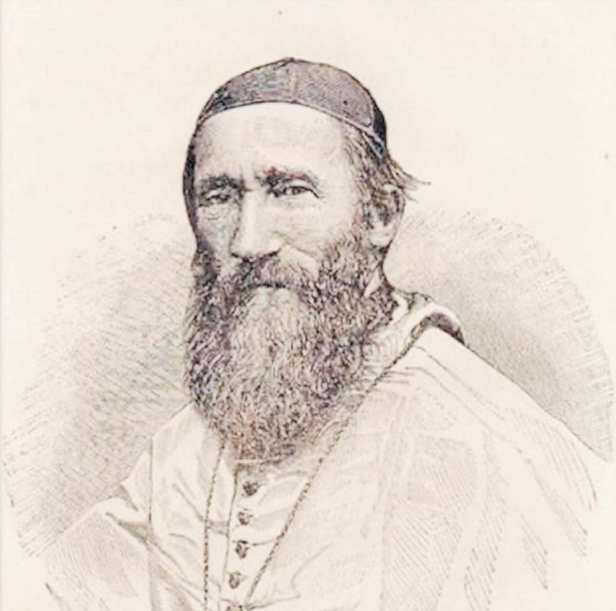
Before these developments, Father Matthieu had already played an important role in establishing the Catholic presence in Fiji.
In the past two parts of this series, we explored the trials and tribulations Father Matthieu endured in establishing the Catholic mission in Rewa and Kadavu – from building relationships with local chiefs and communities to persevering through setbacks, uncertainty and moments when it seemed his efforts might come to nothing.
He relocated to Rewa with the assistance of Roko Bati Vudi, whose relationship with the missionary helped him establish a presence among the people.
In Part VII, he found himself travelling towards Kadavu after his mission boat was wrecked on a reef near Beqa.
He was offered passage aboard Ratu Cakobau’s canoe. It was an important moment for a missionary who had already experienced disappointment in Levuka and difficulties in Rewa. But Father Matthieu’s time in Fiji was drawing to a close.
When Bishop Bataillon reunited the missionaries in Levuka in August 1855, he decided that Matthieu was too exhausted to remain in Fiji. He was sent to Wallis to rest, but his health continued to deteriorate.
He was eventually transferred to Sydney, where he died of typhoid fever in May 1856.
Although his time in Fiji was relatively short, his work in Rewa and Kadavu had helped establish foundations that would outlive his presence.
The closure of Lakeba and Rewa
When Bishop Bataillon arrived in Levuka in July 1855, he brought news that reflected just how difficult the Catholic mission had become. After 11 years of missionary effort in Lakeba, he decided to close the station.
The priests had struggled to make progress, and the bishop believed there was little hope of sustaining the mission.
Fathers Breheret and Roulleaux, together with Brother Sorlin, were brought back to Levuka. Behind them were between 10 and 12 catechumens, including three sons of the chief, whom the missionaries had particularly hoped would continue the Catholic faith.
But what happened to these young men reveals the personal cost of the religious struggles unfolding in Fiji.
The old Catholic records describe how all three remained faithful after the priests departed. The eldest and second was exiled because of his resistance to a Wesleyan minister.
The third, who later became chief of the entire eastern district, remained Catholic for many years.
Even after eventually leaving the Church, he continued to describe Catholicism as the religion of his heart.
Years after the missionaries had gone, he was still baptising those who were dying and wished to receive Catholic baptism.
There was also a young Catholic named Mathew who could not bear the thought of the missionaries leaving Lakeba.
As the fathers prepared to depart, he threw himself into Father Breheret’s arms and begged to accompany him as his servant.
With the bishop’s permission, Mathew travelled to Levuka, where he remained devoted to Father Breheret throughout his life. Records describe him as having died the death of a saint.
These were the people the missionaries were leaving behind.
On 15 August 1855, the Feast of the Assumption, Bishop Bataillon gathered the fathers and brothers and announced his decisions.
Father Matthieu would be sent to Wallis, Father Ducretet would go to Tonga, and Father Roulleaux would accompany the bishop on his journey to France.
Brother August was also granted permission for his requested departure.
Most significantly, the stations at Lakeba and Rewa were officially suppressed.
There would now be only one Catholic mission station in Fiji which would be in Ovalau.
Three priests, Fathers Breheret, Favier and Michel, would remain there with Brother Sorlin. Father Breheret was appointed superior of the Fiji mission, responsible for continuing the work and visiting other islands whenever possible.
For a mission that had once hoped to establish itself across Fiji, it was a considerable setback.
Three warships arrive in Levuka
Just weeks later, an extraordinary sight appeared in the harbour of Levuka.
In September 1855, three foreign warships arrived in Fiji, bringing with them the attention of governments beyond the Pacific.
The American warship John Adams entered Levuka on September 19 under Captain Rothwell.
The following day, the French vessel La Prevoyante, commanded by Commander Laurent, arrived. Finally, on September 21, the English warship Herald, under Captain Denham, appeared.
The arrival of the French vessel was particularly welcomed by the Catholic missionaries — as they were from France.
Commander Laurent had come to address earlier grievances involving the murder of Commander Bureau and the looting of the French ship L’Aimable Josephine.
The presence of these foreign vessels also frightened some people from Tokou, Nasinu, Naikorokoro and Totogo, who had previously been involved in the looting of the Catholic mission boat Ta i na Vutu.
Fearing that the missionaries would report them to the French commander, they approached the priests and announced that they wanted to become Catholics.
Father Favier admitted that their reasons for seeking conversion were far from genuine.
Nevertheless, the missionaries welcomed them, believing that proper instruction and God’s grace could change their intentions.
According to catholic records, most eventually became devoted Catholics.
But the arrival of the English warship would produce an even more remarkable confrontation.
Father Favier challenges Rev Calvert
Captain Denham had arrived with instructions concerning the possible transfer of Fiji to Britain, following claims that Ratu Cakobau wished to give the islands to Queen Victoria.
A formal gathering was arranged, attended by Ratu Cakobau, King Tupou from Tonga, Father Breheret, Father Favier and Wesleyan missionary Reverend Calvert, who was acting as interpreter. During the meeting, Captain Denham asked Ratu Cakobau whether he wished to give his lands to the Queen of England.
Rev Calvert cunningly translated the question differently, asking whether Ratu Cakobau wanted the archipelago to belong to Queen Victoria in the manner they had discussed the previous night. He answered “yes”.
But Father Favier immediately recognised that something was wrong.
He asked Captain Denham for permission to translate the question himself.
When Ratu Cakobau was asked directly whether he wished to give his lands to the Queen of England, his answer was clear.
“Certainly not,” he replied.
“I want her warships to come and protect my lands, but nothing else.”
Captain Denham was furious when he realised what had happened. He tore up the document containing the affirmative response and left the gathering.
The proposed taking of possession did not proceed, and Rev Calvert was disciplined by being sent to England to explain his wrongdoing.
However, according to Father Favier, once the warships departed, hostility towards the Catholic missionaries increased.
They were insulted and, on some occasions, shots were fired as they travelled past.
A kingdom divided by power and religion
The political struggles continued into 1856, particularly involving Ratu Cakobau, King Tupou and the chiefs of Cakaudrove.
One of the most dramatic episodes centred on Rabi, following the killing and eating of two young brothers of Ratu Golea, the chief of Cakaudrove.
Ratu Cakobau saw an opportunity to draw Tupou into a campaign against Rabi. He offered the island to the Tongan king as a reward for avenging the deaths of the brothers.
King Tupou accepted, but when the party reached Somosomo, Ratu Golea made it clear that Ratu Cakobau not welcome.
He held him responsible for his father’s death and warned that he would be killed if he came ashore.
Ratu Cakobau quickly withdrew. However, he secretly instructed people in Tunuloa and Natewa to fight against King Tupou rather than support him.
The Tongans were consequently forced to fight not only the people of Rabi but also forces from Tunuloa, Natewa and Navatu.
King Tupou was defeated, leaving a large number of his warriors on the battlefield.
The king was furious when he discovered Cakobau’s deception.
He sent Ma’afu to demand 12,000 euros in compensation for the loss of Tongan boats and lives, warning that if the amount was not paid within five years, he would return and declare war.
Following the conflict, Tupou met with Ratu Golea and secured his agreement to embrace Wesleyan Christianity.
The records state that the following day all Cakaudrove became Wesleyan, with a Tongan catechist left at Somosomo and permission granted for a Wesleyan minister to establish himself in Wairiki.
Towards the end of 1856, Tupou instructed Ma’afu and Wainiqolo to continue expanding Tongan influence across Fiji, including Vanua Levu and Taveuni.
For the Catholic missionaries, the situation was becoming increasingly difficult.
Their mission had been reduced to one station, their numbers had fallen, and political and military power continued to shape the spread of religion.
Yet, even in this difficult period, the missionaries had not abandoned their work.
What happened next would show just how determined they were to keep the Catholic faith alive in Fiji.
And it would begin with a boat.