
SOME farewells do not begin at the wharf. They begin quietly, in the final walk-through familiar ground, in the last look at trees, sheds and pathways, and in the slow acceptance that a life built over many years is coming to an end.
For Leslie Norman Anderson (LNA) and Hilda Anderson, that farewell began at Delanasau.
Last week, we left the Andersons preparing for one of the most painful moments of their lives, leaving the plantation that had shaped their family, their work and their place in Bua.
After decades on the plantation, the decision to move had become unavoidable.
LNA’s health was declining, the demands of plantation life were becoming heavier, and the future of the copra industry had grown uncertain.
But even as the Andersons prepared to leave, James Norman Stevenson writes that the memories of Delanasau continued to gather around them.
There were the recollections of son Don, who once “went bush” to avoid returning by the Adi Rewa to boarding school.
Even Lala failed to find him. Only later did Don reveal that he had hidden high among the leaves of a well-covered Kaveka tree far from the wharf.
There were also the many fishing trips by launch around the reefs of Bua Bay with Sir Maynard Hedstrom, Suva businesspeople and colonial government administrators who always found time to conduct “inspection tours” to the provinces.
So frequent were these visits that the hallway of the Delanasau home was fitted with racks to hold their deep-sea fishing rods.
And there were the hurricane and flood seasons, when the plantation was cut off for weeks at a time, followed by the back-breaking work of cleaning up.
“All this was part of plantation life,” Stevenson writes.
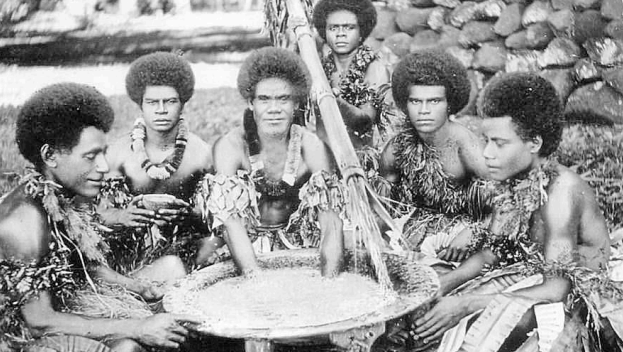
On their last evening at Delanasau, the Andersons were honoured with a traditional kava ceremony.
It was, Stevenson suggests, a mark of deep respect for the Turaga and Marama, who were held in high regard not only for their understanding of local culture, but also for the caring manner in which they dealt with people.
The ceremony was held on the front lawn. The Andersons and the local Ratu sat with their backs to the steps.
Before them, seated on the grass, were the Fijians whose duty it was to officiate at such functions.
They were dressed in traditional attire. A short distance away, sitting cross-legged in semi-circle rows, were many of the people from Lekutu Village.
Stevenson’s description lingers over the setting, as if the landscape itself had gathered to farewell the Andersons.
To the left, the branches of a mango tree spread above the scene. Nearby stood the bure where Hilda rested during the hottest hours of the day.
Beyond it was a short avenue of Golden Shower trees. In front, the lawn dipped towards the crest of the hill, and in the distance could be seen the tops of the coconut trees on the flats.
To the right, lining the race, were the tall and sturdy Jackfruit trees. Closer in were clusters of croton shrubs.
Dominating the right side was a large frangipani tree in full flower, while nearby gardenia trees filled the air with their strong perfume.
“The whole scene was at once picturesque and most expressive,” Stevenson writes.
In their sadness, LNA and Hilda Anderson would have felt an inner warmth at the acceptance and honour accorded to them by the people of Lekutu. The next day, in the cool of the late afternoon, the Andersons began their final journey down from the house.
They were accompanied by longtime retainer Lala and his wife.
Together, the small group walked slowly through the race, down the hill, over the wooden bridge and past the copra sheds.
Out of habit, Stevenson writes, LNA would have cast an eye over the vatas to ensure the copra was protected against the night air and any change in weather.
The group then moved along the track that wound through the flats, making their way towards the wharf.
There, the launch waited with three whale boats, one of which carried their belongings. Among the saddest and heaviest decisions was the choice to leave behind the family piano.
Time had taken its toll on the instrument, which had provided the family with so much pleasure over the years. Also waiting at the wharf, apart from the ship’s company, was Mah Yok.
Stevenson writes that this was going to be the most difficult of farewells. Once the Andersons were seated, the launch moved to mid-river and took up the slack of the whale boats one after another.
Then it slowly steamed down the Lekutu River towards Bua Bay, where the Adi Rewa lay at anchor.
Looking astern, LNA and Hilda Anderson would have watched as first the wharf, then the storage shed, and finally the suspension bridge receded into the gathering evening shadows.
It is here that Stevenson slows the story almost to a silence.
For weeks, this series has followed LNA from his early beginnings and social life in Levuka, through his arrival at Delanasau, the growth of plantation life, the pressures of isolation, war, family, loss and change.
Through Stevenson’s account, readers have been taken not only through one man’s life, but through a particular world of Fiji, one shaped by the sea, plantation work, colonial movement, family ties, village relationships and the slow passing of time.
We have seen Delanasau as a place of work, but also as a place of belonging.
Now, as the Andersons leave the river behind them, the story itself begins to move towards its final pages. The physical departure from Delanasau marks more than the end of plantation life for LNA and Hilda.
It marks the closing of the world Stevenson has been carefully carrying us through.
But LNA’s story is not yet finished. Next week, we follow the final chapters of this story.

