
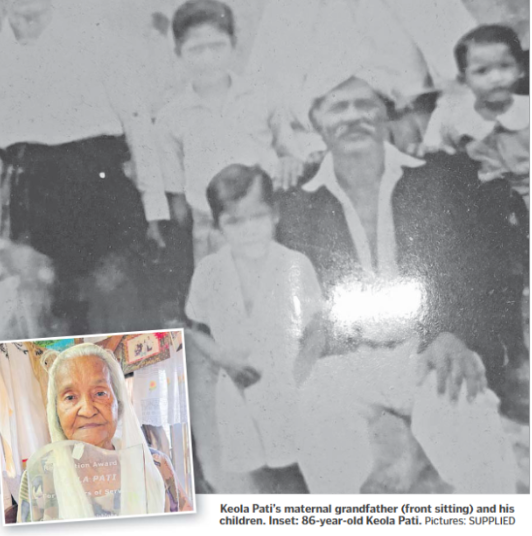
At four o’clock every morning, the men on horseback would arrive. Their voices broke the darkness, calling labourers from their beds and sending them towards the cane fields.
For Keola Pati, those early mornings belong to a history she did not experience herself, but one that was passed down to her through the stories of her father, Rohoni, an indentured labourer who came to Fiji from Bastipur, India.
Decades later, his memories remain vivid in her mind.
“Four o’clock, we have to wake up. They come around on the horse and start yelling, ‘hey, hey, hey’ … and then we all have to wake up early,” Mrs Pati recalled her father telling her.
The workers had little choice.
“We can’t do anything those days. We just have to listen to what they say.”
Her father remembered the man who gave the orders as the “Kulambar”.
“What he say, we have to listen,” he told her.
For the young Keola, these were more than stories about a distant past.
They were lessons about hardship, survival and the determination of people who had little control over the circumstances into which they were placed.
Her father’s experience as a girmitiya became part of the history she carried with her.
So too did the lessons of her maternal grandfather, who had also arrived in Fiji from India as an indentured labourer.
Between the two men, Keola inherited something that would shape her life: the belief that circumstances may be difficult, but a person must continue to move forward with whatever they have.
A journey to Fiji
Keola was still young when she first began asking her father about how he came to Fiji.
His story, as she remembered it, began with something as ordinary as roti and sugar.
As a boy in India, Rohoni had a habit of sneaking out at night to eat roti with sugar. One night, his father caught him. He was beaten and ran away. His escape eventually led him onto a boat. When he tried to leave, he was not allowed to do so.
The boat sailed, carrying him towards Fiji.
“I had very bad habit,” Keola recalled him saying.
“I want to eat roti with sugar night time when I sleep.”
That childhood incident became the beginning of a journey that would take him thousands of kilometres from India and into Fiji’s indenture system.
When he arrived, he was put to work in the fields as a girmitiya.
The stories he later told his daughter captured the harsh routine of plantation life: the early wake-up calls, the men on horseback and the unquestioned authority of those supervising the labourers.
For Keola, listening to her father describe those experiences was an introduction to a chapter of Fiji’s history that was still close enough to touch.
Life after indenture
When the indenture period ended, Rohoni continued working.
He became a hawker, travelling from village to village selling clothes.
The life was still difficult.
The family lived simply in a small bure made from leaves and wood.
“There was no tin roofing, no cement,” Mrs Pati said.
Her mother, Sampatia, was Fiji-born.
She remained at home, caring for the family, cooking, washing and milking the cow.
Food was simple and carefully managed
“Before in the olden days life was very hard. We work the whole of the week.
“We used to cook vegetables, dhal, dhal, dhal, rice like that only.
“Once in the weekend, we used to have like tin fish or tin mutton, just only once.”
Meat was a luxury.
When visitors came, the family might catch a rooster for them. Otherwise, vegetables, dhal and rice formed the ordinary meals of the household.
Yet Mrs Pati remembers those years with something more than sadness.
There was hardship, but there was also a sense of community and simplicity.
“Just a simple life. Very good life, very good life.”
Learning responsibility
As the eldest of five children, Keola learnt responsibility early.
Her education came with obligations at home.
She attended Fulton Seventh-day Adventist School, but getting to school meant completing her household duties first.
“If you want to go to school, you have to wake up and cook food for everybody, then go,” she recalled being told.
So she rose early, lit the firewood and prepared the family’s meals.
She cooked curry and roti over the fire before getting ready for school.
The difficulties continued outside the home.
Sometimes she went to school without shoes.
Sometimes there was no umbrella or raincoat when the rain came.
She and other children would shelter beneath banana leaves.
Schoolbooks could become soaked, forcing her to take them home, open them and leave them out to dry.
“It was a hard life.”
But hardship was not unique to her family.
“Those days, everybody just the same.”
There was little point comparing what one family had with what another did not.
People simply made do.
A father’s lesson
One of the most important lessons Keola received from her father came during an ordinary conversation.
As they walked together one day, he asked her how she was doing. Keola thought about the sacrifices he made for the family.
She told him that he was the one working hard and bringing food home for them.
His answer stayed with her.
“No, no. Everybody’s future is in their hand. It’s written already, it’s written there. Just pray to God. You do good, you get good. You do bad, you get bad.”
For a young girl growing up with very little, the message was powerful.
Her father did not teach her to see poverty as a permanent definition of who she was.
He taught her that she still had responsibility for the choices she made. It was a philosophy shaped by his own difficult life.
He had experienced the loss of freedom that came with indenture. Yet the lesson he passed to his daughter was one of personal responsibility, faith and perseverance.
Another teacher
Her father was not the only person who shaped her outlook.
Her maternal grandfather also became an important teacher.
Like her father, he had come from India as an indentured labourer.
When Keola was young, he would sit her on his lap and teach her lessons drawn not from books but from everyday life.
He taught her how to measure without always relying on a ruler.
He showed her inches, feet and yards. He taught her how to tie different knots.
More importantly, he taught her to look at the world as something in which she already possessed the tools to survive.
“God give us everything; everything is in your hand,” she remembers him saying.
His words reinforced the lesson she had already received from her father.
The future was not simply something to wait for. It was something to work towards.
Standing on her own feet
As Keola grew older, those lessons became the foundation of her life.
“My parents and my teacher told me, always try to stand on your own feet, don’t ask anybody any help.”
It was a philosophy born from necessity.
Her family had survived by making the most of what they had.
That ability to adapt and persevere would later become one of the defining characteristics of her working life. In 1962, Keola began sewing.
She went on to work in factories and furniture businesses before joining Comfort Home Furnishing in 1992.
More than six decades after she first began working, she is still at it. At 86, she continues to work.
“I will work till I can’t.”
For Keola, perseverance is not merely an admirable quality. It is an inheritance.

