
IT is undoubtedly true that the great wars of the world do not only belong to the countries that fight them.
World War I may have been fought thousands of miles from Fiji, but its effects still reached our islands, our ports, our businesses, and even our friendships.
For Suva, the war helped confirm what was already beginning to happen.
The capital was no longer just the seat of government. It was becoming a naval base, a communications centre, and the place where commerce was increasingly being drawn.
For Levuka, this was another quiet blow. Once the centre of colonial life, the old capital was being left further behind as ships, planters, businesses and opportunities turned more and more towards Suva.
In “The View from Delanasau: The Life and Times of Leslie Norman Anderson (LNA)” James Norman Stevenson uses this period to show how quickly life in Fiji could change.
German residents who had once been friends, neighbours and respected businessmen were suddenly viewed through the suspicion of war.
German-owned companies were targeted under enemy property laws.
Morris Hedstrom grew stronger from the collapse of those businesses.
And near Ovalau, the dramatic capture of German sea raider Count Felix von Luckner added fuel to the anti-German feeling already taking hold.
It is in this shifting world that LNA’s story continues. Not as a soldier or politician, but as someone whose life moved through the same towns, plantations, shipping routes and social circles being reshaped by war.
And perhaps that is what makes this part of the story important.
Last week we saw LNA at Delanasau in Bua, where he inherited the plantation, a world that was already tied to the same shipping routes, business networks and colonial friendships now being unsettled by war.
Master of the Plantation
And so far from the noise of war, under wide northern skies and beside the quiet flow of the Lekutu River, LNA settled into plantation life.
Andreson was learning the language of the land itself. He practiced speaking Fijian and was slowly building connections with the people around him, listening as much as he spoke.
He also took on the role of postmaster, marking time and place on envelopes that connected Fiji to the wider world.
Letters arrived steadily at Lekutu, carried by boat, each one needing a careful stamp before continuing its journey across the seas.
And then there was the weather.
Each day, he would record rainfall, winds, and shifting skies for officials in Suva. The local villagers, according to Stevenson, watched this with quiet amusement.
Because before we had siri to tell us the weather, the locals had always read the weather in the clouds, the winds, and the feel of the air.
Where Anderson wrote things down, they simply knew. Life felt steady, even as the world beyond the horizon was anything but.
News of the war came slowly. There was no wireless at Delanasau, only word carried by passing boats.
Letters spoke of distant battlefields and family members far away.
Then, one day, it came closer.
Anderson’s business partner, Alfred Kniezle, was German. And during that time (as I explained above), that alone was enough to change everything.
There were new laws now. Enemy property could be seized. Businesses could disappear overnight.
Sensing what was coming, he made the quiet decision to transfer his assets into his wife Hilda’s name. It was done just in time.
When the government acted, Kniezle lost everything.
His properties were taken, and he was declared bankrupt. Anderson though spared the worst, found himself standing in uncertain ground.
Some of his family urged him to leave Delanasau behind, to move to Suva, where opportunity was growing and his skills as an accountant would be in demand.
But he stayed. And, as sometimes happens, something unexpected followed.
A new opportunity arrived when Morris Hedstrom & Co stepped in to take over former German properties.
Delanasau was among them. He was invited to join a new partnership and take on the role of managing the plantation.
Anderson gladly accepted. Suddenly, what had felt uncertain became stable again.
There was support, investment, and as Stevenson explains, a sense that Delanasau could not only survive, but grow.
But life has a way of mixing gain with loss. If you can recall, In that same year, Hilda’s father, Sydney Wilson, passed away.
The family visited often, and the memories of those visits lingered like soft echoes of another time.
Then came the end of the war. There was relief, of course. A sense that something heavy had lifted from the world.
But not long after, another danger arrived; a flu spread through the islands and our protagonist fell terribly ill.
There was no easy way to get help. The nearest medical station was far away at Nabouwalu in Bua and no ship would come for weeks. Their own launch had already been lost to a flood.
Only one vessel remained, the old cutter, Jessie. And this is where the story turns to Hilda.
She took charge. She arranged for the plantation to continue running, gathered help from nearby villages, and found two skilled seamen willing to make the journey.
Then, with Anderson weak and barely able to move, they set sail.
Stevenson said the sea was not kind and that the Jessie was slow, with the winds refusing to stay steady.
For two long days, they pressed on like that. Until finally, they reached Nabouwalu.
There, Anderson was placed in the care of a Native Medical Practitioner. It was simple care, but careful and steady. Slowly, he began to recover.
When it was clear he would live, Hilda did something remarkable. She turned around and sailed back to Delanasau.
And until Anderson returned, she ran the plantation herself. When he finally came home, things were not quite the same. He had survived, but his strength never fully returned.
Still, life moved forward. The plantation began to flourish. Copra was in high demand, and new changes followed.
The old cutter Jessie was replaced by a new launch, Adi Savuri.
Two tractors, nicknamed Bill and Bert, took over from the bullocks, which were set free to graze among the coconut trees.
There were visits to Australia, laughter with family, and, in time, the birth of a long-awaited son.
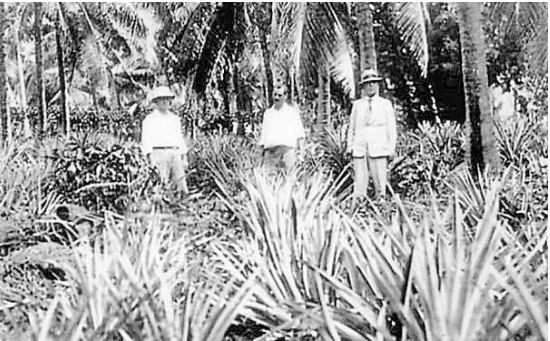
Anderson even tried something new, planting pineapples, hoping to begin a new industry.
For a while, it seemed promising. But the soil had other ideas, and the venture quietly came to an end.
Even so, Delanasau thrived. Visitors came and went, stopping to rest, to fish, to share meals heavy with oysters and stories.
And for a time, everything seemed to fall into place. It was, in my opinion, the brightest moment Delanasau would ever see.
I guess you could say it was no coincidence that things improved the moment a capable wife took charge.
Next week, a dark cloud begins to hover over the Anderson family at Delanasau, as falling copra fortunes, LNA’s declining health, a silting river and the Pacific War start closing in on their once-secure world.

