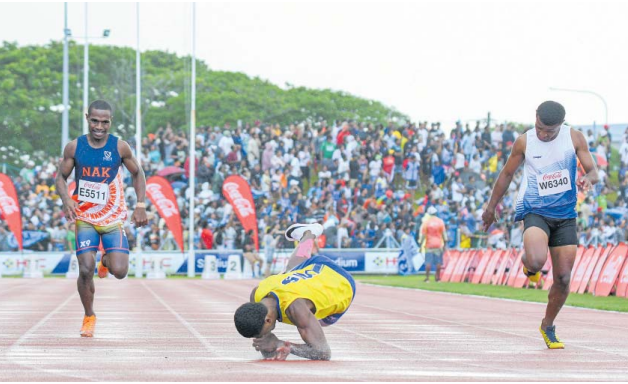
AFTER 65 years of the Coca-Cola Games’ existence, a growing trend of athletes diving across the finish line has sparked debate and this issue is matter of perspective.
The bigger question is whether Athletics Fiji does justice to the diving trend, this mystery habit needs to be looked deep into to bring fairness to other dedicated runners.
In athletics, the finish line is meant to determine the fastest runner through speed, endurance, and proper technique.
However, this growing trend of athletes diving across the finish line has sparked debate.
While organisations like World Athletics allow the practice, many believe it goes against the true spirit of racing.
In competitions such as the Coca-Cola Games and the Fiji Finals, teams like Suva Grammar School have consistently used this tactic, raising questions about fairness and sportsmanship.
Elijah Tokikivunuku of Suva Grammar School dived to the finish line to win the senior boys 400m final at the 2022 Coca-Cola Games.
Many saw that his dramatic, “dive in to win” effort showcased his total dedication to the race.
But to a certain extent, some called it “cheat”.
Again this year, in the final day of the schools athletics competition, Suva Grammar School’s Paula Vonolagi won his second gold medal after narrowly beating Queen Victoria School’s Jone Raibevu in the senior boys 200 metre event. Vonolagi used the same tactic – a dive to the finish line — eventhough commented after the game that “he knew the race would be tough”, but was determined to prove himself and left everything on the track.
Left everything by diving after trailing Raibevu in the final 50 metres and fought his way back through a “dived over the finish line to secure victory by centimetres — an unfair move against the QVS runner – knowing that he gave his best.
Track events are meant for running and not diving, but World Athletics (formerly IAAF) allows athletes to dive, fall, or lunge across the finish line, and it is a legal, albeit rare and risky, technique used to win races.
But the rules stated, “The legality of this move rests on the definition of the finish: an athlete’s time and position are determined by their torso crossing the vertical plane of the finish line, not their head, arms, or feet”.
As it seems unfair to some, the rules stated it is legal and not prohibited in the sport of track athletics.
While the rules do not explicitly say “diving is allowed,” they are “silent” on the subject, making it perfectly legal, like a “dip” or “lean”.
Track events are designed to test an athlete’s ability to run efficiently from start to finish. The winner should be the one who maintains the best speed and form throughout the race.
Diving shifts the focus away from running and instead introduces a last-second manoeuvre that can determine the outcome, even if the athlete was not clearly the faster runner.
It also stated a torso rule that the crucial part of the body is the torso (chest). If a runner dives and their torso crosses first, they win, even if they stumble or fall over.
A classic example was at an international event, Shaunae Miller-Uibo, a Bahamian track and field sprinter, competed in the 200 and 400 metres. She’s a two-time Olympic champion after winning the women’s 400 metres. During the 2016 Rio Olympics, she dove for the finish line in the 400m final, winning gold ahead of Allyson Felix.
Another perfect example is David Neville, an American former track and field sprinter, best known for winning gold in the and bronze in the 400m at the 2008 Beijing Olympics. During the 2008 Beijing Olympics, he dove for the line to secure a bronze medal in the 400m final.
And we have Joao Vitor de Oliveira in 2016 Rio Olympics. He is a Brazilian Olympic athlete, who dove headfirst in the 110m hurdles to qualify for the semi-finals.
It remains to be seen that even after years of relentless training and standout performances, these young sprinters rose to stardom, cementing their place among the elite athletes at the top of the game — can only deemed wasted if diving becomes a habit in the Fiji Finals competition.
Diving at the finish line creates an uneven playing field. Not all athletes are trained or willing to risk injury by throwing their bodies forward.
This means that those who choose to run through the line properly may lose to someone using a risky technique rather than pure running ability.
In this sense, diving can be seen as exploiting a loophole rather than demonstrating true athletic excellence.
Another major issue is safety. Diving can lead to serious injuries, including head impacts, shoulder damage, and abrasions. Encouraging or normalising this behaviour, especially among school-level athletes, sends the wrong message.
Young competitors may feel pressured to dive just to stay competitive, putting their health at risk.
Athletics is not just about winning — it is also about integrity and respect for the sport.
When teams repeatedly rely on diving to secure victories, it can undermine the values of fair competition.
Observers may begin to question whether results truly reflect athletic ability or simply who is willing to take the biggest risk at the finish line.
The tough call of banning the technique should be a future move by the stakeholders.
Even though diving is currently permitted, rules in sports are often updated to preserve fairness and safety. Banning dives at the finish line would ensure that races are decided by running performance alone.
It would also protect athletes from unnecessary harm and reinforce the idea that technique and endurance — not risky stunts — should determine winners.
Diving at the finish line may offer a competitive edge, but it challenges the core principles of track racing.
It introduces unfair advantages, increases the risk of injury, and shifts focus away from true athletic performance.
For the sake of fairness, safety, and the integrity of the sport, this practice should be reconsidered and ultimately banned.
Again, it begs a deep question of what we can do, and must, be done to make it fair for elite track athletes, and if not, we will see the same things happening repeatedly.
Waisale Koroiwasa is a sub editor at The Fiji Times. The views expressed are his and not of this newspaper.