
“ON top of a hill.” That’s what Delanasau in Bua, Vanua Levu means.
The estate is one of Fiji’s early plantation sites, dating back to the early 1860s, a place that would eventually become central to the life of Leslie Norman Anderson (LNA), a man whose restless journey across Fiji led him, quite literally, to settle above it all.
According to his grandson, James Norman Stevenson, in the book ‘The View from Delanasau: The Life and Times of Leslie Norman Anderson’, Delanasau was more than just land, it was a fully functioning world, carved out of ambition, geography, and colonial enterprise.
Stevenson explains that Delanasau became commercially established in 1869 when pioneer planter Robert Langley Holmes purchased and developed the land into a sprawling 300-acre copra plantation.
It was strategically positioned along the Lekutu River, a natural highway that allowed goods to move easily by boat.
The estate was fitted with infrastructure that spoke to both ingenuity and isolation: a wharf for loading cargo, copra drying sheds for production, and even a wire suspension bridge linking it to neighbouring property across the river at Vatu Colo.
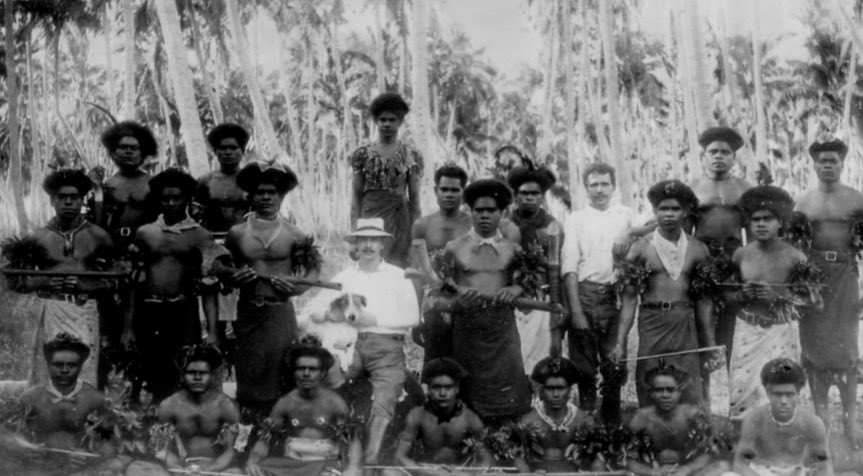
It was, in Stevenson’s words, “largely self-sufficient” producing coconuts, crops, livestock, sustained by both local Fijian labour and workers brought from the Solomon Islands. Over time, the plantation evolved beyond its commercial identity.
It became a home, particularly for the Anderson family, who would live there for 35 years and come to know it simply as “home.”
LNA entered this world through transition. He took over the farm from Holmes, inheriting not just land but a system, organised, productive, and deeply rooted in its environment.
From there Delanasau became the centre of his life in Fiji.
The journey to that life began in 1912.
Stevenson vividly describes the Anderson family’s relocation as they departed Suva aboard an inter-island vessel bound for Labasa.
The trip itself was part of a regular route that passed through Levuka, Nabouwalu Government Station, and the Macuwatu ports, carrying cargo and passengers alike.
Copra would be loaded for the return journey, a sign that Holmes’ earlier vision of trade was now a reality.
On this particular voyage, the ship carried more than goods. It carried a family beginning again. LNA, his wife Hilda, and their children Una and Jean brought with them 10 years’ worth of belongings, essentials for life in an isolated plantation, carefully packed and transported.
Among the most prized of these was a piano, meticulously crated and loaded under strict supervision. They travelled overnight. By the following day, the vessel rounded a headland into Bua Bay and anchored near the mouth of the Lekutu River.
Stevenson notes that the headland, known to Fijians as Nia Vaka for its resemblance to a pig’s head, would later become a distinctive landmark when viewed from the Anderson home.
At sunrise, the ship crossed the river bar and made its way inland. After about an hour, they reached the plantation wharf. Though Stevenson notes that within a decade, silting would force cargo to be transferred by longboat instead.
Waiting to receive them was Holmes himself, who remained temporarily to oversee the handover, along with the plantation overseer Jonsen and a group of workers. What followed was less an arrival and more a procession. The piano was loaded onto a copra cart, furniture and luggage carried by labourers, and the family moved inland, led by a bull-drawn cart, followed by LNA, then Hilda and the children, and finally the workers. Stevenson likens it to a safari as they moved across the flats.
Their first sight of Delanasau was sweeping and alive: the wide Lekutu River, thick foliage reaching the water’s edge, and coconut trees stretching skyward.
The suspension bridge stood across the view, linking to Vatu Colo. Nearby, the dark entrance of another creek, the mysterious Minga, hinted at the unknown.
But it was only after the climb, up the hill, through the cattle race, across the lawn, and standing at the doorway of their new house that the reality settled in. This would be their home for the next 35 years.
Stevenson describes how the magnitude of this undertaking struck Hilda Anderson in that moment. Yet, drawing on what he calls the “grit of her Northern European forebearers,” she became the strength behind the household, a constant source of support for LNA and their growing family.
From there, LNA began to shape Delanasau into his own. Though he inherited a well-run estate, he introduced changes, upgrading the aging plantation, expanding the house with new bedrooms, adding verandas with all-weather shutters, and building a large dining room. He cleared bushland, planted new coconut trees, fully aware they would take seven years to bear fruit, a sign, Stevenson notes, that he was planning for the long term.
Not everything ran smoothly. Stevenson recounts the curious character of Jonsen, the inherited overseer, a man prone to excess, particularly alcohol.
Without Holmes’ strict oversight, his habits worsened, including the bizarre practice of draining alcohol from ships’ compasses when supplies ran low.
Eventually, these indiscretions caught up with him, and he left. LNA chose not to replace him.
The rhythm of plantation life continued. The daughters returned to Levuka as boarders. A new launch, named Una, replaced an older vessel. Labour remained a challenge, local villagers were often reluctant to commit long-term, so LNA recruited workers from across Vanua Levu and nearby islands, though Stevenson notes this was time-consuming and steeped in protocol.
A key relationship developed with district chief Ratu Veli, built on mutual respect and frequent visits. This as an example of how LNA navigated not just land, but people and culture.
The plantation itself diversified. An oyster bed was established in the river using seedlings imported from Stewart Island in New Zealand. The oysters became highly sought after, often sent to friends and associates in Levuka and Suva.
Life, however, carried its share of loss. In 1913, Hilda’s mother, Margaret Jane Shields, passed away in Suva and was buried in Levuka.
Around them, neighbours came and went. Across the river at Vatu Colo, occupants changed frequently, including a Scotsman, Alex Hall, involved in the short-lived Bua Meat Company, who later married Hilda’s sister before leaving the area.
Through it all, Delanasau thrived. High-grade copra production continued, supported by strong market prices and reliable shipping routes linking Fiji to other island groups.
But beyond the horizon, events were already unfolding.
“In far off Europe,” Stevenson writes, “in August 1914, the British, French and German empires went to war.”
And even in a place perched “on top of a hill,” the world was about to change.

