
In the mid 1980s, Fiji’s churches were not only places of worship but also testing grounds for cultural dialogue.
Columban priest Fr Frank Hoare, in his book A Missionary Diary Fiji 1973-2024 recalled moments of tension and unexpected humour that revealed how faith could open pathways to deeper understanding between communities.
Last week we saw how, in 1982, young leaders clashed with tradition in parish meetings, how Easter Vigil in Raviravi brought light across cultures, and how shared experiences dissolved old prejudices. This week, we step into 1983 and 1984, when Columban priest Fr Frank Hoare found himself in moments of drama.
Drama in the Liturgy
On 14 January 1983, the final Sunday of a cross-cultural course, Indo-Fijian youths who had lived three weeks in a rural Fijian parish staged a dramatic liturgy.
“They sat on either side of the altar, trading phrases in their own languages, caricaturing each other,” Fr Hoare said.
A catechist preached on love, but the two groups at first insisted it meant love only within their own community.
“Then angry words flew, and the drama turned violent, ending in the death of everyone.”
As a reader proclaimed Ezekiel’s prophecy over dry bones, the ‘dead’ slowly rose, reconciled, and exchanged cultural symbols of respect. Together they proclaimed the Gospel of love.
“It was a powerful lesson.
“The parishioners and the young leaders all had to reflect on life in a multicultural, multi religious society in light of the Gospel.”
Joseph’s wisdom
By April 1983, Fr Hoare was back in Suva, where he often visited Indo-Fijian families with his companion Joseph, a builder from Taveuni.
“One evening we tried to reach Vikram, a man with a bad reputation. But he refused to come out of his house.”
Frustrated, he was ready to give up. But Joseph quietly interjected:
“Father, don’t be too hard on him. He is a poor man and must struggle for life.”
“It struck me then how much compassion Joseph carried. He grounded me when I was too quick to judge.”
A tireless worker
On June 1, 1983, he met another figure of inspiration, Catherine Singh of Lautoka.
“She had endless energy and a broad smile, always rallying donations for the poor.”
But when she looked visibly exhausted, he suggested she rest.
“She side stepped the advice at first.
“But I thought of a convent near a maternity hospital where the sisters would welcome her.”
Catherine agreed, and the short retreat restored her.
“We must look after our generous activists too.”
Walking on fire
The following month, his path crossed Hindu devotion. At a temple in Nadera, he watched firewalking, a ritual brought from South India by indentured labourers.
“I sat close to the fire pit. When a young woman behind me whispered in Hindi to her friend: ‘How can this be? Your father in law has just arrived and is sitting in front of you!’”
In Hindu custom, such communication was taboo. Believing he was a foreign tourist who didn’t understand, the women carried on.
“When I was leaving, I turned and said in my best Hindi, ‘Your father in law excuses himself as he must leave now!’ They nearly fainted.”
Weddings and expectations
On February 22, 1984, Fr Hoare was called to celebrate four Indo-Fijian weddings in Labasa within just two weeks.
“The ceremonies were held in sheds with iron roofs, decorated with lights and streamers.
“It was hot, muddy, and humid, keeping dry clothes was a challenge.”
But what struck him most was an evening discussion:
“Someone said, ‘The only way to get a young troublemaker to mature is to marry him off.’ Everyone agreed. I was shocked. ‘But what about his wife?’ I asked. ‘What will happen to her while he is considering maturing?’”
A night gone wrong
Just months later, in May 1984, he had a night he would never forget. Visiting families with Fr Theo, the two split up, planning to reunite later.
But after being pressed to drink yaqona and stay for dinner, the unreliable parish van broke down on a steep road.
“The family insisted I stay the night. I gave in.”
Meanwhile, Fr Theo waited until midnight before reluctantly sleeping at another house.
“When I finally picked him up in the morning, I tried to explain, but he greeted me with silence.
“I think that silence lasted for days.”
When the statue fell
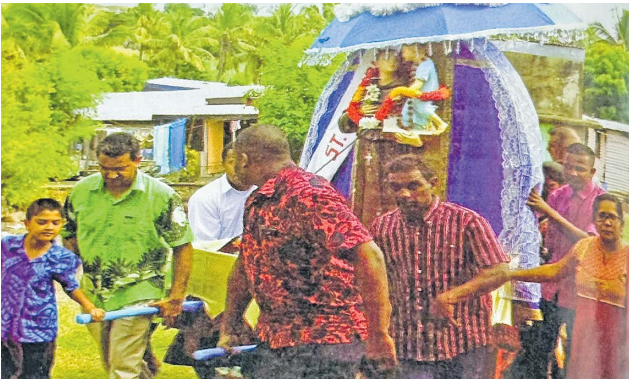
On June 13, 1984, Fr Hoare joined hundreds at Raviravi for the feast of St Anthony, the patron of South Indian Catholics.
The statue of the saint, tied to a palanquin, was carried three times around the church.
“But during the second round, a rope snapped, and the statue fell.
I noticed a Hindu woman raise her eyes to the sky rather than look at the accident.”
There was unease, but the procession continued. Later, two Catholic men were overheard consoling one another.
“‘Wasn’t it terrible the statue fell today?’ one said. ‘Ah yes,’ the other replied, ‘but it could have been worse.
“Only the child Jesus lost his head. St Anthony wasn’t damaged at all.’”
Lessons in faith and culture
The years 1983–1984 gave Fr Hoare lessons that were sometimes humorous, sometimes sobering, but always deeply human.
“Through liturgies, visits, feasts, and even breakdowns. I saw how faith and culture intertwine. Each moment challenged me to be patient, to listen, and to see God working in the midst of human frailty.”
In Fiji today, those same challenges remain, as communities still wrestle with cultural differences.
Next week in The Fiji Times, the journey continues into the mid 1980s.

