FOR thousands of children in Fiji, the places meant to offer safety and protection are also where they experience violence, abuse and neglect.
From physical punishment in their homes to sexual abuse, bullying and growing online threats, the risks facing children remain a serious national concern.
Figures from the 2021 Multiple Indicator Cluster Survey reveal that 80 per cent of children aged between one and 14 experienced some form of violent discipline in the month before the survey, with more than one in 10 suffering severe physical punishment.
The findings also show that violent discipline affects children in both rural and urban communities, with rates of 84 per cent and 76 per cent respectively.
Between 2020 and 2024, the Fiji Police Force recorded 4159 child sexual offence cases, while the National Child Welfare and Protection Database recorded more than 9000 cases of child abuse between 2020 and 2025.
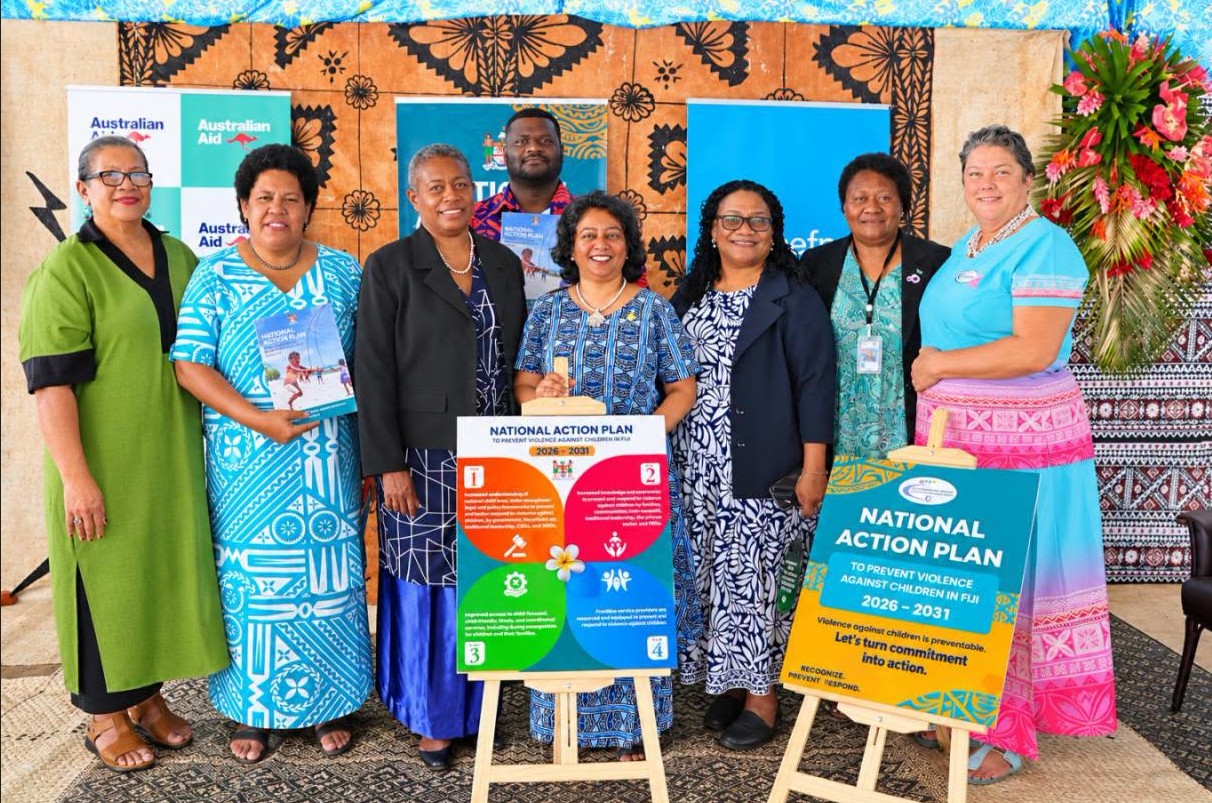
These figures paint a troubling picture of childhood in Fiji and underline the urgency behind the Government’s newly launched National Action Plan to Prevent Violence Against Children 2026–2031.
Speaking at the launch in Raiwaqa last week, Minister for Women, Children, Social Protection, and Cohesion Sashi Kiran said the five-year plan aims to strengthen the country’s child protection system through a coordinated approach involving government agencies, families, communities, civil society, faith-based organisations and development partners.
“These figures must make every one of us stop and ask, are our homes safe enough for children to speak up? Are our schools and communities protecting them?”
A 2024 study by the Governor of Fiji and UNICEF estimated that violence against children costs the country approximately $459.82 million annually, equivalent to 4.23 per cent of Fiji’s gross domestic product.
However, Ms Kiran said the greatest cost could not be measured in dollars, but in childhoods lost to fear and dreams that might never be realised because someone failed to protect them.
The National Action Plan provides a roadmap to address these challenges through four interconnected pillars including prevention, early intervention, compassionate response and system strengthening.
Under prevention, the Government aims to change harmful attitudes and practices through public awareness campaigns, positive parenting programs, school-based education and improved digital safety.
Early intervention will focus on identifying children and families at risk before situations worsen.
This includes strengthening screening in health and education settings, community outreach, family counselling, case management and clear referral pathways.
The third pillar focuses on ensuring children who experience violence receive timely, child-friendly and compassionate support.
This includes access to medical and forensic services, psychosocial care, legal assistance, emergency shelter and safe temporary care.
The fourth pillar seeks to strengthen the capacity of frontline workers, including social workers, police officers, teachers, health professionals and counsellors, through specialised training, professional development and better coordination.
Acting permanent secretary Selina Kuruleca said the plan provided a common direction for all those involved in protecting children.
“Violence against children is not inevitable, it is preventable and must be prevented,” she said.
Ms Kuruleca said addressing violence required more than coordination, but a sustained and evidence-based response across every sector of society, from homes and schools to health systems, justice institutions and local communities.
She also highlighted the importance of aligning the new plan with existing efforts to prevent violence against women and girls, noting that both issues had areas of intersection and required stronger cooperation.
UNICEF Pacific Deputy Representative Roshni Basu recalled that many of the perpetrators identified in the 2021 survey were family members, highlighting how violence could take place within the very environments expected to protect children.
The plan also recognises growing concerns around online exploitation, child neglect, bullying, child labour and child marriage, while giving attention to children with disabilities and those who face discrimination or barriers to accessing services.
According to Ms Kiran, the plan builds on the Child Care and Protection Act 2024 and the Child Justice Act 2024, as well as Fiji’s commitment made at the 2024 Global Ministerial Conference on Ending Violence Against Children in Bogota Colombia.
Among the immediate priorities are mapping child protection services nationwide, establishing an operational arm of the National Coordinating Committee for Children, creating a Children and Youth Advisory Group and strengthening referral pathways, psychosocial support and medical and forensic procedures.
Ms Kiran said protecting children could not be left to one ministry or institution.
“Let us raise our children with love, not fear.”
The plan was developed under the leadership of the Ministry of Women, Children, Social Protection and Cohesion, with key contributors included the Ministry of Education, Ministry of Justice, Ministry of Health and Medical Services, Fiji Police Force, Office of the Director of Public Prosecutions, Fiji Judiciary, Legal Aid Commission and Online Safety Commission.
Civil society organisations included Aruka Fiji, Fiji Council of Social Services, House of Sarah and Frank Hilton Organisation, while faith-based contributions came from the Fiji Council of Churches, Sangam Fiji, Fiji Muslim League, Arya Pratinidhi Sabha and Sanatan Dharam. UNICEF, UN Women, UNFPA and the Government of Australia also provided support towards the development of the plan.