
SEVENTEEN tonnes of illicit drugs was seized in the Pacific in 2026.
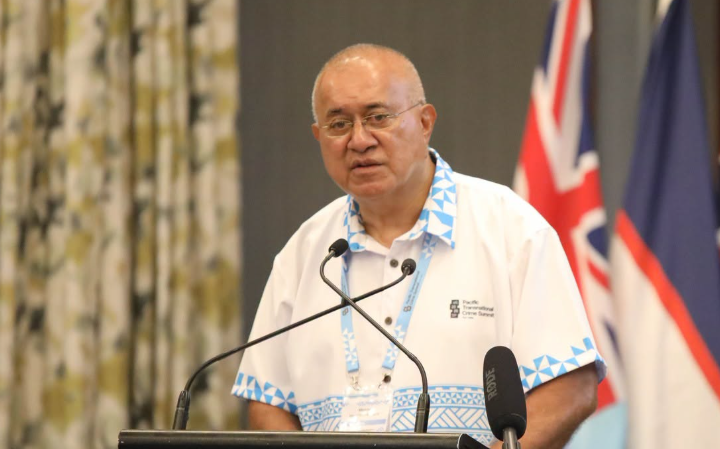
Speaking at the Pacific Transnational Crime Summit at Momi Bay, Minister for Policing Ioane Naivalurua said this was three times the amount captured in 2025.
“This is a tide and it is rising.”
Mr Naivalurua said the recent Vatia drug bust was a warning to regional leaders.
“The 2026 Vatia cocaine seizure which you know of was 2.64 tonnes, the largest in Pacific history, was a warning our maritime domain is being targeted by sophisticated criminal networks with global reach.
“A single seizure without institutional architecture is a moment not a movement.”
He said regional leaders needed to close the gap between bold declarations and frameworks and effective action.
“What remains unfinished is the translation of that intent into coherent, coordinated, intelligence led action on the water and on the ground or on the land.
“As ministers we are not here to receive briefings, we are here to lead.
“Our commissioners and our police chiefs are doing their work with discipline and dedication but operational excellence without political coherence is a ship without a rudder.
“The central challenge before us is not a lack of intent, intelligence or essence. It is the absence of coherence between leader’s policy priorities and operational delivery across the regional system.
“That gap is ours to close.”
Calls for stronger capabilities
BETTER alignment between Pacific security agencies and regional systems is critical if the region is to effectively disrupt transnational crime networks, says Minister for Policing Ioane Naivalurua.
Speaking at the Pacific Transnational Crime Summit 2026 in Momi Bay, Mr Naivalurua urged Pacific ministers to strengthen support for police commissioners and improve coordination across national and regional security frameworks.
He said while the Pacific now had stronger intelligence and analysis capabilities than ever before, major gaps remained in translating intelligence into operational action.
“One gap we must close this week is the intelligence to deployment gap,” he said.
Mr Naivalurua noted that several regional systems — including the Pacific Fusion Centre, Pacific Transnational Crime Network, Oceania Customs Organisation, and Fisheries Forum Agency vessel monitoring systems — were carrying out important work but were still not operating as one integrated system.
“Maritime assets are still deployed by schedule when they should be deployed by threat.”.
He stressed that stronger ministerial oversight and accountability were needed under the Pacific Islands Forum architecture to improve implementation of regional security priorities.
“Without that alignment, coordination remains a conversation — and conversation does not disrupt criminal networks.”
Minister reveals scale of drug imports threatening Australia
ABOUT 8000 kilograms of illicit drugs was seized by Australian authorities in 2024.
Speaking at the inaugural Pacific Transnational Crime Summit in Momi Bay, Australia’s Home Affairs Minister Tony Burke said they have been conducting drug operations in Colombia for the last 25 years.
“We have had a permanent presence in Colombia since 2000.
For 25 years the Australian Federal Police have had a presence in Colombia,” he said.
“In 2024, between Colombia and Mexico we seized a total of 8000 kilograms of illicit drugs, half of it in Colombia, half of it in Mexico.
“Every one of those kilograms are drugs that don’t make it to Australia so they don’t transit anywhere through the Pacific.
“Organised crime groups are importing illicit drugs to Australia on what is sadly on an industrial scale.
“The proportion of Australians who are reportedly users of illicit drugs in the past 12 months has continued to increase.
“We know that we need to take real action in Australia to reduce the size of the market and the demand that impacts the flow through the Pacific and our agencies are working together to dismantle the drug market through law enforcement operations.”
He said Australian border security was the first line of defence but operations have been focused on in source countries.
“Border force works in detecting, intercepting and maintaining border control using advanced technology, detector dogs and Australian intelligence.
“Earlier this year border force has continued to seize high volumes of drugs including $75million worth of ketamine and the federal police our investigative arm involved in intelligence gathering and the prostituting of criminals.
“We are focused on demand reduction, supply reduction and harm minimization.
“The Transnational, Serious and Organised Crime (TSOC) Pacific Taskforce which is a partnership between Australia, Fiji, Tonga and New Zealand have seized in excess of 86 kilograms of cocaine, 78 kilograms of meth, 2 kilograms of MDMA and 4.5 tonnes of cannabis.”

