As dark clouds gathered over the Antalya Expo Center on Wednesday evening, the weight of nearly two weeks of deadlocked climate diplomacy hung heavily over the UN Climate Change Conference (COP31).
With the closing gavel expected to occur later today (Fiji time), the Turkish COP31 Presidency, working alongside Australian COP31 president of Negotiations Chris Bowen, turned to an ancient Ottoman tradition to break the impasse — the Divan or Fiji’s equivalent to a talanoa.
Drawing its name from the historic Turkish council where leaders sat side-by-side to listen, deliberate, and forge consensus, the four-hour ministerial Divan brought together ministers from more than 100 countries and representatives from over 190 nations in Antalya’s Blue Zone.
Designed as a frank, open-floor stocktake ahead of final negotiations, the session laid bare the deep geopolitical fault lines threatening to derail COP31’s overarching cover decision.
For Fiji and the broader Blue Pacific, the stakes could not be clearer or more personal.
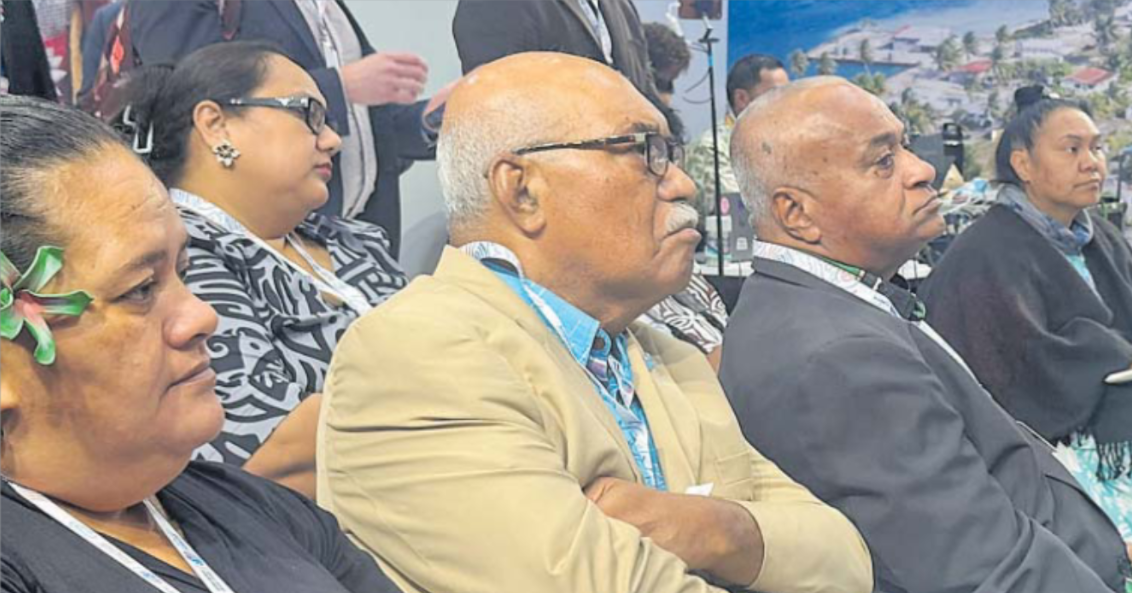
Speaking during the high-level push in Antalya, Minister for Environment and Climate Change Lynda Tabuya cut through the diplomatic proceduralism with an urgent warning over developed nations tightening their budgets and pushing back against scaled-up adaptation funding.
“Our countries are sinking, and it’s a matter of survival for our people,” said Ms Tabuya.
She emphasised that Pacific Island nations are on the front lines of an existential threat and cannot afford to wait while wealthy nations drag their feet on adaptation finance.
“My appeal was to please just see us in the Pacific as part of the human family and what they would do or give to protect the human family,” said Ms Tabuya.
“And so the need to remember the Pacific, that was the message at pre-COP and it’s the same message I’ve brought here to COP, to remember the Pacific family.
“Because in 50 years time, when we are not here, our children will be living with what we decide here, what the legacy will be here at Türkiye’s COP with Australia as the president of negotiations.
“It was a call to hold Australia to account in terms of our commitments to each other with the Pacific partnership and also to Türkiye’s presidency and the world to continue to hold to their commitments to reduce greenhouse gases and to transition away from fossil fuel to clean renewable energy.”
Her intervention echoed the priorities Pacific leaders carried from the October Pre-COP in Nadi and Funafuti: holding the line on 1.5°C, protecting the ocean-climate nexus, and closing the widening delivery gap that leaves billions in pledged climate finance tangled in bureaucratic access rules rather than reaching vulnerable communities.
Yet, as detailed in the November 18 Earth Negotiations Bulletin (ENB) from the International Institute for Sustainable Development (IISD), the negotiating rooms outside the Divan remain bogged down in fierce disputes over money, ambition, and trust.
While negotiators managed a rare moment of consensus on Wednesday evening, agreeing to forward a decision on matters relating to the Least Developed Countries (LDCs) for adoption, major battlegrounds remain unresolved.
In Presidency consultations on climate finance, deep rifts persist over the Climate Finance Work Programme (CFWP) and Article 2.1(c) on aligning financial flows.
Developing nations, led by the G-77 and China, have insisted on keeping the mandates distinct, while developed countries like New Zealand, the UK, and Canada argue they must move in tandem.
Similarly, talks on the Fund for Responding to Loss and Damage stalled over whether scaling up resources must explicitly cite developed countries’ obligations, with the LDCs, Philippines, and China expressing frustration over the omission of rapid disbursement modalities and this was a move the European Union dismissed as “micromanaging”.
Meanwhile, the Mitigation Work Programme remains deadlocked, with the Arab Group drawing a “red line” against expanding its scope to reference the latest Intergovernmental Panel on Climate Change (IPCC) science.
As one negotiator noted in the ENB corridors, trust or the glaring lack of it has become a common refrain, with delegates warning against “hostage-taking” where progress on one issue is held ransom for concessions on another.
It is precisely this paralysis that COP31 President and Türkiye’s Environment Minister Murat Kurum sought to dismantle through the Divan.
Framing the gathering around the Presidency’s three pillars of “Dialogue, Consensus, and Action,” Mr Kurum urged ministers to stop reciting well-worn national positions and instead identify concrete areas of convergence.
“We do not expect a new commitment, we do not expect a new decision, but we want to hear that meaningful, determined word on fulfilling existing commitments,” Mr Kurum told ministers, emphasizing that Antalya’s legacy will be measured not by rhetoric, but by real-world implementation.
He assured delegations that no view expressed in the Divan would remain trapped in the room, pledging that ministerial feedback would directly shape the final revisions to the 18-page draft cover decision.
Australian Minister Chris Bowen echoed that sentiment, calling the Divan a vital turning point rooted in transparency and trust.
For Fiji and its Pacific neighbours, however, the Presidency’s candid framing carries both promise and peril.
While initial drafts of the cover text include welcome markers on ocean health, temperature overshoot, and a pathway toward tripling adaptation finance, Pacific negotiators warn that “fulfilling existing commitments” must not become an excuse to avoid scaling up new, grant-based finance or softening language on fossil fuel transitions.
In Fiji’s coastal villages, and low-lying atolls across the region, the success of Antalya’s Divan will not be judged by the emotions inside the hall, but by whether those spoken warnings are locked into firm, actionable cover text before the final gavel falls on Friday night.